Aberdeen's Managerial Turmoil: Stephen Robinson's Short Stint Ends
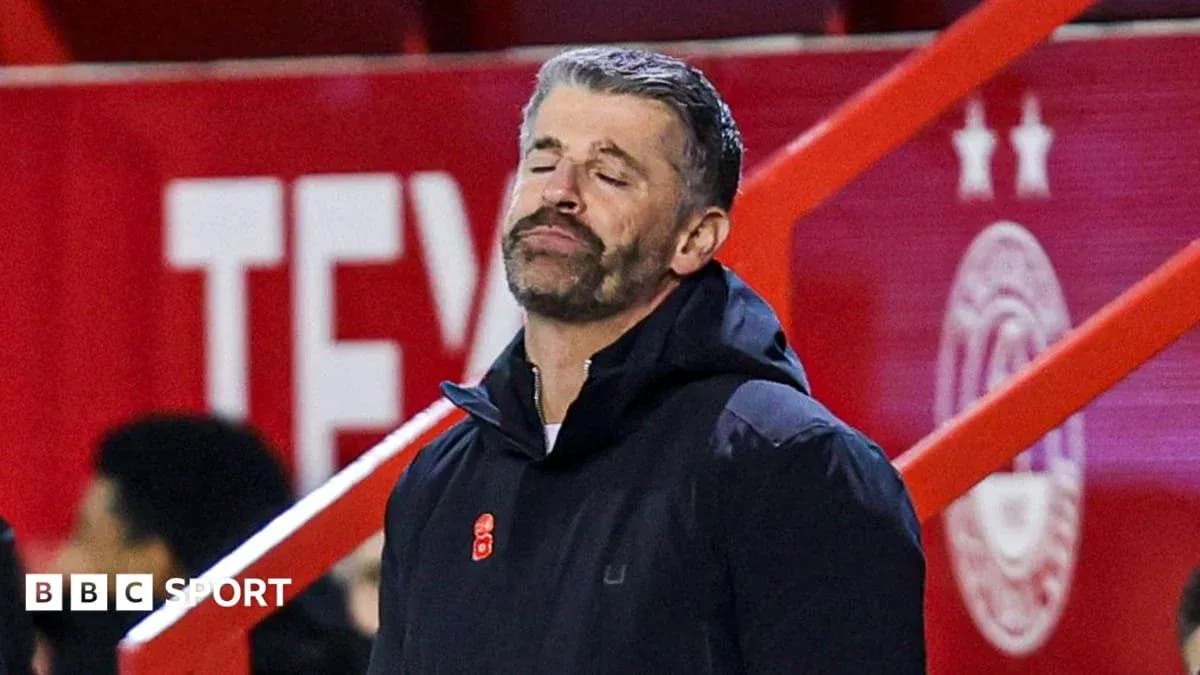
Stephen Robinson’s short and stormy Aberdeen reign is over after just eight months, cut short on the back of a grim run that has dragged the club to the edge of a relegation fight.
Three wins from 12 Premiership games. Second bottom. Four straight defeats in all competitions. The 4-0 home collapse to Hibernian on Saturday didn’t just feel like a bad result; it felt like the point of no return.
By Sunday night, the decision was made. Robinson was out. His assistants Brian Kerr and Stephen Craigan went with him. Stuart Duff steps in as interim head coach, handed the task of trying to steady a dressing room drained of belief and stripped of momentum.
A project that never settled
Robinson arrived in March with his stock high. Three successive top-six finishes and a League Cup win at St Mirren had earned him a long-term deal at Pittodrie, running to the summer of 2029. Aberdeen sold it as a reset, a manager with a clear identity and a proven record of punching above his budget.
He became the sixth permanent manager since Dave Cormack took charge in November 2019. That in itself told a story of churn and impatience. Still, Robinson’s first job was simple: get Aberdeen away from danger. He did that last season, easing them out of immediate relegation trouble with the squad he inherited.
Then came the overhaul.
Fifteen players out. Fifteen players in. A full-scale rebuild, backed by the board and driven, in the main, by Robinson’s own judgment. It was bold. It was risky. And it never came close to looking settled.
Club legend Willie Miller watched Saturday’s capitulation and didn’t bother with diplomacy. He called the result “utterly embarrassing” and said Robinson looked “a man lost”. His wider verdict on the squad was even more scathing.
“The players aren't up to scratch, not up to playing at this level and dealing with high-ish expectations,” Miller said, stressing he was talking not about trophies, but simply about being in the top six. “They’re nowhere near that.”
Tactical turmoil and a toothless attack
On the pitch, the numbers are unforgiving. Across 28 games in all competitions, Robinson leaves with 11 wins, five draws and 12 defeats. That record might not look catastrophic in isolation, but the trend this season has been unmistakable.
Aberdeen are the joint lowest scorers in the league. Confidence has drained. The tactical picture has been muddled.
Robinson veered between a back four and a back five, searching for solidity that never arrived. Two clean sheets in the Premiership is all he found. The constant reshaping only added to the sense of a team without a clear identity, a side trying on systems rather than inhabiting one.
From the raft of summer signings, only goalkeeper Marius Muller and full-back Nesta Guinness-Walker have started every league match. Top scorer Kevin Nisbet is the only other ever-present. Even he, the captain and leading goal threat, felt the wrath of a restless support. When he was substituted against Hibs, the home crowd cheered – a raw, public sign of how fractured the relationship between team and fans has become.
The recruitment gamble has not paid off. Former Aberdeen defender Alex McLeish was blunt about the stakes.
“Recruitment is absolutely key and if you've bought a bunch of players and then they're not performing then that is a real worry,” he said. He sees “a few players” at a good level, but the rest? They have not yet shown they can carry Aberdeen back to where the club expects to be.
Cormack’s cycle and the weight of history
The phrase “rinse and repeat” has become a weary mantra around Pittodrie. The manager arrives with a plan, the plan falters, the axe falls, and the search begins again. It has started to feel less like a strategy and more like a loop.
No-one questions Cormack’s commitment or investment. He has pushed hard to restore Aberdeen to something like their historic standing and has a recent Scottish Cup win on the ledger. But the managerial hit rate under his watch has been poor, and that is being generous.
Each appointment has been framed as the one to break the cycle. Each dismissal has deepened the sense of drift. Aside from that cup triumph, the broader direction of travel has been downward, the club slipping away from the standards that once defined it.
Robinson’s tenure felt strained from day one. He arrived only after a long, drawn-out search for Jimmy Thelin’s successor. Many supporters saw the appointment less as a carefully plotted move and more as a late pivot, a decision rooted in anxiety rather than clarity. The mood never truly shifted.
As the defeats mounted, Robinson’s body language in the technical area told its own story. So did his post-match interviews, which grew increasingly heavy as the pressure closed in. By the time Hibs walked off 4-0 winners, the atmosphere around Pittodrie had turned toxic. The frustration, the boos, the sense of something broken – it all felt far beyond a tipping point.
What comes next
Now the responsibility passes to chief executive Adrian Bevington and sporting director Lutz Pfannenstiel. Both arrived with reputations for strong networks and smart connections. Those reputations will be tested immediately.
They must identify a manager who can do two things at once: stop the slide and rebuild trust. The first task is brutally simple – get points, climb the table, remove any whiff of relegation panic. The second is subtler and just as important – give Aberdeen a coherent identity again, something supporters can see and believe in.
The fixture list offers no kindness. After the international break, Aberdeen travel to Kilmarnock on 21 November, then go to Rangers three days later, before Dundee visit Pittodrie on 28 November. For a fragile squad, those games will reveal plenty.
The new manager will inherit a group low on confidence, short on goals and still learning one another’s names and habits after the summer churn. The formation has been in flux, the spine of the side unsettled, the crowd restless.
Miller summed up the scale of the rebuild when he looked back at the summer: “You are looking at 15 players out and 15 players in, so it is a huge turnaround of players.” Robinson, he noted, did manage to coax performances from the old group when he first arrived, but once the changes came, stability never followed.
That is the challenge now. Aberdeen cannot afford another misstep. The next appointment cannot simply be another sequel in a tired franchise.
With the club hovering near the bottom and the mood around Pittodrie brittle, the question is stark: who is willing – and able – to walk into this and drag Aberdeen away from the edge?