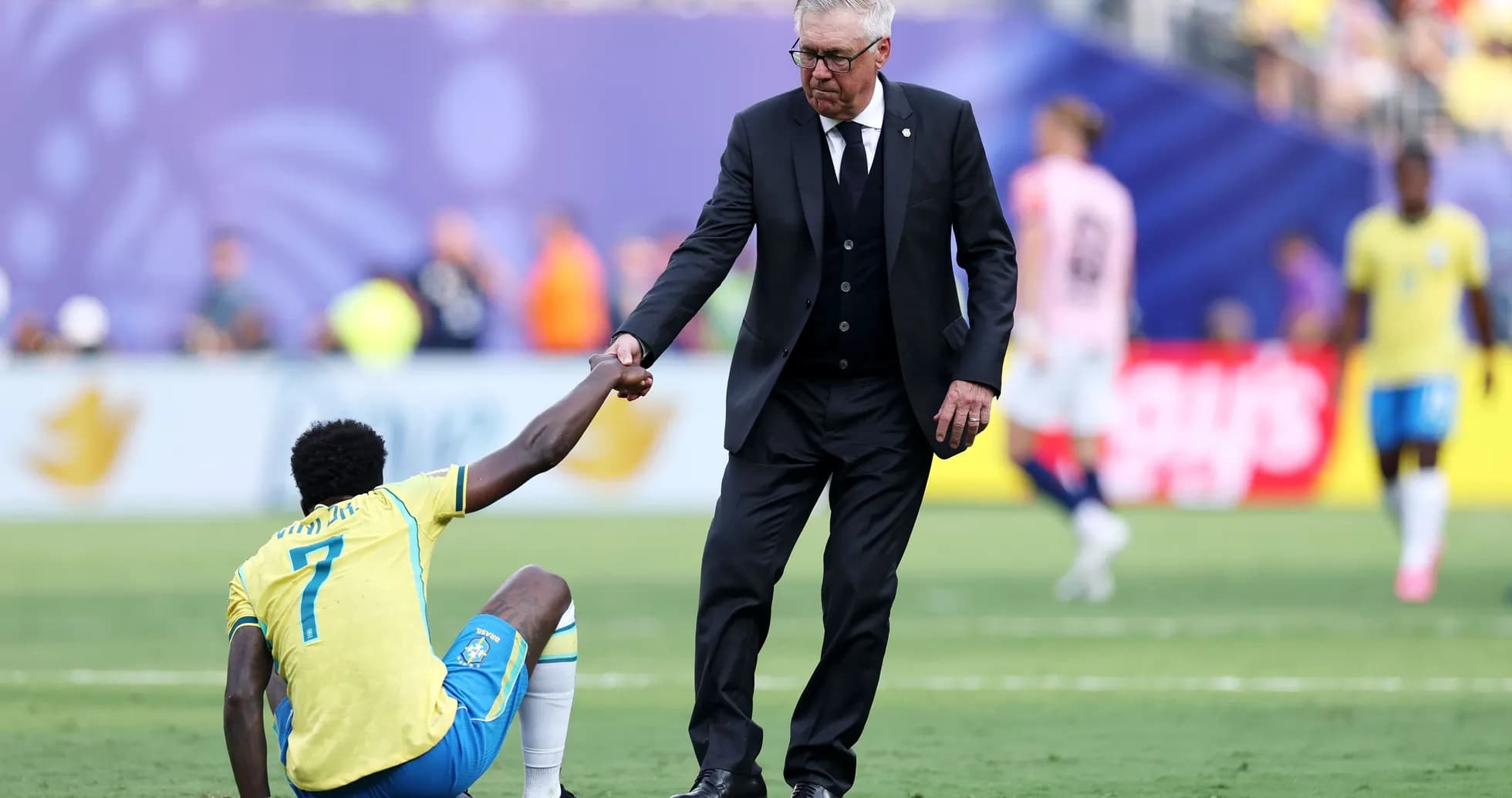
Carlo Ancelotti Reflects on Brazil's World Cup Exit
Carlo Ancelotti has lived enough football lives to know that World Cups are rarely lost on a single moment. Yet when he looks back at Brazil’s exit in 2026, he keeps returning to one detail that would usually pass without mention: a water break.
Brazil fell 2-1 to Norway in the round of 16, another early exit for a nation that has not lifted the trophy since 2002. For Ancelotti, the turning point did not come with Erling Haaland’s decisive strike, nor with the late introduction of Neymar. It came when the referee stopped play for players to drink.
“We lost the World Cup during the water break”
Up to that pause in the second half, Ancelotti insists, Brazil had the match where they wanted it.
“The team was in control of the flow of the match until that moment,” he reflected, speaking to ESPN. Norway had the ball, often deep in their own half, but Brazil felt comfortable in the pattern. They had seen this movie before.
“Norway played the same way against England,” Ancelotti noted. “They controlled the match, but in the end, they could have beaten England.” Possession did not bother him; the rhythm did.
Then came the break. Time to breathe, time to think – perhaps too much time. Convinced that Brazil were slipping out of control, Ancelotti chose to act. He changed the line-up. The match changed with it.
“Perhaps my mistake was here, when I thought the team had lost control of the match when that was not the case,” he admitted. Soon after, Haaland struck. “We had the problem of Erling Haaland’s goal. And in the World Cup, when they score a goal against you in the thirtieth minute of the second half, it is very difficult to recover. But we did have a chance to recover.”
They never fully did.
A year of work, undone in minutes
Ancelotti did not hide behind excuses. He began by defending the broader project. Over the year leading into the tournament, he felt Brazil had done almost everything right.
“In general, I think the work done over a year was excellent,” he said. The logistics, he stressed, were impeccable: hotel, stadium, training ground, all aligned. He praised the squad’s level. “I think the players’ performance throughout the year was positive. I also think the 26 players who were called up were the most suitable to be there.”
The plan, though, did not survive the injury list.
“The plan drawn up last year changed slightly because of injuries,” he explained. “We suffered many injuries in the period between March and the World Cup: Militão was injured, and Rodrygo, then Estêvão, and Wesley was injured before the World Cup, and during the World Cup, Raphinha was injured. So the plan changed a little.”
By the time Norway stood in their way, Brazil were already a reshaped version of the side he had imagined. The details of that reshaping, and the decisions taken in the heat of the knockout tie, are what now haunt the coach.
The Neymar question
If the water break was the turning point, Neymar was the lightning rod.
Ancelotti’s decision to bring on the forward in the final stages drew fierce criticism. The move was accused of “upsetting the balance” of a team chasing the game. He rejects that idea outright.
No,” he said firmly. “When Neymar came on at that moment, I took off Ryan and brought on Endrick as a right winger, thinking that Neymar was capable of creating a goal, or showing his skills at that moment, in the 70th minute. That is what I intended to do against Japan.”
The plan for Neymar had been carefully drawn. Against Japan, in an earlier match, Ancelotti had chosen a different route.
“Why did I bring on Gabriel Martinelli against Japan?” he asked. “Because the team was completely in control of the match. Japan relied only on counter-attacks. The aim was not to score a goal, rather I was thinking of bringing on Neymar in extra time against Japan.”
Against Norway, the script changed. Control slipped – or at least Ancelotti believed it did. He accelerated the Neymar plan.
“I brought Neymar on a little early to regain control of the match,” he admitted. It was a coach’s gamble, taken in the tension of a World Cup knockout, with the clock and the weight of history pressing down.
“You have to think about the decisions you have to take,” he added, referencing Thomas Tuchel’s own experience with heavy criticism. “It is a moment full of tension, and you do not always get it right.”
No regrets, only responsibility
What Ancelotti will not do is turn Neymar into a scapegoat.
“I think Neymar should have been brought on, he had to come on at that moment because he was performing well, trained well, and prepared well,” he said. “I liked his sporting spirit. I think he helped the team. But, with him coming on, there was no need to change the structure of the team.”
That final line lingers. The player was right. The timing, in his mind, was justified. The structural tweak around him, less so. Between the water break, the perception of lost control, and the reshuffle that followed, Brazil’s World Cup slipped away.
For a coach who has built a career on reading games better than almost anyone, the irony is stark. One pause to drink, one misread of a match’s pulse, and a nation’s 24-year wait goes on.