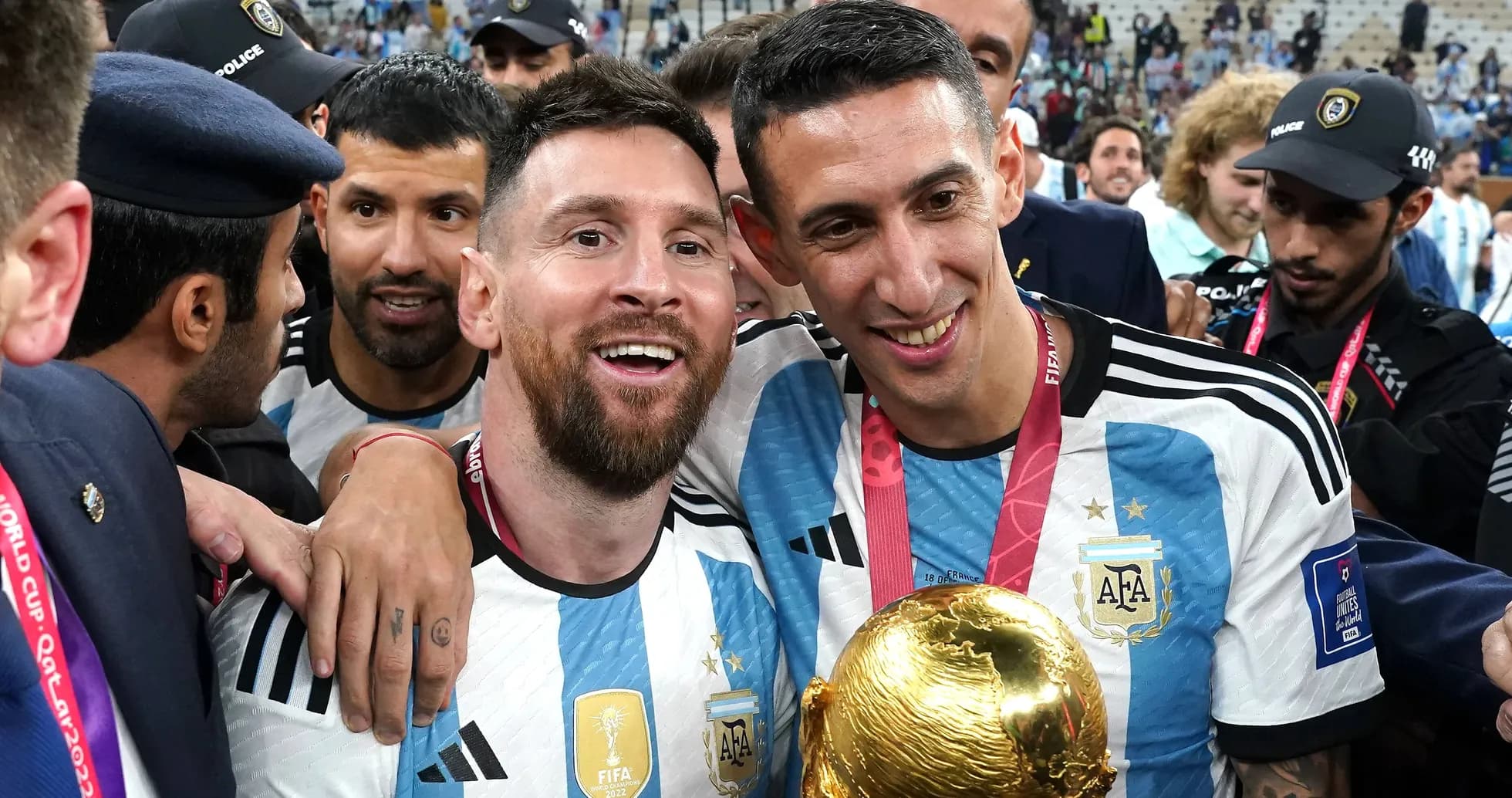
Ángel Di María on Messi's Future: He Must Keep Going
Ángel Di María has never been one for half-measures. Not on the pitch, and certainly not when it comes to Lionel Messi.
Fresh from Rosario Central’s 2-1 defeat to Belgrano, with the sting of the loss still in the air, Di María parked club frustrations to talk about something far bigger: the future of his long-time friend and captain.
“Leo has to keep going”
Argentina is still coming down from the emotional high and heartbreak of the 2026 World Cup, a tournament Messi had privately framed as his last dance with the national team. Leandro Paredes has already revealed that the final was, in Messi’s mind, his farewell to the Albiceleste shirt.
Di María isn’t ready to accept that.
"Leo has to keep going as long as he wants," he said, the message as much a plea as a statement. "I think he can continue for many more years. At 39, he's shown that he's one of the best and that he can continue to be one of the best in history. He has no ceiling, there's nothing more for him."
In a country that has lived every minute of Messi’s career as if it were its own, those words land heavily. This isn’t a pundit speculating from a studio. This is a man who has shared dressing rooms, finals, flights, tears and trophies with Messi for more than a decade.
For Di María, age is just a number stapled to a legend who keeps rewriting his own script.
Scaloni, the anchor of a golden era
The conversation around Argentina’s future doesn’t stop with Messi. Di María turned quickly to another figure who, in his eyes, is just as crucial to what comes next: Lionel Scaloni.
"Scaloni is the leader of the national team, I hope he stays for everyone's sake," Di María insisted.
It’s hard to argue. Scaloni has overseen a historic cycle: the World Cup, two Copa Américas, and the Finalissima. Four major trophies, one generational reset, and a squad that has learned how to win on the biggest stages.
"He's developing a good generation of young players who are coming through now, and every little bit helps. I hope he stays; it's his decision. Scaloni, better than anyone, knows what he wants, but obviously, as an Argentine, I'd like him to continue."
That line – “as an Argentine” – carries weight. It’s not just about tactics or line-ups. It’s about identity. Scaloni has become the calm at the centre of the storm, the coach who turned a fragile, burdened team into a ruthless, united champion. For Di María, tearing that structure down now would be a step backwards just as a new wave of talent begins to emerge.
A team that already belongs to history
Di María also allowed himself to look back, to step away from the rawness of defeat and focus on what this group has already etched into football’s memory.
“They deserve more than just applause for everything they've achieved and have continued to achieve," he said. "Beating England was the culmination of all that. For me, the World Cup ended there, and we gave the country its greatest joy, and that's the most beautiful thing for everyone."
Those are not casual words. In a nation obsessed with its footballing mythology, to say “the World Cup ended there” is to admit that, emotionally, the peak had already been reached. Whatever came after that high – the tension, the final, the heartbreak – couldn’t erase the euphoria of that moment.
This Argentina side, in Di María’s eyes, has already crossed the threshold from successful team to eternal reference point. They are no longer just champions; they are part of the country’s collective memory, alongside 1978, 1986, and every street celebration that followed.
Suffering, pride and what comes next
Di María didn’t pretend the journey was easy to watch from the outside.
"I suffered through every match," he admitted. "But in the end they drew on their inner strength and that's what led to victories. Finals are finals; sometimes you win, sometimes you don't. This time it wasn't our turn, but I think the lads did the national team proud."
That is the voice of someone who has lived both sides of the story: the agony of injuries in key tournaments, the ecstasy of finally lifting silverware with Argentina, the helplessness of watching from afar as others carry the flag.
He knows what it means to walk into a final with a country on your shoulders. He also knows that, in Argentina, the line between hero and scapegoat can be brutally thin. This time, he’s having none of that. For him, the verdict is clear: pride, not regret.
So where does that leave Argentina?
Messi stands at a crossroads, publicly silent, privately weighing a decision Di María insists should be his alone. Scaloni holds the keys to a new generation, his future still a point of national anxiety. The core of a legendary team has already secured its place in football’s pantheon.
The trophies are in the cabinet. The memories are untouchable.
The only real question now is whether Messi and Scaloni choose to write one more chapter.