Arsenal Secure Narrow Victory Over Brighton with Saka's Goal
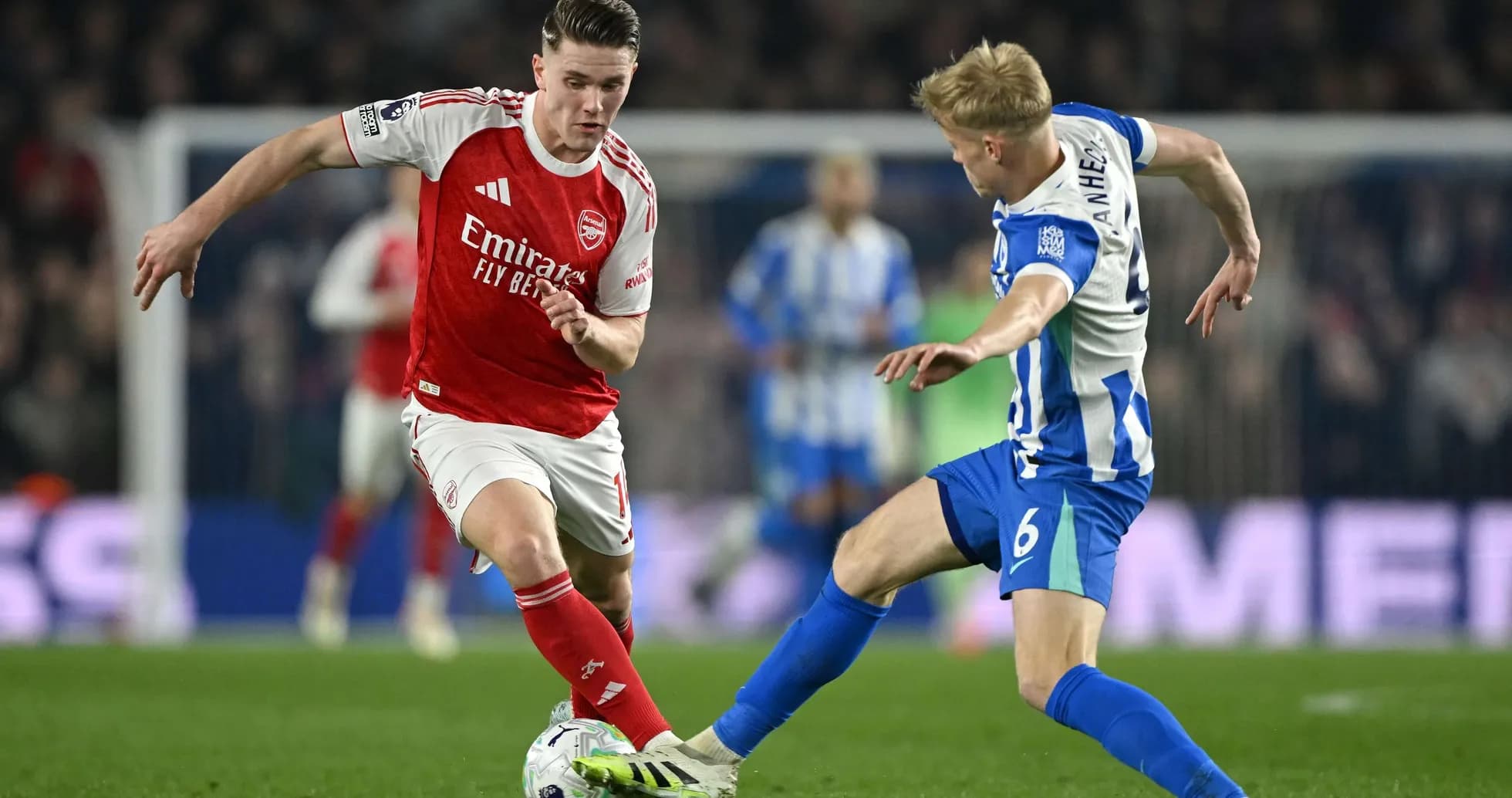
At the Amex Stadium on 4 March 2026, Arsenal ground out a 1–0 win over Brighton in Premier League Round 29, a result that underlined the league leaders’ capacity to manage tight games as much as blow teams away. Bukayo Saka’s early goal from open play proved decisive in a contest where Brighton, 13th on 37 points, controlled much of the ball but struggled to turn territory into clear chances. Arsenal, top with 67 points, leaned on structure, discipline and game management to protect a slender lead.
First Half Analysis
The pattern of the night was set early. Brighton, in their 4-2-3-1, tried to build patiently from the back, while Arsenal mirrored the shape but pressed in well-drilled waves. The breakthrough came on 9': Saka finished a flowing move with a composed goal from open play, assisted by Jurriën Timber, whose overlap and delivery from the right exploited a brief disorganisation in Brighton’s back line.
Brighton attempted to respond with Pascal Groß trying to dictate from deep, but Arsenal’s double pivot of Declan Rice and Martín Zubimendi screened central areas effectively. The visitors accepted long spells without the ball, preferring to keep their block compact rather than chase possession.
Cristhian Mosquera’s yellow card on 11' for a foul was a reminder of Arsenal’s aggression in duels, but it did little to disrupt their defensive rhythm. Brighton moved the ball with intent, Kaoru Mitoma and Jack Hinshelwood rotating in the half-spaces, yet the final pass was consistently crowded out. Despite 60% possession overall, Brighton’s first-half threat remained largely speculative, with Arsenal content to reach the interval at 0–1, their defensive line largely unbreached in genuinely dangerous areas.
Second Half & Tactical Shifts
Brighton signalled their intent immediately after the restart. On 46', Y. Minteh replaced K. Mitoma, a like-for-like change on paper but with a more direct, vertical dribbler introduced to attack space behind Timber. The hosts tried to increase tempo, but frustration began to show. Diego Gómez collected a yellow card on 52' for a foul as Brighton pushed higher and risked leaving themselves open to transitions.
Mikel Arteta responded with controlled, pragmatic changes to lock down the lead. On 59', K. Havertz came on for V. Gyökeres, adding more link play and pressing intelligence up front. A minute later, on 60', L. Trossard replaced G. Martinelli, giving Arsenal fresh legs on the left to carry the ball out of pressure. The key defensive tweak arrived on 64', when R. Calafiori came in for C. Mosquera, shoring up the back line with a left-footed balance and extra composure.
Roberto De Zerbi then rolled the dice in a flurry of changes. On 69', D. Welbeck replaced J. Hinshelwood, an attacking gamble that effectively shifted Brighton towards a more front-loaded shape with two natural forwards. At 77', J. Veltman came on for M. Wieffer, while H. Howell replaced D. Gómez in midfield, followed a minute later by Y. Ayari for C. Baleba on 78'. The cumulative effect was a more chaotic, risk-taking Brighton, but not necessarily a more incisive one.
Tension escalated as the clock ticked down. Olivier Boscagli was booked on 80' for dissent, underlining Brighton’s irritation with some marginal calls and their inability to break Arsenal down. In the same minute, Arsenal tightened the midfield further: C. Nørgaard replaced M. Zubimendi, reinforcing the visitors’ capacity to disrupt Brighton’s rhythm and manage transitions.
Brighton’s defensive line also frayed under the strain. Ferdi Kadıoğlu saw yellow on 82' for an off-the-ball foul, and deep into stoppage time Yasin Ayari was booked on 90+4' for another foul as Arsenal ran the clock down intelligently. Despite Brighton’s late pressure and extra attackers, Arsenal’s block held firm, with David Raya required for only routine interventions.
Statistical Deep Dive
The numbers told the story of contrasting approaches. Brighton’s 60% possession reflected their territorial dominance, yet Arsenal’s 40% share was a deliberate choice to focus on structural control rather than ball hoarding. Brighton attempted 470 passes and completed 385, an 82% accuracy that underlined their technical security. Arsenal, with 322 passes and 226 completed (70% accuracy), were less polished but more purposeful, using the ball to escape pressure rather than to probe endlessly.
In terms of attacking output, Brighton’s 11 total shots to Arsenal’s 7 suggests a home side on the front foot, but the quality gap was smaller. Brighton managed only 3 shots on target, Arsenal 2. The xG figures – 0.82 for Brighton against 0.47 for Arsenal – underline how few truly clear chances were created by either side. Arsenal’s early goal from open play effectively came from one of the game’s rare high-quality moments.
Defensively, Arsenal’s back line was notably efficient. Brighton had 5 shots blocked, meaning Arsenal’s defenders stepped out to make five crucial interventions. At the other end, Brighton’s rearguard produced just 1 block, reflecting how rarely Arsenal pulled the trigger in crowded zones.
Discipline tilted slightly against the hosts. Brighton committed 14 fouls to Arsenal’s 12 and collected 4 yellow cards – Gómez, Boscagli (for dissent), Kadıoğlu and Ayari – compared to just 1 for Arsenal, Mosquera’s early caution. The card profile mirrored the emotional arc: a calm, controlled Arsenal against an increasingly exasperated Brighton.
Standings & Implications
For Brighton, remaining 13th on 37 points with a goal difference of +2 keeps them in mid-table limbo: comfortably clear of danger but struggling to find the cutting edge to climb towards the top half. Arsenal’s position at the summit, first on 67 points with a formidable +37 goal difference, is reinforced not by a statement scoreline but by the kind of professional, low-margin away win that often defines title campaigns. This was less about sparkle and more about steel – and it keeps their Champions League-bound season firmly on course.