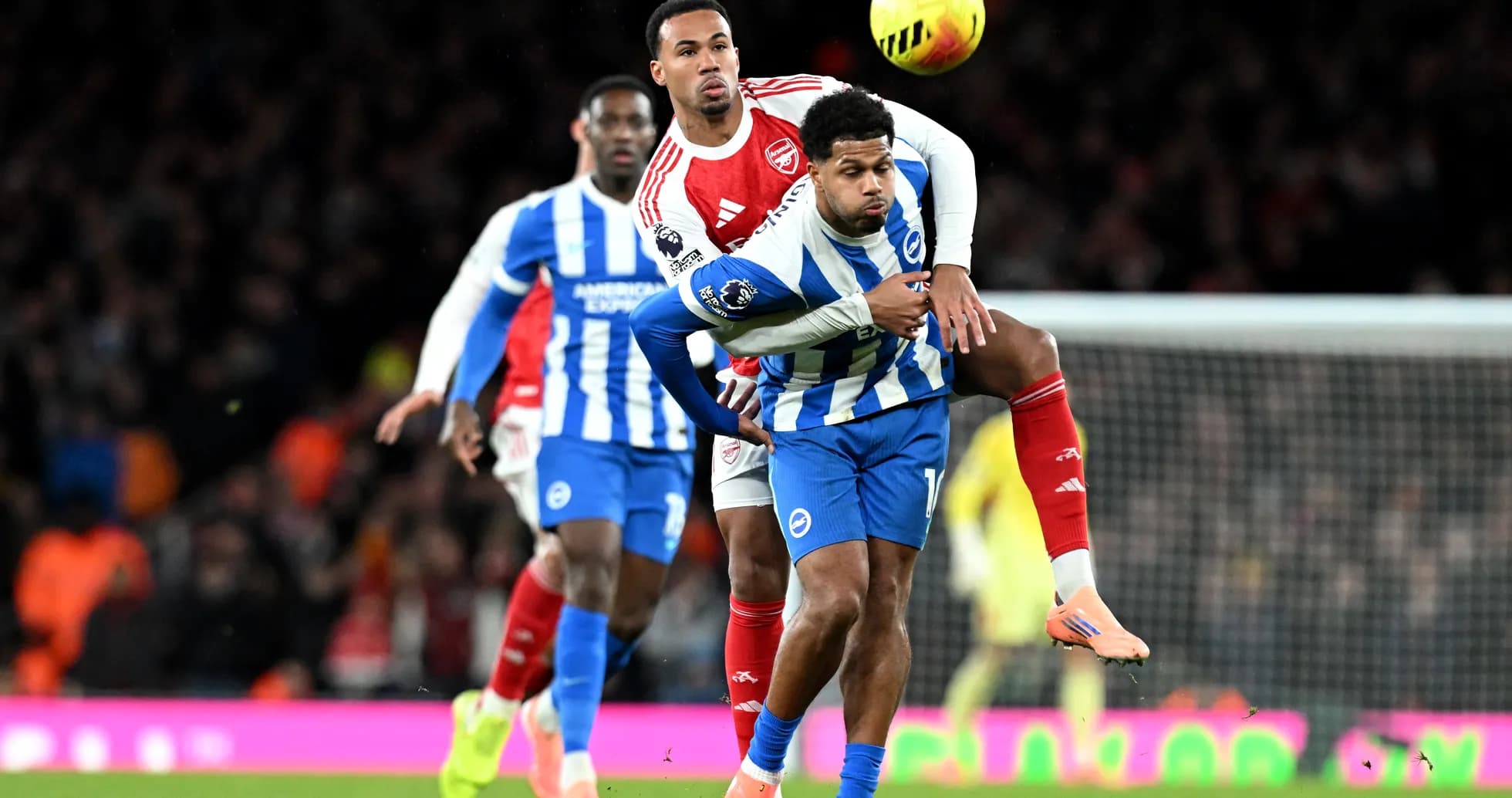
Arsenal's Efficiency Triumphs Over Brighton's Possession Dominance
Arsenal’s low-possession control and Brighton’s sterile dominance
The battle for control was paradoxical. Brighton held 60 percent of the ball, completed 470 passes at 82 percent accuracy, and mirrored Arsenal’s 4-2-3-1 structure. Yet the scoreline, 1–0 to Arsenal, reflects a game where territory and circulation did not translate into real threat. Arsenal, with only 40 percent possession and 322 passes at 70 percent accuracy, accepted a reactive role, trusting their compactness and early lead.
In terms of efficiency, the numbers are stark. Brighton generated 11 shots to Arsenal’s 7, but both sides produced very modest xG: 0.82 for Brighton, 0.47 for Arsenal. The decisive moment was Bukayo Saka’s ninth-minute strike, assisted by Jurriën Timber. One of only 2 shots on target for Arsenal, it delivered a return well above their underlying chance quality. Brighton, by contrast, turned 3 shots on target into no goals, underperforming their xG and highlighting a lack of penalty-box incision rather than goalkeeping heroics, given David Raya needed only 2 saves.
Offensively, Brighton’s structure was clear: a single striker in Georginio Rutter, supported by Kaoru Mitoma, Jack Hinshelwood and Diego Gómez between the lines, with Pascal Gross and Carlos Baleba as the double pivot. They produced a balanced shot map (6 inside the box, 5 from range), but Arsenal’s block density was crucial. Brighton had 5 shots blocked by Arsenal, indicating that whenever Brighton did reach shooting zones, Arsenal’s back line and midfield screen closed space quickly, forcing rushed or crowded attempts.
Arsenal’s attack was more selective. They managed 6 of their 7 shots from inside the box, reflecting a focus on high-value locations rather than volume. Viktor Gyökeres provided a central reference, with Saka and Gabriel Martinelli attacking the half-spaces. When Gyökeres was replaced by Kai Havertz on 59 minutes, and Martinelli by Leandro Trossard on 60, Mikel Arteta preserved the same structure but refreshed the pressing and hold-up profiles to maintain an outlet without overcommitting.
Defensive intensity tilted towards Brighton’s frustration. They committed 14 fouls to Arsenal’s 12 and collected four yellow cards: Diego Gómez for a foul on 52 minutes, Olivier Boscagli for an argument on 80, Ferdi Kadıoğlu for an off-the-ball foul on 82, and Yasin Ayari for a foul deep into stoppage time. Arsenal’s only booking, for Cristhian Mosquera on 11 minutes (foul), did not alter their defensive discipline. Brighton’s Bart Verbruggen made just 1 save, underlining how rarely Arsenal tested him after the opener; the visitors instead protected their lead through structure rather than volume of defending.
Roberto De Zerbi’s substitutions from 46 minutes onward (Yankuba Minteh for Mitoma, then Danny Welbeck, Joël Veltman, Harry Howell and Yasin Ayari between 69 and 78) show a clear attacking gamble: fresh wide threat, an extra striker, and more advanced midfield profiles. Yet the underlying metrics barely shifted; Arsenal’s block count and compact mid-block continued to suffocate Brighton’s final actions.
Overall, the data points to a game where Arsenal’s early efficiency and disciplined block-based defending trumped Brighton’s possession and shot volume. Brighton controlled the ball; Arsenal controlled the risk, and that distinction decided the match.