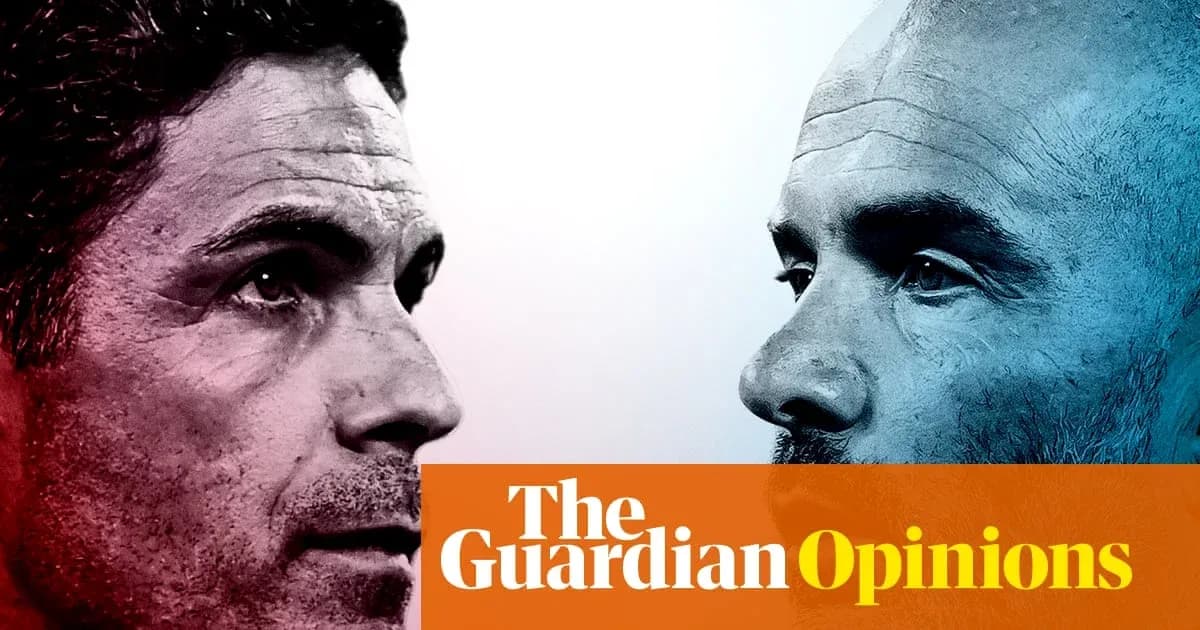
Arsenal vs Manchester City: A Community Shield Showdown
Arsenal have finally climbed the mountain. Now comes the question that stalks every champion: what happens when the thing you’ve chased for decades is suddenly yours?
They waited 22 years for their 14th league title. Three straight seasons of finishing second, three straight years of being close enough to taste it and still going home empty-handed, finally gave way to the catharsis of May and a Premier League trophy back in north London. The toll was obvious. Declan Rice ran himself into the ground. Bukayo Saka drifted in and out of the World Cup. William Saliba left that tournament with a back problem. The legs were heavy, but the emotions were heavier.
The start of a new season after a World Cup is rarely smooth. Players return at different levels of fitness, minds still half-locked in international mode. This one feels even stranger. Nine of the 20 Premier League clubs have changed manager. For the first time in 40 years, none of the five giants of the modern era – Sir Alex Ferguson, Arsène Wenger, José Mourinho, Jürgen Klopp or Pep Guardiola – stand on a Premier League touchline. The era of the super-manager has finally given way to something looser, less defined.
Even at Arsenal, stability comes with caveats. Mikel Arteta is now the longest-serving manager in the division, but continuity doesn’t guarantee clarity. After such an emotionally draining climb, nobody quite knows how quickly his team will find their rhythm again. A slow start would surprise nobody.
City without Guardiola: a new age, same demands
At the other end of the spectrum stand Manchester City, a club whose idea of disappointment bears little resemblance to anyone else’s. By their own sky-high standards, the last two seasons under Guardiola felt flat. Now, after a decade of living under one man’s footballing doctrine, City walk into Wembley with a new voice in the dressing room.
Enzo Maresca arrives with a familiar silhouette. He looks like Guardiola, he talks a similar tactical language and his football carries clear echoes of the time he spent as Pep’s assistant. But the questions around him are real. He took Leicester up and lifted the Europa Conference League and Club World Cup with Chelsea, yet large sections of both fanbases never warmed to the way his sides played. Chelsea’s squad was unbalanced, and the club’s wider problems were glaring, but there was still a sense he hadn’t squeezed everything out of what he had.
Now he inherits a dressing room conditioned to Guardiola’s exacting standards and habits. The Community Shield will not give a full verdict on whether he can carry that weight. It might, however, offer the first hints of how City respond when the man who built their modern identity is no longer there.
The anti-bellwether that still reveals cracks
The Community Shield is a curious thing. It is the first competitive line in the new season’s story, yet almost nobody trusts it. Not since 2018 have the winners gone on to lift the Premier League. In that sense it functions as an anti-bellwether: what happens at Wembley often bears little resemblance to what unfolds nine months later.
Where it does matter is in what it exposes. Not the polished strengths of a champion, but the loose threads that might later be pulled apart. Tactical experiments that don’t quite fit. Players who look a step off the pace. A mood that feels a touch off.
History offers enough warnings. In 1974, the infamous fight between Kevin Keegan and Billy Bremner didn’t just provide tabloid fodder; it shone a harsh light on Liverpool’s unease after Bill Shankly’s retirement and the deeper malaise at Leeds following Brian Clough’s arrival in Don Revie’s shadow. The full significance only became clear later.
The same was true in 2015. José Mourinho turned up for the Community Shield looking nothing like the razor-edged figure who had defined his first Chelsea spell: unshaven, in tracksuit bottoms and a baggy T-shirt, then beaten by Wenger for the first time. It felt odd, but few grasped that the season was about to unravel so spectacularly that he would be sacked before Christmas.
Last year’s game carried similar warning signs. Crystal Palace beat Liverpool on penalties after a 2-2 draw, but the real story sat in the details. Arne Slot’s side looked disjointed. Mohamed Salah seemed out of sync with the rest of the front line. The defence creaked, twice surrendering a lead. In hindsight, those were clear markers. At the time, they were easy to file away as pre-season rust.
That is always the challenge with this fixture: deciding what is temporary and what is terminal.
Arsenal’s left flank, a teenage talent and a midfield tweak
This Sunday’s meeting is no different. It won’t provide definitive answers, but it can at least sharpen a few questions.
Arsenal’s midfield will draw attention. Bruno Guimarães, who came off the bench in Wednesday’s friendly against Como, could feature again, likely alongside Myles Lewis-Skelly. The 19-year-old has been one of the stories of Arsenal’s pre-season, stepping up while Rice, Martín Zubimendi and Martin Ødegaard enjoyed extended breaks after the World Cup.
His future, though, sits in a grey area. He has been linked with a move, and that gave his celebration against Como extra weight: a goal, a heart sign with his hands, a tap on the badge. It looked like a player making a point, either to his current club or any suitors watching.
Out wide, the champions are patching up the left side of their attack. Leandro Trossard has been sold, leaving a gap that the market has not fully filled. Morgan Rogers chose Chelsea. Vinícius Júnior stayed at Real Madrid. Arsenal moved instead for Christos Tzolis from Club Brugge, a 24-year-old Greece international whose role will become clearer with minutes.
Wembley offers the first real look at how he fits into Arteta’s structure. Is he a starter who can carry that flank through a title defence, or a rotation piece who still leaves Arsenal short in that channel?
City’s midfield surgery and life after Stones and Silva
Across the halfway line, City’s biggest headache is the one they cannot yet fully control. Rodri’s proposed move to Barcelona hangs in the air, unresolved, and with it the timing of any succession plan. While that deal stalls, City hesitate.
Enzo Fernández sits at the top of their list as a potential replacement, but the question is obvious: can his game, built more on timing and technique than brute strength, survive at the base of midfield in a side that often defends vast spaces? The signing of Elliot Anderson, more robust and physically imposing, hints at a possible solution, but the balance is still untested.
Tijjani Reijnders, who started pre-season friendlies against Inter and Atlético, is heading to Al-Qadsiah. Bernardo Silva has gone to Real Madrid. Two reliable midfield cogs gone, one of them a player who so often glued Guardiola’s City together in big moments. The overhaul in that area is no longer theoretical; it is happening in real time.
Where Phil Foden fits into this reshaped picture remains one of the most intriguing subplots. Crowned player of the year in 2024, he has since struggled to hit that same level. He started the Inter and Atlético games, but rhythm has escaped him. With others still playing their way back after the World Cup, the next few weeks offer him a clear runway. If he is to be the face of the post-Guardiola City, this is the window to show it.
Then there is John Stones. On paper, his departure should barely register: just 11 starts across the last two seasons. On the pitch, City have already learned to live without him. Inside the dressing room, it is different. Losing Stones and Bernardo Silva, on top of Guardiola, rips out a chunk of the team’s core identity. The voices that set standards, the characters who knew exactly what it took to win, are gone.
What emerges in their place will define Maresca’s early months.
A curtain-raiser with questions, not answers
So Sunday at Wembley becomes a kind of mirror. One side shows Arsenal, finally champions again, trying to prove that last season was not the summit but the start of something longer. The other shows City, stripped of the manager who shaped their greatest era, trying to redraw themselves without losing their edge.
It is only the Community Shield. The trophy itself barely registers in May. But the patterns, the partnerships, the body language – those linger.
The real question is simple: will what we see at Wembley be a fleeting snapshot, or the first glimpse of how this new Premier League landscape will really look when the serious business begins?