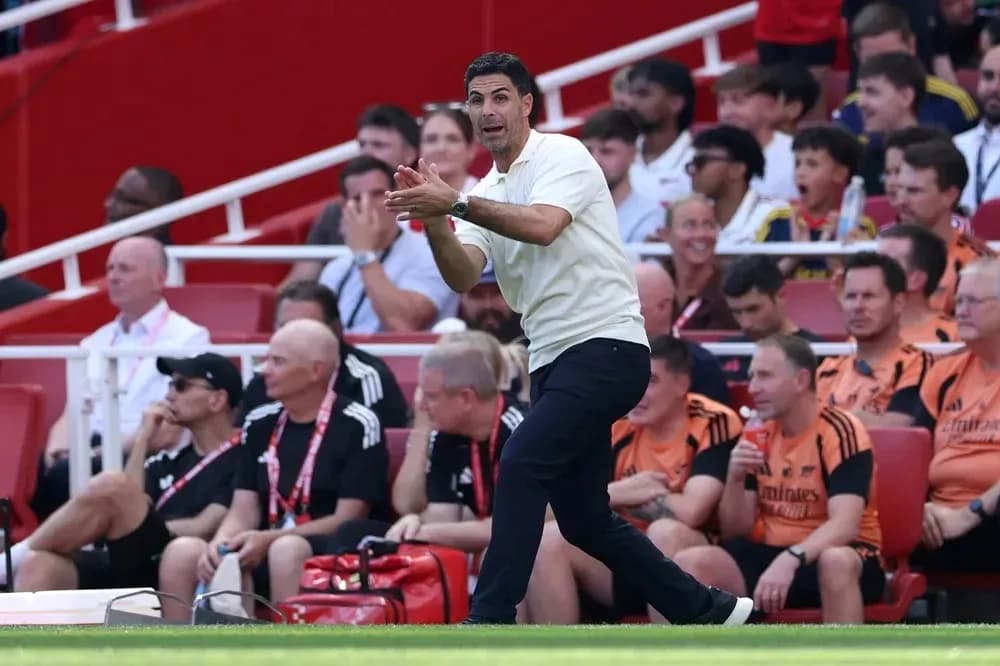
Arteta Calls for Change in Premier League Squad Rules
Mikel Arteta left Wembley with a trophy in his hands and a headache in his mind.
Arsenal’s 3-0 dismantling of Manchester City in the Community Shield delivered the perfect early-season statement, yet the manager walked away still fighting a different battle – one with the Premier League itself.
Big win, big omissions
On the day, Arsenal were ruthless. City were brushed aside. But the team sheet told another story.
William Saliba and Jurrien Timber were both missing, their absences straightforward enough: injuries, nothing more. Timber even travelled to Cardiff, involved around the group despite being unavailable.
Illan Meslier was there too, suited up but not listed among the substitutes. For a third-choice goalkeeper in a domestic competition, that’s normal. There are only so many seats on a Premier League bench.
And that, Arteta argues, is exactly the problem.
Under UEFA rules, clubs can name a 23-man squad on a matchday. That extra space has real consequences. Last season, young goalkeeper Tommy Setford often travelled with Arsenal for domestic fixtures, joined the warm-ups, then disappeared from the official team sheet – yet he was regularly included in Champions League squads all the way to the semi-final. Same player, same club, different competition, different rules.
Against City, the squeeze was even more obvious. Beyond Meslier, Arteta had to leave out Gabriel Martinelli, Ethan Nwaneri, Gabriel Jesus, Fabio Vieira and Reiss Nelson entirely. All fit enough to be considered, none of them involved.
Under UEFA rules, at least two of those outfield players would almost certainly have been on the bench.
Arteta’s push for change
Arteta did not hide his frustration when he spoke after the game. He confirmed he is actively lobbying for a rule change.
"I've been trying to persuade the Premier League and the clubs to be able to extend the number of players that we can have, especially the outfield players in the squads, because we play more and more games and the load is unreal," he said.
For him, this is not a luxury issue. It’s about managing an increasingly brutal calendar.
"It's just a shame (to leave players out), so it's the most difficult part of the job," he admitted. "It's just a fact that we can bring 18 outfield players and we believe that for today's game these were the options that we needed, especially with the physical condition of certain players."
The message was clear: the modern game demands bigger benches. Managers want more tools, not fewer, when trying to navigate fatigue, injuries and relentless scheduling.
The looming divide
Not everyone will see it that way.
Smaller clubs are likely to push back, wary of handing even more power to the league’s elite. A 23-man matchday squad gives richer teams more ways to change a game from the bench, more tactical variety, more fresh legs. Many of those fighting at the other end of the table simply can’t afford that kind of depth.
Some clubs may not even have 23 fully fit senior players they trust to name in a squad every week. From their perspective, the change risks widening the gap, not just in quality, but in options.
Yet the landscape has shifted. Almost half the Premier League now competes in Europe each season. Those clubs already live in a world where 23-man squads are standard on Tuesday and Wednesday nights, then cut back down again at the weekend.
Arteta’s argument is that the domestic game should catch up with that reality. The question now is whether the rest of the league is willing to let it.