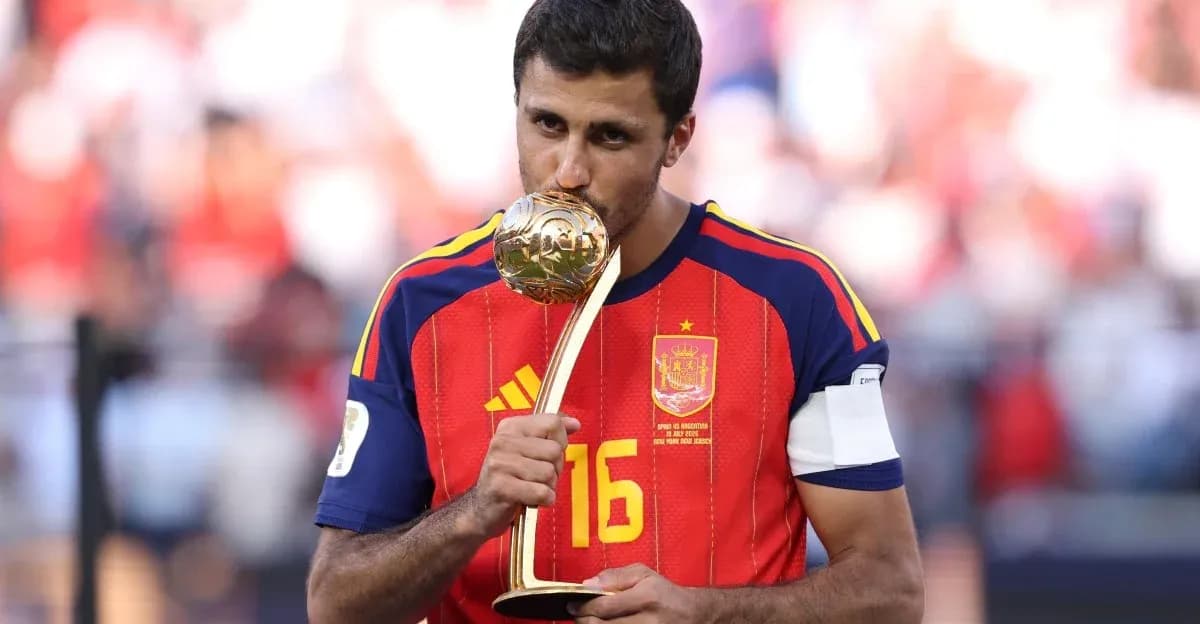
Barcelona's Late Bid for World Champion Rodri Amid Real Madrid Interest
FC Barcelona are exploring a dramatic late move for Spain’s World Cup talisman Rodri, just as the Manchester City midfielder edges closer to a switch to Real Madrid, according to Catalan radio reports.
It would be a bold play. And a complicated one.
Rodri’s contract at Manchester City runs out next year, a ticking clock that has only grown louder since his return from long-term injury. Back fit, back in rhythm, he drove La Roja to World Cup glory and came home with the award for best player of the tournament – a decision that stirred debate but underlined his towering influence on the pitch.
His value has soared. So has the competition.
Real Madrid in the Driving Seat
Inside Spain, the expectation is clear: Real Madrid hold the upper hand. On the financial side, the numbers lean decisively towards the Bernabéu. The European champions are in position to outbid any late intervention from Barcelona, should this tentative interest from Catalonia turn into something more concrete.
At this stage, it hasn’t.
Barcelona have not lodged a formal offer. The club have only signalled internal interest, a recognition that a midfielder of Rodri’s calibre could transform their core. Any talk of a “hijack” remains hypothetical, and Real’s advantage is real, not imagined.
Yet context matters, and Barcelona’s midfield context is changing fast.
De Jong’s Injury Shakes the Midfield Plan
Frenkie de Jong’s injury has reopened a debate that never fully went away at the Camp Nou: do Barça have enough in the middle of the pitch to compete at the very highest level, week after week?
Without the Dutchman, the structure looks fragile. Even with him, some voices within the club hierarchy reportedly believe a new midfielder is essential to elevate the team’s level and stabilise the spine of the side. Rodri, with his positional discipline, passing range, and authority in front of the back line, fits that need almost too perfectly.
That is the attraction. That is also the problem.
Barcelona’s financial restrictions are well documented. Real Madrid’s are not. When the bidding starts in earnest, the Catalans may find themselves staring at a ceiling their rivals simply do not have.
A Madrid Son, Courted by Both Giants
Rodri’s story gives this pursuit an extra edge.
Born in Madrid, he first rose through the academy at Atlético de Madrid before moving to Villarreal, where he truly broke into La Liga and established himself as one of Spain’s most intelligent midfielders. Atlético brought him back, only to see him depart again, this time for Manchester City and Pep Guardiola’s footballing laboratory.
Now, after conquering England and the international stage, his status in Spain has never been higher. He is no longer just a promising pivot; he is the reference point in his position for club and country.
At Real Madrid, that hasn’t gone unnoticed. Inside “the White House,” Rodri is viewed as a flagship signing – a player who can anchor the midfield for years and embody the next evolution of their team.
Politics, Power and a Changing Calculation
There had been whispers that Real Madrid president Florentino Pérez initially hesitated over Rodri. The reason floated in Spanish circles: Enrique Riquelme, Pérez’s rival in the club’s presidential race, had made signing Rodri a central plank of his campaign project. In a club where politics and power plays never sleep, that detail carried weight.
If it ever slowed things down, it no longer does.
The political noise has faded. What remains is football logic and fan demand. Rodri is now widely seen among Real supporters and leadership as a priority target, a player whose arrival would send a statement across Europe and, crucially, across the Clásico divide.
A Transfer Battle Loaded With Symbolism
For Barcelona, simply entering the race would be an act of defiance.
Going after a Madrid-born World Cup hero, adored by Real fans and courted by the Bernabéu, would evoke the old transfer wars that once defined this rivalry. It would also expose the current gap between the two giants in pure financial muscle.
The stakes are obvious. If Real Madrid close the deal, they add the World Cup’s standout midfielder to an already lavish pool of talent. If Barcelona somehow find a way to intervene, they do more than sign a player: they land a psychological blow on their greatest rival and hand their own rebuilding project a formidable anchor.
The question is not whether Rodri would improve Barcelona. He would. The question is whether the Catalan club, in their current state, can realistically fight Real Madrid for a player Madrid want this badly – or whether their limited resources should be directed elsewhere on the pitch.