Bayern Munich's Säbener Straße: A Legacy of Transformation
On Säbener Straße, Bayern’s past and future keep colliding.
What began as a few rough pitches by the River Isar, a groundsman’s house and some wooden huts is now a high-security performance machine that Europe’s elite envy. And yet, once again, the bulldozers are being warmed up. Bayern are preparing to rip up and rebuild the heart of the club – for the third time in half a century.
This time, the price of progress is around €100 million.
From café table to permanent home
FC Bayern’s story didn’t start on Säbener Straße at all. It started at Café Gisela near Odeonsplatz in 1900, with a handful of men and a big idea. The first training ground lay on Schyrenstraße by the Isar; offices and pitches shifted around Munich as the club grew and the city changed.
The decisive step came in 1949. President Kurt Landauer, the visionary who shaped modern Bayern more than anyone, secured the rights to use the district sports ground on Säbener Straße from the City of Munich. Suddenly, Bayern had something they had never truly possessed: a fixed home.
Back then, the complex sat just south of the city centre, close to the old Grünwalder Stadium and not far from TSV 1860’s base. Today, a statue of Landauer stands guard, a reminder that all the glass, steel and sports science that followed rests on one deal struck 75 years ago.
Sepp Maier remembers the early days vividly. When the 14‑year‑old goalkeeper arrived in 1958, there were three pitches, the groundsman’s house with a kitchenette downstairs and living quarters upstairs, and simple wooden huts used as changing rooms and showers. Pros on the left, amateurs and youth on the right. Behind them, bootmaker Sepp Renn’s workshop. That was Bayern’s “campus.”
There was hot water in the showers, Maier insists – but not for long. If you weren’t among the first under the spray, you froze while the boiler recovered. Wages were collected once a month in town because bank transfers simply weren’t a thing.
From this modest base, a team featuring Maier, Franz Beckenbauer and Gerd Müller rose through the ranks: promotion in 1965, the first Bundesliga title in 1969. Suddenly, Germany was too small a stage. Bayern wanted Europe.
The first big leap: clubhouse and European crowns
To compete with the continent’s giants, Bayern needed more than talent. They needed infrastructure. Conveniently, they had a building contractor as president: Wilhelm Neudecker.
In 1970, the club appealed in its newsletter for donations to fund a new clubhouse on Säbener Straße. Members responded, raising 500,000 marks. It was only a fraction of the eventual 3.8 million mark cost, but it signalled a club ready to think big.
On 17 May 1971, in front of 150 guests including Munich’s Lord Mayor Hans-Jochen Vogel, Bayern unveiled their new home. It wasn’t just dressing rooms anymore. The complex housed the administrative offices, a restaurant, a multi-purpose sports hall, four grass pitches and a hard court. The old barracks stayed on as sheds for garden tools, a last echo of the past.
The idea behind the renovation? Keep the players on site longer, bind the squad together, professionalise daily life. Rooms with beds were built so the team could stay overnight on Fridays before games. In theory, it sounded progressive.
In practice, it flopped.
“We only did that maybe three times,” Maier recalls. The players complained the set‑up felt like a youth hostel, with none of the comfort expected of rising stars. They refused to accept it. Manager Robert Schwan, ahead of his time in many ways, listened. Neudecker relented. The team went back to hotels, and before big matches they even checked into the plush Bachmair on Lake Tegernsee.
The training base, though, had already done its job. Improved conditions, coupled with the club’s broader professionalisation, laid the foundation for Bayern’s first great European era. In 1974, 1975 and 1976, they lifted the European Cup three times in a row.
Inside Säbener Straße, the hierarchy was written in bricks and doors. After the renovation, the pros changed in the basement. “There were four changing rooms down there,” says Klaus Augenthaler. “The first for the coaches, the second for the stars – Beckenbauer, Maier and Müller – the third for the rest of the first-team players, and the last one for everyone else.”
When Augenthaler arrived in 1975 as a 17‑year‑old, he found himself at the back of every queue, including the one for treatment. Masseur Josip Saric focused on the big names, the ones who tipped. Equality existed only on the pitch.
The pitches themselves told their own story. Perfect in summer, cut to ribbons by autumn. “By autumn they were no longer fit for a Bundesliga club,” Augenthaler says. Yet they remained open to everyone.
Open doors, full terraces, and the Bayern Boutique
For decades, Säbener Straße lived with its doors flung open. Every training session was public. During school holidays, the touchlines filled with fans. The new “Insider” restaurant, with its raised terrace beside the pitches, became a vantage point and meeting place. After training, players and supporters sometimes sat together over a drink.
The feedback was direct and unfiltered. “When we played badly, the onlookers would have a go at us,” Maier remembers. “‘You played a right load of rubbish on Saturday,’ they’d say, ‘but never mind, we’re not angry with you anymore, let’s have a pint, come on then.’”
In 1983, a young general manager named Uli Hoeneß brought another idea back from the USA: merchandising. On Säbener Straße he opened the Bayern Boutique, a small shop selling fan gear. Six years later, in 1989, it expanded during the second major refurbishment of the site.
That same project gave Säbener Straße its most recognisable feature: the glass dome. It also created a separate building for the professional squad. Bayern were slowly morphing from a club with a training ground into a football corporation with a headquarters.
The pros, it turned out, liked this new world. Where Maier’s generation had fought to escape the “youth hostel” and head for hotels, the next wave of stars started treating Säbener Straße as a second home.
Sometimes a little too literally.
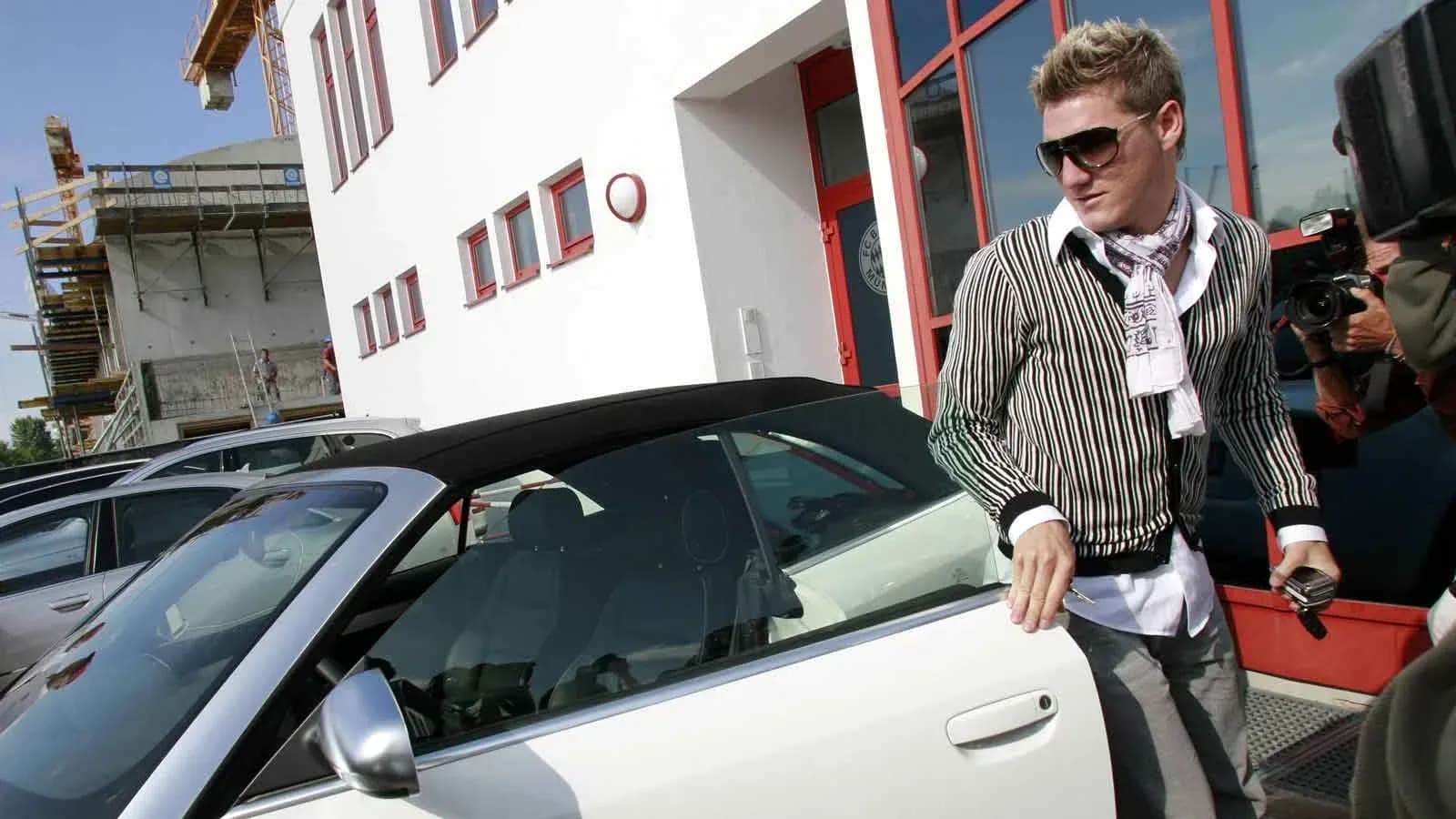
In 2003, 18‑year‑old Bastian Schweinsteiger was discovered in the hot tub at 2am with a young woman. When security, alerted by the alarm system, arrived, he introduced her as his cousin. The story passed into Säbener folklore.
Not all late‑night tales were so light-hearted. In 2000, a fire broke out in the basement sauna. Mehmet Scholl and Giovane Elber had to escape from first-floor windows using ropes. The damage ran to around two million marks and forced yet more repair work.
Minor refurbishments followed. Then came the man who wanted to drag Säbener Straße into a different era altogether.
Klinsmann’s revolution: Buddhas, PlayStations and backlash
In early 2008, FC Bayern turned to the Munich-based architectural firm Arnold / Werner. The club’s designated coach, Jürgen Klinsmann, had a bold vision for Säbener Straße. Inspired by NBA and NFL franchises in the USA, he wanted a campus that would fuse sport, wellness and education – and keep his players under the club’s roof for eight hours a day.
Uli Hoeneß and Karl-Heinz Rummenigge, still buoyed by the 2006 World Cup “summer fairy tale”, backed him.
Architect Sascha Arnold remembers the pitch at the Hotel Palace in Bogenhausen. He and his team presented their concept for a campus with a restaurant, wellness area, changing rooms, an auditorium and more to Klinsmann, Hoeneß and Rummenigge. Arnold / Werner won the contract partly because they ran several Munich bars frequented by Bayern players, including Edmoses. The bosses liked the idea that these architects understood the younger generation.
The result was radical. In just seven weeks, more than 2,000 square metres were stripped back to the shell and rebuilt. Work ran around the clock in three eight-hour shifts. The project is believed to have cost €15 million.
“Before that, the clubhouse grounds were a 1970s building in a 1980s style, which in parts looked like a Bavarian card-playing corner,” Arnold says. The transformation was total.
Suddenly, Säbener Straße boasted an auditorium with booths for simultaneous interpreters, a library, language courses, common rooms with table tennis and pool tables, a PlayStation and even a DJ booth. Klinsmann raved: “This is unique in the world; neither Real Madrid nor FC Barcelona have anything like it.” Captain Mark van Bommel, who had worn Barça colours himself, added: “You don’t see anything like this anywhere in Europe. Perhaps in hotels in Dubai, but not at a football club.”
Christian Lell, then 23 and very much part of the “younger generation” Klinsmann wanted to reach, called it a “really cool location” and half‑joked about wanting a granny flat on site so he could stay there permanently.
Klinsmann’s personal interior designer, Jürgen Meißner, added a spiritual touch: Buddhas dotted around the complex. Those statues quickly became a symbol of something very different – Klinsmann’s failure. Ten months after taking charge, without a single title won, he was sacked.
The Buddhas stayed as a punchline. The infrastructure he commissioned did not. It dragged Germany’s biggest club firmly into the modern age.
From open training to high curtains
Progress came at a cost. One of the biggest losers in the Klinsmann era wasn’t a player or a coach, but a landlady.
Erika Niemeyer’s pub, a beloved meeting point for fans and locals near Säbener Straße, had to close as part of the redevelopment. “I am appalled and extremely sad,” she said at the time. “They are tearing my heart out. Everyone here, including the fans, is losing a piece of home.”
Years later, the “Paulaner Treff” emerged as a kind of successor. Yet it is only open during public training sessions, which themselves have become rare. What used to be a daily ritual is now a handful of dates each year.
High curtains went up along the fences to shield “secret” sessions. In 2024, Bild reported that fans who tried to stand behind those curtains just to listen to training were being chased away. Since 2017, even Bayern’s own youth players have been barred from watching the first team at work.
Space played a part. The entire youth academy, including the boarding school, moved north to a new €70 million campus near the Allianz Arena. Säbener Straße, once a cradle for kids and pros alike, became almost exclusively the preserve of the senior team and the club’s executives.
At the same time, the site kept growing. During the 2010s, Bayern added a modern multi-purpose hall, another office building and new outdoor areas, including a sandpit and a football tennis court. Arnold / Werner returned to install a swimming pool with a counter-current system for aqua jogging and to build a new medical area on the top floor.
In 2013, they redesigned the office of incoming coach Pep Guardiola. Arnold offered him a choice: a standard Norman Foster desk or a unique, asymmetrical, sculptural piece Arnold had designed himself. Guardiola chose the latter “cool” desk without hesitation. For the chair, Arnold recommended a grey Eames aluminium model with a soft pad. Delivery delays meant Guardiola initially received a black version. When the grey chair finally arrived, Arnold kept the black one for himself. “I still use it today,” he says. “Pep’s chair is still comfortable to sit on.”
Time for another rebuild
Even the best hotels, Arnold points out, renovate every ten to twelve years. Bayern last overhauled Säbener Straße in 2008. The clock has been ticking.
Former CEO Oliver Kahn had already hinted that another refurbishment was on the way. His successor, Jan-Christian Dreesen, made the direction explicit in a 2024 press release: “A new training centre is a key component in ensuring that FC Bayern can continue to attract international players and remain competitive at the very highest level.”
The Münchner Merkur reported in December that preliminary planning permission had been secured. This week, fresh reports suggested that construction of a new training ground could begin soon. The project is expected to take around three years and cost roughly €100 million, with work potentially starting as early as 2026.
What exactly will rise on Säbener Straße this time remains to be seen. The pattern, though, is clear. From barracks to youth hostel feel, from Dubai‑style hotel vibes to a sealed‑off high‑performance bunker, Bayern have repeatedly reshaped their headquarters to match their ambitions.
The next version will tell us plenty about what kind of club they want to be in the 2030s: a fortress for the few, a home for the many – or something that, once again, tries to be both.