A Beautiful Obsession: Guardiola's Struggles and Triumphs
Pep Guardiola has spent the last decade being filmed, analysed and mythologised. Yet nothing has cut as close to the bone as Amazon’s new four-part series, A Beautiful Obsession – a documentary that Manchester City themselves controlled and shot, but which refuses to act as a love letter to their greatest manager.
The cameras catch the collapse. Not the treble, not the parades, but the winter of 2024-25, when City’s “machine built for winning” – Khaldoon al-Mubarak’s phrase – juddered, lurched and finally broke. Nine defeats and a single win in 13 games. Aura gone. Certainties smashed. A dynasty suddenly wobbling on its axis.
This is the story the club chose to show the world.
A season coming apart
From Wednesday, viewers on Prime will see Guardiola flailing for answers he cannot find. The series does not duck the ugliest nights or the most contentious calls. The 2-0 Champions League defeat at home to Bayer Leverkusen, when Guardiola changed 10 players, is not brushed aside as a footnote. It is dissected, then detonated.
Khaldoon’s fury at that decision is left in, raw and unvarnished. So is the cold, clinical choice to let Kevin De Bruyne – the defining player of City’s modern era – walk away without a new contract. No soft-focus farewell, no airbrushed revisionism. Just the brutal truth of elite football: even legends become numbers on a spreadsheet.
What emerges is not a hagiography but a portrait of a man and a club under strain, both forced to confront what they are willing to sacrifice to keep winning.
“I’m fucking divorced”
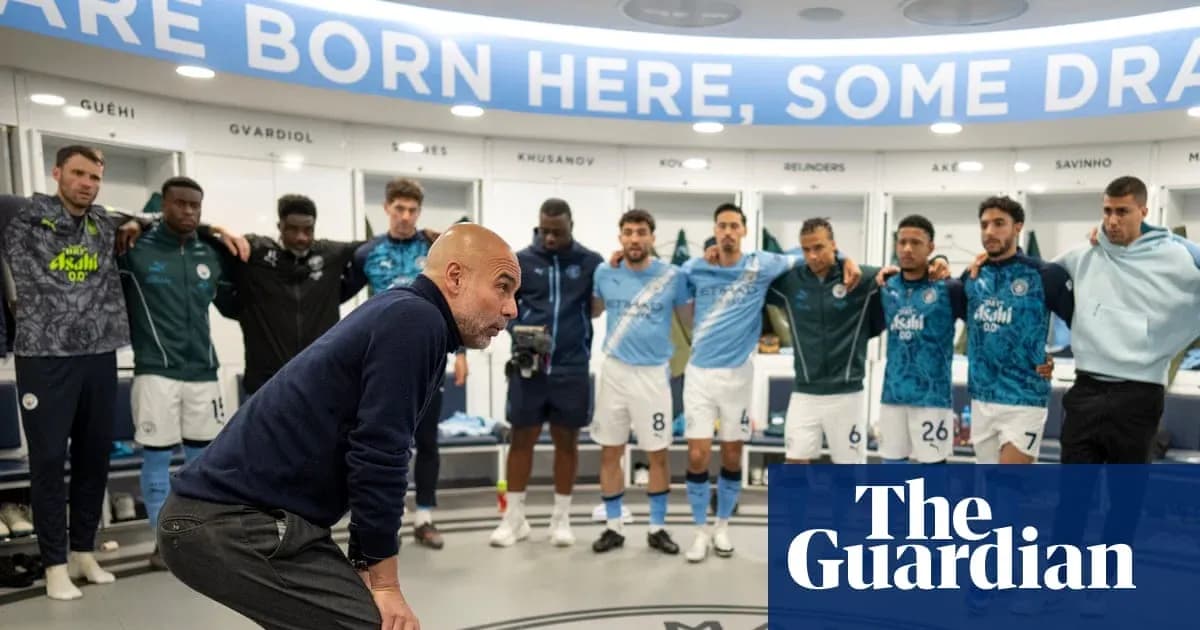
The most jarring moment comes after a 2-0 defeat by Juventus on 11 December 2024, City’s seventh loss in 10 matches. Guardiola, disgusted with his team and desperate to jolt them out of their slump, detonates a bomb in the dressing room.
“I’m fucking divorced from the most beautiful woman on your planet,” he tells his players. “I love her unbelievably, but we lost the passion. How do you play football, because you are paid? Or because of something inside? Where is the passion?”
It is a startling choice of weapon: his own private life, dragged into the middle of a crisis meeting. He has every right to speak about his marriage, but the impact is complicated. The line between professional and personal dissolves. The usual managerial tricks have failed, so he reaches for something deeper, more dangerous.
Later, he explains what being a No 1 really demands. “You have to convince your players [that they would] go to the penthouse, the roof and jump down [for you].” The implication is clear: he is no longer sure they would.
A year on, after those infamous 10 changes against Leverkusen, the theme returns. Guardiola stands in front of his squad again, still searching for a response that never quite comes.
“I leave my life, my divorce and my family is away, and everything for all of you. And what do you give back?”
The words hang in the air, heavy and unresolved.
The friend who lifts the curtain
If Guardiola’s confession feels risky, the follow-up is even more revealing. In the second episode, The Rebuild, his closest ally at City, Manuel Estiarte, explains that he went to the players himself.
Estiarte, the club’s director of first-team operations, tells them why Guardiola is “anxious, sad, different”.
“I said to the team: ‘Please, you have to understand, you’re not playing with a coach who can be a bit impulsive, intense, sometimes a bit up and down. You’re seeing a human being. He’s getting a divorce.’ It was necessary for the team not only to visualise Pep as a manager but for the first time as a human being.”
The admission lands with a double edge. Why did Guardiola not deliver this message personally, if the aim was to connect? And behind the scenes, how far did Khaldoon and CEO Ferran Soriano go in asking whether his private turmoil was undermining his work?
The cameras then cut to a different Pep. Smiling, lighter, almost defiant.
“In my life I made a lot of changes – I got divorced and I have to settle a bit. But no complaints at all honestly,” he says, before clarifying where his happiness lies. “In my job, yeah.”
The job, as the series makes clear, is consuming him.
Captains, loyalty and Anfield tears
Relationships run through the documentary like a thread. Episode three is even titled Love and Hugs. But in part one, The Desert, affection gives way to accusation.
Guardiola is close to tears when Kyle Walker, his captain, chooses to leave in January 2025 – right when City are reeling and need leadership most. The manager tells the squad Walker did not behave like their leader. Then he turns the spotlight on them.
They had voted him captain. Why, he asks, did they not pin him to the wall and demand more loyalty?
The scene that triggers Walker’s exit is shot with almost cinematic cruelty. Inside the Anfield dressing room, after Walker’s error leads to Luis Díaz winning a penalty that Mohamed Salah converts in a 2-0 defeat, Guardiola calls it out. Walker snaps back that he is being blamed “every meeting”.
The argument ends not with shouting but with Guardiola in tears, delivering a monologue about why he stayed. Only 11 days earlier, in the middle of the catastrophic run, he had signed a new contract. He insists he did it to fight.
As he speaks, the camera frames Walker in the same shot, silent now, absorbing every word.
“If captains first, then the other ones, for example [feel] that there’s a problem, tell me,” Guardiola pleads. “It’s not going to change the love I have for all of you. I’m sorry.”
The regret lingers long after the scene cuts away.
De Bruyne, the coldest goodbye
Episode two opens with another wound. Kevin De Bruyne, the man Soriano calls “the greatest player in the modern history of City”, is told he will not be offered a new deal.
Soriano stresses to Khaldoon that De Bruyne must get the respect he deserves. Guardiola reveals that “Super Kev” broke down in his office when he learned his fate. The manager admits there had to be a cold edge to the decision to move him on.
The cameras then find De Bruyne, asked what he will miss most. He cannot hold it together. “My kids don’t want to go,” he says, tears flowing.
In that moment, the documentary strips away the armour. The viewer is reminded that beneath the tactical boards and press conferences lie real lives, real families. Emotion is not a luxury at this level; it is the fuel that drives everything. When it runs dry, careers end.
When the boss is to blame
The series does not spare Guardiola from internal criticism either. His 10 changes for the Leverkusen defeat become a flashpoint not just for fans, but for the men who run the club.
“Our attitude with Pep Guardiola should not be too negative. But it shouldn’t be too kind or accommodating either. This is his mistake this time,” Soriano says.
Khaldoon is even blunter. “To pick an entire new [outfield] team in a game this important is probably one of the lowest points we’ve had. I can’t speak to him – I’m so angry.”
These are not the usual boardroom platitudes about “learning experiences”. They are a public airing of frustration at the man who has defined City’s era. The machine keeps whirring, but even its chief engineer is not untouchable.
Twenty trophies and an exit
By the time part four rolls around – titled Nothing Is Eternal – the storm has eased. Not completely, but enough for perspective.
City do what City do: they win. The Carabao Cup and FA Cup fall into Guardiola’s hands, lifting his haul to 20 trophies in 10 years, including three Community Shields. The league title slips away, yet second place feels almost like a reprieve after the mid-season freefall.
The rebuild, at least in structural terms, is complete. The squad has been reshaped, the emotional scars partially sutured. Guardiola receives the kind of send-off his decade demands.
And then he looks beyond it all.
“Life should not just be about football. It’s too much to be honest,” he says.
For a manager who built a “machine for winning”, the most striking image of A Beautiful Obsession is not a trophy lift or a tactical masterclass. It is a man admitting that the machine has taken almost everything from him – and deciding, finally, to step away before it claims the rest.