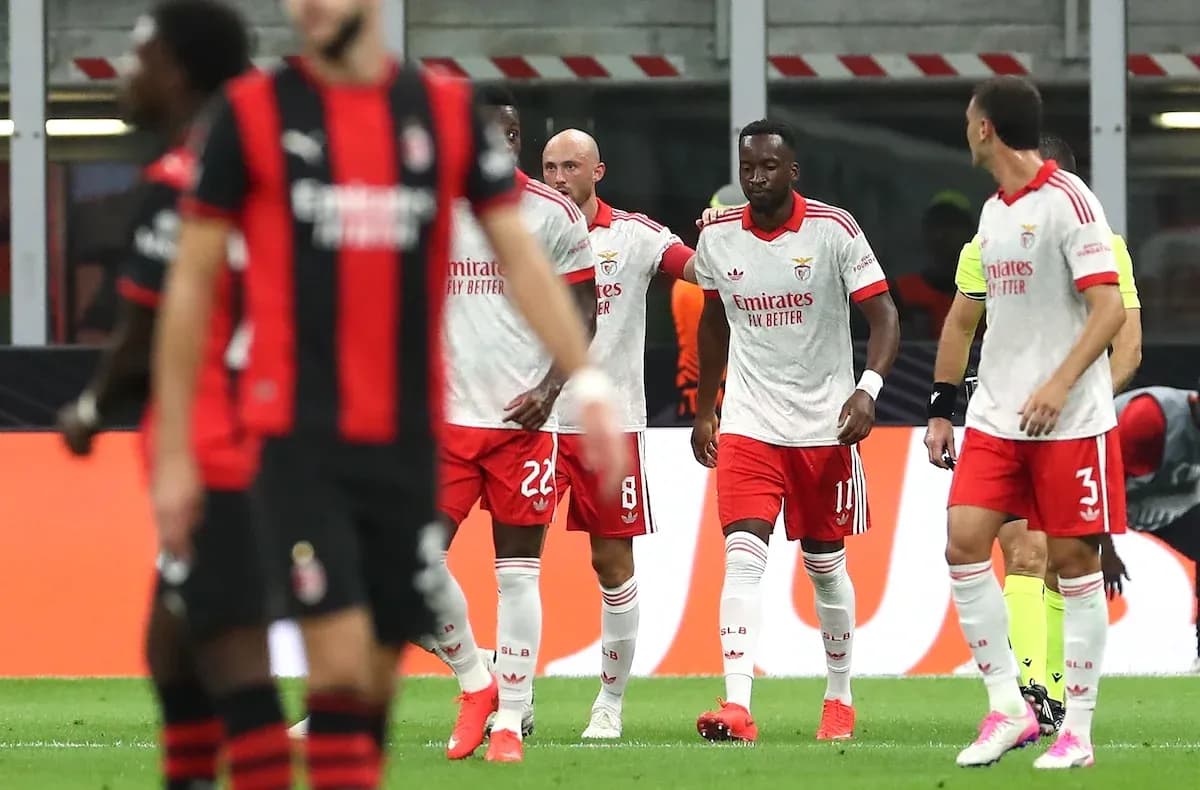
Benfica vs FC St. Gallen: UEFA Europa League Prediction
Benfica host FC St. Gallen in Lisbon in the second leg of the UEFA Europa League 2nd Qualifying Round, needing to overturn a 2-1 deficit from the first meeting at Kybunpark on 23 July 2026. The Swiss side took that game 2-1 at home, putting all the pressure on Benfica in front of their own fans.
Form-wise in this Europa League campaign, the data set is extremely small but clear. From the predictions block, Benfica’s tournament form is “L”, with 1 match played, 0 wins, 0 draws and 1 loss, scoring 1 and conceding 2. FC St. Gallen’s form is “W”, also with 1 match played, 1 win, 0 draws, 0 losses, 2 scored and 1 conceded. So in the direct Europa League sample, St. Gallen have been more efficient at both ends.
Looking at the recent performance metrics in the predictions data, Benfica’s last-five segment (here just 1 game) shows attack index 7 and defense index 86, with 1 goal scored and 2 conceded. That suggests a relatively weak attacking output so far in this tie but not a complete defensive collapse. St. Gallen’s last-five block shows a form index of 100, attack 14 and defense 93, with 2 goals scored and 1 conceded, reflecting that they edged the first leg and were slightly more productive in attack while maintaining a solid defensive rating.
From the league subsection of the predictions data, Benfica average 1.0 goal scored and 2.0 conceded per Europa League match so far, while St. Gallen average 2.0 scored and 1.0 conceded. Both sides scored in the first leg, and the goal timing data shows that all goals for both teams came in the 31–45 and 76–90 minute intervals, hinting at vulnerability and threat around the ends of each half rather than early blitzes.
Head-to-Head Data
Head-to-head data is minimal but important: there is one competitive meeting on record in this competition. On 23 July 2026 at Kybunpark in St. Gallen, the hosts FC St. Gallen beat Benfica 2-1 in regular time, with St. Gallen as home winners and Benfica as away losers. The comparison block in the predictions reflects this: h2h index 0 for Benfica and 100 for St. Gallen, underlining that the only direct reference point favours the Swiss club.
The model’s comparison indices lean toward St. Gallen overall: form 0 vs 100, attack 33 vs 67, defense 33 vs 67, goals 33 vs 67, and total 33.0 vs 67.0. These are not probabilities but relative strength indicators, and they consistently rate St. Gallen as the better-performing side across this very small Europa League sample.
However, the market picture is radically different. Pre-match odds across bookmakers are extremely short on the home win. Home prices range from 1.10 (SBO) to 1.14 (William Hill). That implies an approximate home-win probability band of about 87.7% to 90.9%. Draw odds range from 6.28 (SBO) to 9.00 (Bet365), implying roughly 11.1% to 15.9% chance of a stalemate. Away odds range from 10.12 (SBO) to 19.00 (Betfair), translating to around 5.3% to 9.9% implied probability for a St. Gallen win in 90 minutes. The market is heavily weighting Benfica’s home advantage, squad quality, and need to chase the tie, despite the first-leg loss.
The prediction engine, by contrast, assigns 0% to a Benfica win, 50% to a draw and 50% to an away win, and explicitly advises “Double chance : draw or FC ST. Gallen”, with the winner field pointing to FC St. Gallen with the comment “Win or draw”. This is a strong model-based stance that Benfica are more likely to fail to win than the betting market suggests.
Betting Verdict
Reconciling these, we have a classic clash between model and odds. The safest way to stay faithful to the official prediction data is to follow its advice: oppose the short-priced Benfica home win and back St. Gallen not to lose.
- Main pick: Double chance – Draw or FC St. Gallen. This aligns exactly with the model’s advice and its 50%/50% split between draw and away win, while taking advantage of the very short and potentially overvalued home price.
- Correct score lean: A tight game with Benfica pushing suggests something like 1-1 or 2-2 is consistent with both teams having scored in the first leg and the model’s strong expectation that Benfica do not win in 90 minutes.