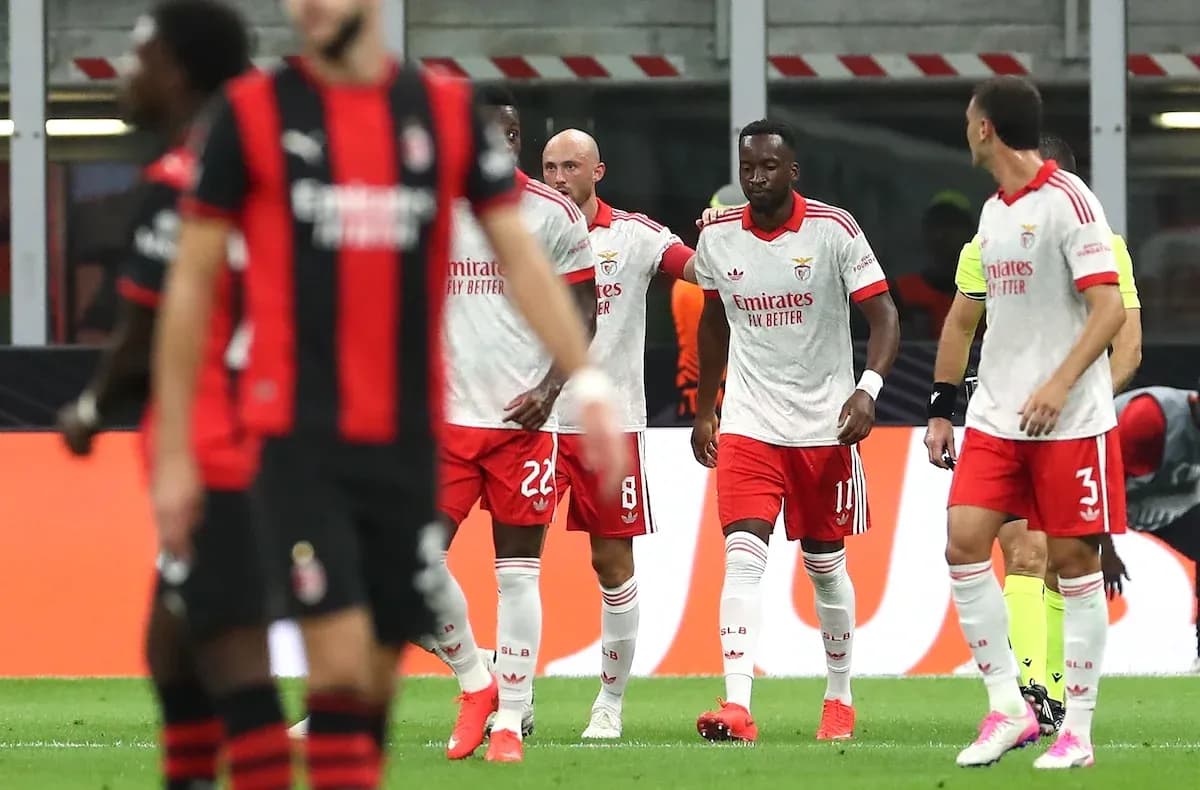
Benfica's Tactical Domination in 6-1 Victory Over Hearts
Benfica’s 6-1 win over Heart Of Midlothian at Estádio da Luz was a tactical domination rooted in structure, tempo control and intelligent occupation of space. With 67% possession and an 11–2 advantage in shots on goal, Marco Silva’s 4-2-3-1 systematically dismantled Wouter Vrancken’s 4-4-2, forcing Hearts into a reactive low block that never stabilized.
Out of possession, Benfica’s shape looked more like a 2-3-5 in sustained attacks. Full-backs Alexander Bah and S. Dahl pushed high and wide, pinning Hearts’ wide midfielders C. Miller and A. Kyziridis deep and stretching the second line. The double pivot of L. Barreiro and E. Barrenechea (before his substitution) provided the platform: one sitting to screen transitions, the other stepping into the right or left half-space to connect with the advanced line of G. Prestianni, G. Sudakov and Rafa Silva behind V. Pavlidis. This structure repeatedly created 4v3 and 5v4 overloads between the lines against Hearts’ central pairing of Laurent Mendy and Blair Spittal.
First Goal
The first goal on 3 minutes encapsulated Benfica’s plan. Early circulation from the back drew Hearts’ front two, C. Braga and P. Kabore, into a narrow press. Benfica then broke the first line and immediately attacked the half-space, with L. Barreiro stepping up to link play and feed Rafa Silva, who exploited the gap between full-back and centre-back. The speed of vertical progression, combined with precise positional staggering, meant Hearts’ back four were constantly defending while retreating, rarely able to hold a line and compress space.
Hearts’ Struggles
Hearts’ 4-4-2 struggled structurally. The wide midfielders were caught in a dilemma: step out to Benfica’s full-backs and leave the half-spaces open, or tuck in and allow free progression on the flanks. The 67% possession figure for Benfica reflects not just technical superiority but a territorial lock; Hearts’ 33% share was spent mostly in their own half, with only sporadic forays forward. Their 2 shots on goal and 3 blocked shots underline how infrequently they reached threatening zones with stability.
Set-pieces and dead-ball situations further highlighted the imbalance. Benfica’s 6 corner kicks to Hearts’ 2 showed how often the hosts pinned Hearts back and forced last-ditch interventions. The first-half penalty converted by Pavlidis at 42 minutes came from sustained pressure, with Hearts unable to clear their lines or reset their defensive block. Once Benfica went 3-0 up before half-time, the tie’s tactical dynamic was fixed: Hearts had to open up, which only widened the spaces Benfica were already exploiting.
Second Half Adjustments
After the break, Vrancken attempted to adjust with a double substitution at 46 minutes, introducing J. McCart and T. Renaud for H. Milne and Laurent Mendy. The idea was to refresh the left side and add more physical presence and legs in midfield. However, the structural issues remained. Hearts’ back line still sat deep, the distances between midfield and attack were too large, and their pressing triggers were inconsistent. Even as they committed more players forward in moments, Benfica continued to find clean exits and attack the vacated spaces.
Benfica’s attacking midfielders were central to maintaining control. G. Sudakov’s positioning between the lines constantly forced Hearts’ centre-backs to step out or leave him free to turn. Prestianni, despite picking up a yellow card, was aggressive in his movements, frequently driving inside from the right and occupying the right half-space as Bah overlapped. On the left, Rafa Silva balanced between coming inside to overload central zones and stretching the line, making it difficult for Hearts to maintain compactness horizontally.
Second-Half Goals
The second-half goals reinforced this pattern. Prestianni’s strike at 59 minutes came from Benfica again accessing the central lane after drawing Hearts wide, while J. Duran’s 87th-minute goal, assisted by A. Schjelderup, arrived with fresh legs attacking a disorganized back line late on. Even Hearts’ consolation goal from T. Renaud at 72 minutes was more a product of a rare, direct vertical sequence than any sustained territorial control; it did not meaningfully alter the game’s tactical narrative.
Discipline-wise, both sides committed 12 fouls, but Benfica managed those duels more intelligently within their structure. Their 2 yellow cards, to Prestianni and Bah, were isolated incidents within a controlled press. Hearts, by contrast, collected 4 yellows as they increasingly resorted to late challenges and emergency defending under constant pressure. The card profile mirrors the game state: Benfica dictating terms, Hearts reacting and often arriving second to the ball.
Without detailed passing data, the possession and shot profile still tells a clear story. Benfica’s 11 shots on goal from a total volume backed by 5 blocked efforts indicates repeated entries into high-value zones and a high tempo around the box. Hearts’ 2 shots on goal, despite 5 off target and 3 blocked, show that when they did progress, Benfica’s block was compact enough to contest shooting lanes and force low-probability attempts.
In sum, this was a textbook example of a dominant 4-2-3-1 against a stretched 4-4-2. Benfica controlled central corridors through their double pivot and No.10, stretched Hearts laterally with aggressive full-backs and wide playmakers, and turned that territorial and structural superiority into a 6-1 scoreline. Hearts’ adjustments, including the early second-half changes, never solved the core issues of spacing and pressing coordination, leaving them chasing shadows at Estádio da Luz.