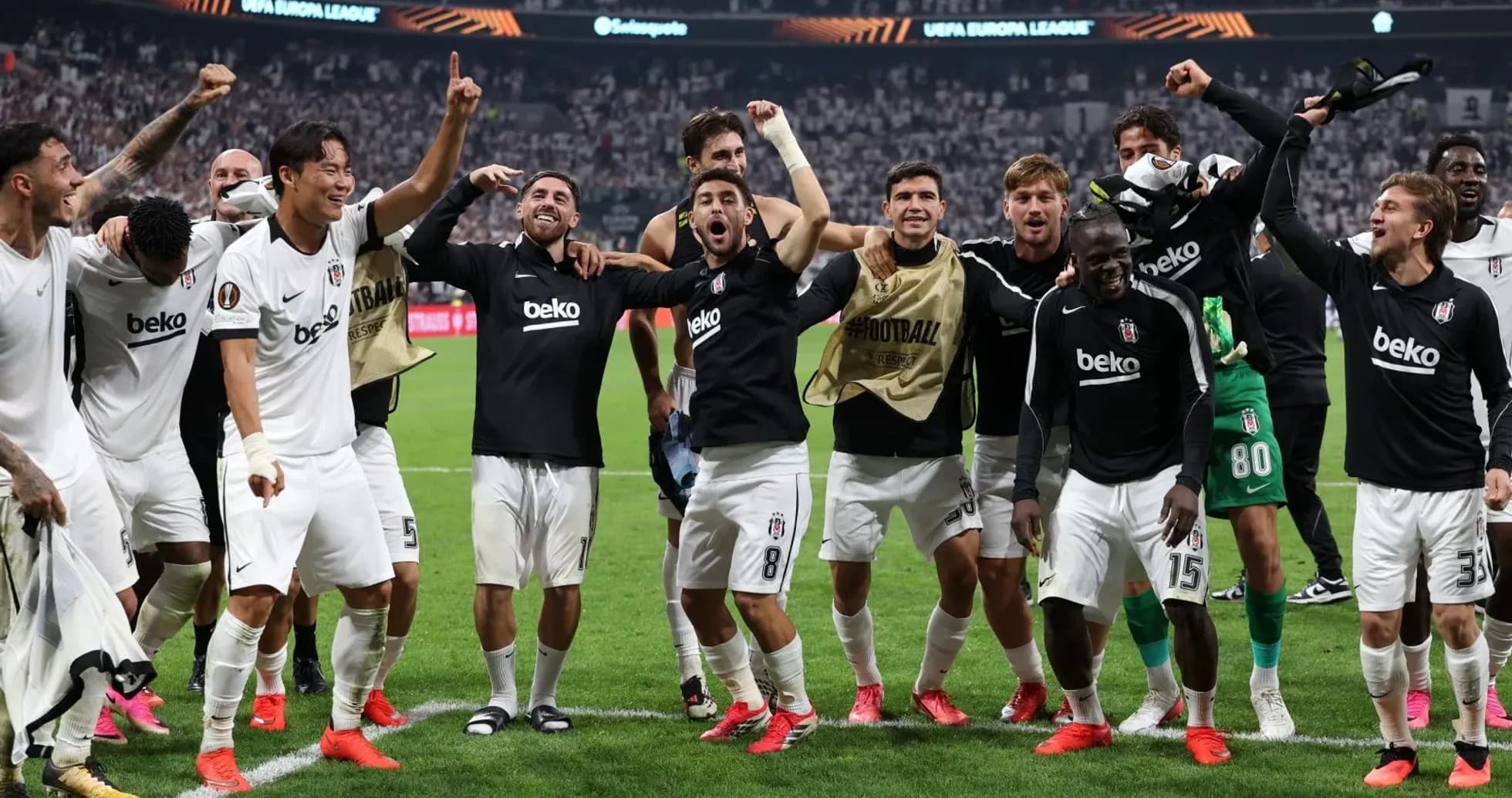
Beşiktaş Dominates Kauno Žalgiris in 3-0 Victory
Beşiktaş’s 3–0 win at Tüpraş Stadyumu was the product of a clear structural superiority in and out of possession, underpinned by a dominant 4-1-4-1 that pinned Kauno Žalgiris’ 4-2-3-1 deep for almost the entire match. The territorial and statistical imbalance was stark: 77% possession, 15 corners to 2, 6 shots on goal to 0, and just 3 fouls committed against 16 from the visitors. This was a textbook example of a high-possession side using width, full-back aggression and a single pivot to suffocate an opponent who never managed to convert their defensive block into a counter-attacking threat.
In build-up, Beşiktaş used S. Ozcan as the lone pivot in front of a back four of R. Yilmaz, T. Djalo, M. Murillo and E. Topcu. With Kauno Žalgiris defending in a 4-4-1-1 shape out of their nominal 4-2-3-1, Ozcan often dropped between the centre-backs, allowing both full-backs to push high and create a five-man line across midfield. This gave natural width for V. Cerny and L. Trossard on the flanks, with O. Kokcu and J. Olaitan (before his substitution) occupying the half-spaces behind lone striker Oh Hyeon-Gyu.
Goals
The first two goals encapsulated this structure. On 6 minutes, Beşiktaş progressed down the left, with R. Yilmaz stepping high from full-back to deliver for Oh Hyeon-Gyu, who finished to make it 1–0. Six minutes later, the same pattern of pressure from wide areas yielded a second: again R. Yilmaz supplied from advanced territory, and this time centre-back M. Murillo attacked the delivery to score for 2–0. That a defender was the second scorer underlines how far Beşiktaş’s back line was allowed to advance, with Kauno Žalgiris unable to get out of their third.
Kauno Žalgiris’ 4-2-3-1 never stabilized into a genuine double pivot in possession. V. Slivka and A. Kalik were forced so deep by the Beşiktaş press and the volume of crosses and set pieces (15 corners conceded) that they acted more as auxiliary centre-backs than launchpads for transitions. The front four of L. Krekovic, F. Baldassarra, A. Benchaib and G. Debeljuh were isolated; the away side finished with 0 shots on goal and only 2 shots off goal, highlighting their inability to progress beyond the first line of pressure.
Second Half
The second half began with both coaches adjusting personnel but not fundamentally altering the tactical picture. For Beşiktaş, V. Cerny (OUT) made way for I. Fakili (IN) at 46', a like-for-like switch that kept the wide occupation intact. Kauno Žalgiris responded with J. Moutachy (OUT) replaced by L. Kastrati (IN) and G. Debeljuh (OUT) replaced by M. Burba (IN), also at 46', attempting to refresh their right side and central presence. However, with Beşiktaş still monopolizing the ball, these changes did little to alter the flow.
The decisive third goal, from the penalty spot on 59 minutes, came after sustained pressure rather than a transition. O. Kokcu stepped up to convert, pushing the score to 3–0 and effectively ending the contest. The penalty underlined Beşiktaş’s ability to create repeated box entries; while exact “shots inside the box” data is not provided, the combination of 6 shots on goal, 8 off goal and 7 blocked shots against a side that committed 16 fouls tells the story of a penalty-area siege.
Substitutions from 60' onward were about game management and rotation rather than tactical emergency. At 60', J. Olaitan (OUT) was replaced by A. Hadziahmetovic (IN), adding fresh legs in central midfield, and Oh Hyeon-Gyu (OUT) gave way to D. Vlahovic (IN) to maintain a fixed reference point up front. For Kauno Žalgiris, A. Kalik (OUT) was replaced by Renan Oliveira (IN) on 62', and L. Krekovic (OUT) by F. Ourega (IN) on 63', attempts to inject creativity and running behind. Later, at 79', A. Benchaib (OUT) was replaced by I. Fiolic (IN), another attacking reshuffle that still failed to yield a single shot on goal.
Discipline further illustrated the game’s pattern. Kauno Žalgiris collected 4 yellow cards to Beşiktaş’s 1, consistent with a side under constant defensive strain. Cards for Franco Baldassarra (67'), Renan Oliveira (68'), Anton Tolordava (72') and Ivan Fiolić (82') came as they tried, mostly unsuccessfully, to disrupt Beşiktaş’s rhythm. Beşiktaş’s lone booking went to M. Murillo (77'), a rare moment of defensive intervention in a match where the hosts were rarely stretched.
From a defensive standpoint, Beşiktaş’s control meant their back line and goalkeeper were largely untroubled; Kauno Žalgiris managed no shots on goal and only 2 off target, and there are no recorded goalkeeper saves for either side in the statistics. The home side’s defensive index in this match is therefore more about counter-pressing and rest defence structure than last-ditch actions. With Ozcan screening in front and Djalo–Murillo holding an aggressive line, Kauno Žalgiris were consistently forced to play long and imprecise, surrendering the ball back quickly.
Statistically, the match reads like a classic Europa League home leg where the higher-quality side asserts dominance early and then manages energy. Beşiktaş’s 77% possession and 15 corners show sustained territorial control, while 6 shots on goal, 8 off goal and 7 blocked shots reflect both volume and variety in their attacking play. Kauno Žalgiris, by contrast, ended with 23% possession, 2 shots off goal, 1 blocked shot and 2 corners, never building enough pressure to threaten a comeback.
In synthesis, Beşiktaş’s 4-1-4-1 functioned as a fluid 2-3-5 in possession, with full-backs and advanced midfielders overwhelming Kauno Žalgiris’ midfield screen. The visitors’ 4-2-3-1 collapsed into a low block without transition threat, leading to a one-sided tactical contest that the 3–0 scoreline and all key metrics fully support.