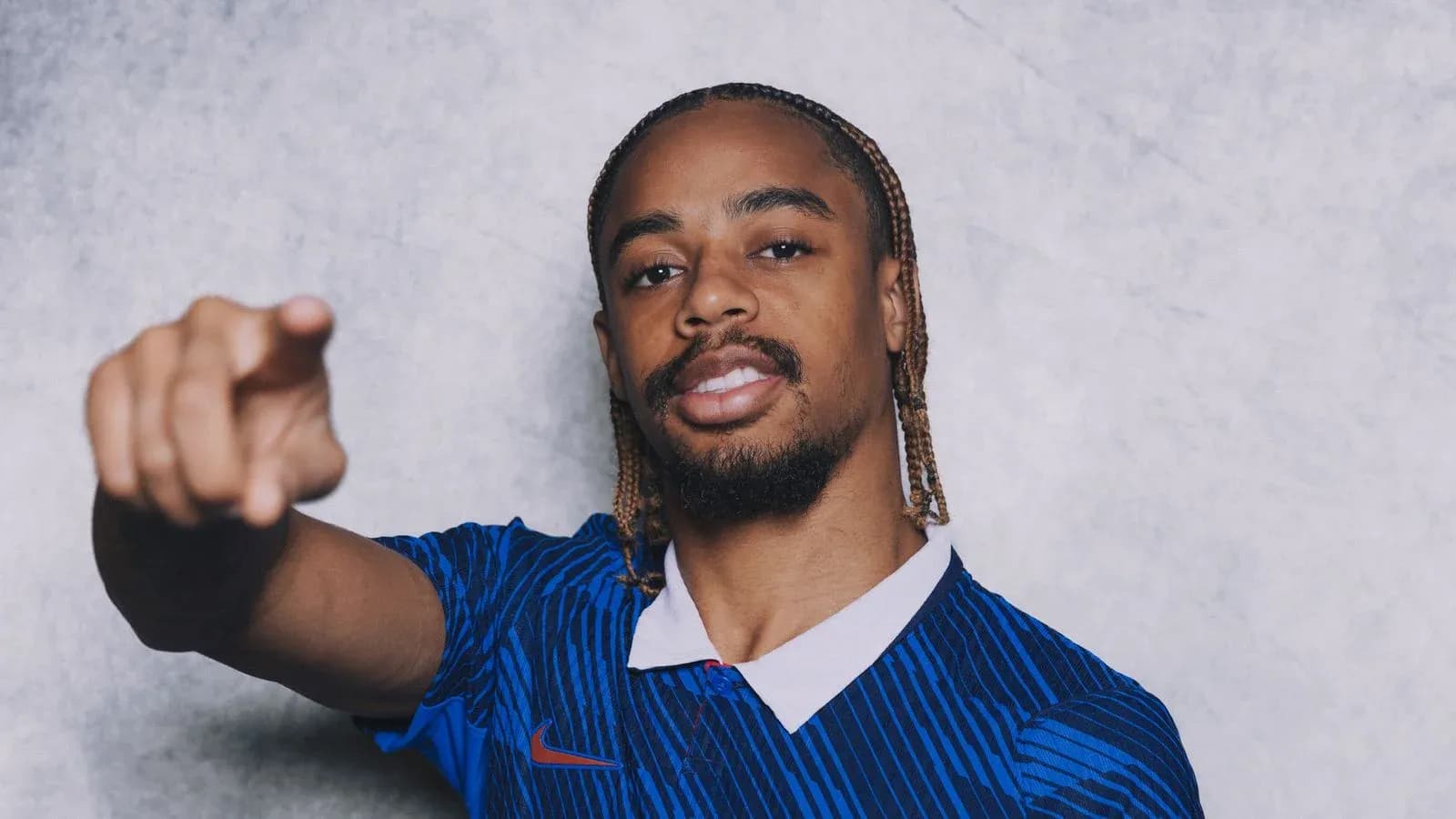
Bradley Barcola: The Rising Star of Football
Bradley Barcola is about to find out what a price tag really feels like.
Liverpool want him. Arsenal want him. Paris Saint-Germain already have him and would rather not let him go. If the numbers spiral the way many expect, the 23-year-old could become the most expensive transfer of the summer.
For a player who has just won back-to-back Champions League titles, that might sound logical. For a player who has started neither final, it sounds like a gamble.
The truth lies somewhere in between – and it is where the biggest clubs like to shop.
From fringe to frontline
Barcola’s story does not read like that of a predestined superstar. No age-group fast-tracking. No age-cheating rumours. No viral clips of him destroying kids two years older.
At Lyon, he was just another promising attacker on the fringes of Laurent Blanc’s first team, waiting, watching, almost drifting. Then one decision changed his career.
Karl Toko Ekambi wanted out.
"A club in Switzerland was interested because he was not playing for the first team," recalled Jean-Francois Vulliez, then in Lyon’s set-up. Blanc had Toko Ekambi, Barcola was the understudy, and a loan seemed likely. Then the situation flipped.
Toko Ekambi pushed to leave. Blanc, suddenly aware he might need cover, blocked Barcola’s loan. One game later, an injury hit. The door opened.
Barcola walked through it and never really looked back.
In early 2023, he scored five goals in nine games. The numbers were one thing. The way he did it – direct, fearless, decisive – was another. His performances at that summer’s European Under-21 Championship pushed him onto a bigger radar.
His body was still in Lyon. His head, as Vulliez put it, was already in Paris.
The late bloomer who learned to think first
Vulliez knows Barcola as well as anyone in football. He coached him in Lyon’s academy. He then followed him to PSG, where he now works as a development coach with the French and European champions.
He has seen the conveyor belt of talent up close. Kylian Mbappé types who seem fully formed at 17. Others who burn bright early and fade. Barcola did not fit either category.
"He was a normal kid," Vulliez said. No skipping age groups, no being thrown in with older boys. No France youth caps. Just steady, quiet progression.
The reason was simple: he was not physically ready. The speed was there, but the frame was not. He could not dominate defenders with his body, so he had to find another way.
He started to dominate them with his mind.
"He developed his intelligence," Vulliez explained. Barcola learned to scan the pitch, to take in information quickly, to use space rather than force. His game became a series of clever calculations: when to drift inside, when to stay wide, when to burst beyond.
That foundation matters. Vulliez is blunt about it: "I do not think you can transform a player after the age of 17 because if the player does not have the intelligence at that age then they will never have it."
Barcola had it. The muscles caught up later.
As his body filled out, his game exploded. The pace stayed, the power arrived, and the tactical brain that had been sharpened as a lightweight teenager suddenly had a new weapon to work with. That blend – tactical, technical, physical – is what the market is now pricing.
Reinvented in Paris
Since his move to PSG, the honours list has grown at a dizzying rate: 13 trophies, over 150 appearances, 39 goals. On paper, that looks like a player already at the summit.
Yet he is still fighting for his starting place.
The arrival of Khvicha Kvaratskhelia from Napoli in January 2025 shifted the hierarchy. The Georgian established himself as first choice on the left, and Barcola, despite his contributions, found himself coming off the bench in both Champions League finals.
That detail will not scare Liverpool or Arsenal. If anything, it tempts them. Here is a Champions League winner, already shaped by the demands of a superclub, who still feels there is another level to reach.
Under Luis Enrique, Barcola’s game has been refined. He takes better care of the ball now. The wildness that can define young wingers has been trimmed without losing the edge. He knows when to run at a defender and when to recycle possession. When to gamble and when to wait.
He has been used mainly as a left-sided forward, but the instincts are those of a striker. That is no accident. At Lyon, he played through the middle until the age of 17. From the flank, he loves to cut inside and whip shots towards the far corner with his stronger foot.
These are not just stylistic flourishes. Elite clubs crave wide players who bring end product, not just step-overs. Barcola offers both goals and creativity. He ranks among the top 10 in Ligue 1 for shot volume per 90 minutes, despite often starting wide. The position does not limit him; it gives him more angles.
"He is very clever with his runs inside," Vulliez noted. The timing is everything. He knows when to drop between the lines, when to dart beyond the last defender, when to arrive late from deep. Coaches can build patterns around that.
And crucially, he listens. "We never had a problem with him at the academy because he is intelligent and listens," Vulliez said. For a manager, that is gold: a player who can adapt to any strategy, any tweak, and absorb information quickly.
A winger now, a No 9 later?
For all the hype, Barcola is not the finished article. His finishing still frustrates at times. The composure deserts him, the shot snatches wide, the chance goes.
Luis Enrique has pushed him hard on that front, demanding more ruthlessness. Vulliez is relaxed about the process. Many top forwards, he points out, sharpened their finishing later in their careers once the rest of their game settled.
Barcola has time. He also has options.
Right now, the left wing looks like his best position. The angles suit him, the space to attack is there, the cut-inside-and-shoot pattern feels natural. But Vulliez is openly curious about what comes next.
"I am curious to see how he develops because I believe he is able to become a No 9," he said.
That is where the intrigue deepens for potential buyers. You are not just signing a left winger. You are buying a forward who can operate on the right, who has the pace to hit the byline, who ranked among the top 10 fastest players in the Champions League last season, and who might yet evolve into a central striker.
He can play knock-and-run, stretch defences, or come short and link. You can shift him across the front line without losing his threat. For a coach, that flexibility is priceless. For a recruitment department, it is a headache – in a good way. How do you value a player who might be two different kinds of star in three years’ time?
The player nobody saw coming
Inside Lyon’s academy, Barcola was respected, but he was not the one everyone pointed at and said: future superstar. He was not Mbappé. He was not the poster boy.
"Nobody could have imagined this," Vulliez admitted of the player now linked with a record-breaking move.
That is what makes him such a fascinating proposition. He is already better than the skinny teenager Lyon nurtured. Better than the exciting prospect PSG took a chance on. Better than the squad player who first slipped into Blanc’s plans because someone else wanted out.
And yet, the sense is that the real Bradley Barcola is still forming.
He has tasted the biggest nights in club football, felt the weight of expectation in Paris, and learned under a demanding coach who has stripped some of the excess from his game. He has the pace, the power, the intelligence, the adaptability.
Now comes the next question, the one Liverpool, Arsenal and anyone else circling must answer with a cheque: just how much better can he still become?