Brazil and Morocco Clash Under World Cup Pressure
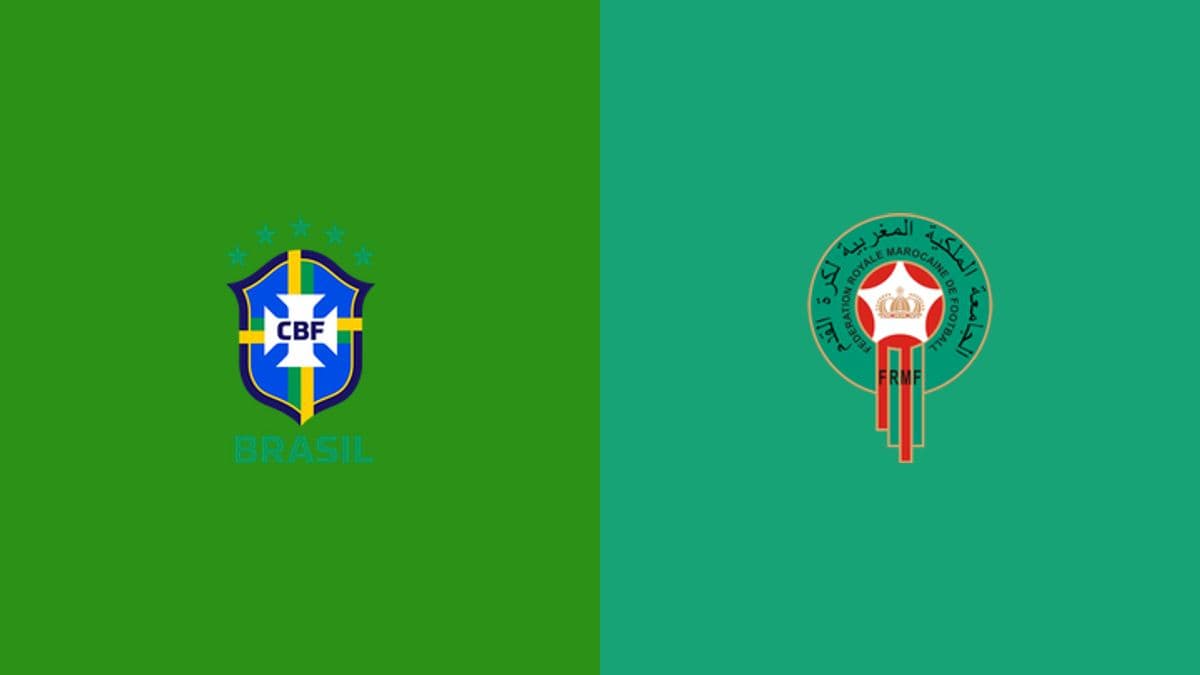
The World Cup rarely waits to apply pressure. In East Rutherford on 13 June 2026, it drops like a weight on both Brazil and Morocco the moment the ball moves at New York New Jersey Stadium.
Group C is unforgiving. Scotland lurks with pedigree, Haiti with raw energy, and there is no room for a false start. This opener is not a gentle introduction; it is a stress test. One of the tournament’s glamour sides against the continent’s new standard-bearer. Five-time champions against the team that tore up Africa and shook the world four years ago.
Brazil’s turbulent road to redemption
Brazil arrive in North America with their aura slightly dented and their standards questioned. Their CONMEBOL qualifying campaign was messy, at times chaotic. Early stumbles turned into a genuine crisis, the nadir coming with a bruising 4-1 defeat to Argentina that rattled the federation and the fanbase alike.
The response was seismic. Carlo Ancelotti, the most decorated club coach of his generation, was handed the keys to the Seleção. An outsider in every sense: Italian, steeped in European club culture, and now entrusted with a national religion.
He inherited a side sitting fourth with 21 points, fragile but not broken. Under him, Brazil steadied. The football became more structured, the panic subsided, the results just about good enough. They closed out the final qualification windows of 2025 with the kind of ruthless pragmatism that Ancelotti has built a career on, grinding their way to a fifth-place finish and automatic passage.
The record remains: Brazil have never missed a World Cup. This time, though, they arrive not as untouchable royalty, but as a wounded giant with something to prove under foreign leadership.
Ancelotti’s Brazil is not a possession-obsessed machine. His 4-2-3-1 is built to spring forward, to turn recovery into threat in seconds. He wants his midfielders looking vertically, not sideways, and his forwards living in the spaces behind defensive lines. It is a system that can devastate in transition, but it leaves a question hanging over East Rutherford: can his double pivot protect a back line exposed by adventurous full-backs when the pace of the game spikes?
Neymar managed, Vinicius unleashed
Selection-wise, Brazil’s squad reads like a roll call of European royalty. Alisson and Ederson guard the posts. Marquinhos, now captain and Champions League finalist, anchors the defence alongside Arsenal’s Gabriel Magalhães. Around them, the depth is elite, from Alex Sandro and Danilo to Bremer and Douglas Santos.
The biggest storyline, though, is Neymar Jr. His return to the World Cup stage after a two-and-a-half-year absence should be a festival. Instead, it is wrapped in medical reports. A minor muscle edema picked up with Santos has Brazil’s medical staff working on an individual programme, with Ancelotti determined to keep him in the group but ready to shield him in the early stages.
With Neymar potentially eased in, the attacking burden shifts decisively to Vinicius Junior and Raphinha. Vinicius arrives as a Real Madrid superstar on the cusp of Ballon d’Or conversations, a winger who no longer just entertains but decides major finals. Raphinha, in sparkling Barcelona form, has drawn glowing praise from Ancelotti, who views him as the best in the world at attacking deep space.
That hint is tactical as much as complimentary. Expect Raphinha to drift into advanced, flexible midfield zones, operating close to Morocco’s defensive line, hunting those vertical channels that Ancelotti’s system is designed to exploit. Around them, Brazil can rotate through Endrick, Gabriel Martinelli, Matheus Cunha, Igor Thiago, Luiz Henrique, Rayan and more. This is not a squad short on firepower.
Morocco’s march and a bold new era
If Brazil stumbled their way to North America, Morocco stormed through the door. Their CAF qualification campaign was a statement, not a negotiation. Eight wins from eight in Group E. No blemishes, no drama, just relentless control.
They rode the momentum of that extraordinary fourth-place finish at Qatar 2022 and turned it into something even more imposing: continental dominance. Walid Regragui built a side that could suffer without the ball, defend with a low block, and then cut teams apart on the break. In African qualifying, that identity hardened into superiority.
Then came the twist. In March 2026, Regragui stepped down, choosing to move aside to let the squad evolve. It could have thrown Morocco off course. Instead, it opened the door for Mohamed Ouahbi, the coach who had just guided the U-20 side to a global title in 2025.
Ouahbi arrives with a different energy. Belgium-born, 49, and unafraid to tinker, he respects the defensive steel that made Morocco famous in 2022 but wants more with the ball. His blueprint leans towards an energetic, possession-based style, built on overloading the flanks and attacking quickly once the second ball is won.
He prefers a three-man midfield that can press aggressively and then combine at speed with full-backs and inverted wingers. The low block is no longer the only plan; Morocco now have a vertical, expansive edge.
The warm-up signs are encouraging. A 2-1 win over Kosovo came with no major injuries, leaving Ouahbi free to pick from a fully fit, battle-tested squad.
Hakimi’s stage, Ouahbi’s kids
Some pillars remain unshakable. Achraf Hakimi is still the structural reference point. For Paris Saint-Germain, he is a world-class right-back. For Morocco, he is a system in himself. He locks down his flank defensively and then turns into a wide playmaker, driving attacks, stretching teams, and setting the rhythm of their transitions.
Around him, Morocco blend experience with fresh blood. Nayef Aguerd and Chadi Riad bring presence at the back. Sofyan Amrabat, Azzedine Ounahi, Bilal El Khannouss and Ismael Saibari give Ouahbi options in that all-important midfield trio, each capable of pressing, carrying, or threading passes through the lines. Up front, Abde Ezzalzouli, Soufiane Rahimi, Ayoub El Kaabi, Brahim Díaz and others offer different profiles: dribblers, runners, finishers.
The intriguing subplot is Ouahbi’s faith in youth. Two of his U-20 world champions, Othmane Maamma and Yassir Zabiri, have made the step up. They are unlikely to start, but as impact substitutes they could inject chaos into tired legs, especially in a game that may open up in the final half-hour.
Yassine Bounou, Munir El Kajoui and Ahmed Reda Tagnaouti cover the goalkeeping spots. Noussair Mazraoui, Anass Salah-Eddine, Youssef Belammari, Zakaria El Ouahdi, Redouane Halhal and Issa Diop add depth at the back. Samir El Mourabet, Ayyoub Bouaddi and Neil El Aynaoui flesh out the midfield options. Chemsdine Talbi, Gessime Yassine and Ayoube Amaimouni complete a forward line that offers variety rather than a single focal point.
This is not a plucky underdog. This is Africa’s most formidable qualifier, arriving early, confident, and unafraid of reputations.
The duels that could tilt Group C
Strip away the narratives and the tactics, and this match may hinge on three individual battles.
Down one flank, Vinicius Junior versus Achraf Hakimi is pure box office. Vinicius wants isolation, the chance to square up a defender and go. Hakimi is one of the very few full-backs with the speed, strength and positional sense to live with him stride for stride. If Vinicius starts winning those duels, Morocco’s shape will buckle and Brazil’s attack will flood into the gaps. If Hakimi holds his ground and counters with his own surges, Brazil’s defensive line could find itself dragged into uncomfortable, unfamiliar spaces.
In the middle, Raphinha against Morocco’s central block is a test of discipline. With Ancelotti asking him to operate close to the defensive line, always on the move, always sniffing for that vertical pass, the responsibility falls heavily on Sofyan Amrabat and his partners. They must deny the half-turn, close the passing lanes, and prevent Raphinha from receiving cleanly between the lines. One lapse, one missed step, and Brazil’s runners from deep – full-backs, midfielders, wide forwards – will be streaming through.
Then there is the penalty area. Gabriel Magalhães versus Youssef En-Nesyri promises a bruising, old-school duel. En-Nesyri thrives on crosses and chaos, attacking the ball with ferocity and never allowing centre-backs a moment’s rest. Gabriel’s task is simple in theory, brutal in practice: dominate his zone, win the aerial battles, and clear his lines under pressure from set pieces and wide deliveries. If he falters, Morocco’s efficiency from dead balls could punish Brazil in the most basic, unforgiving way.
A pressure cooker in East Rutherford
By the time the teams walk out at 22:00 GMT, 18:00 EST, the noise inside New York New Jersey Stadium will feel like a verdict waiting to be delivered. Brazil, with their flawless World Cup attendance record and a foreign coach for the first time in decades, are chasing validation as much as victory. Morocco, carrying the weight of a continent and the confidence of a perfect qualifying run, are out to prove that Qatar 2022 was not a one-off miracle but the start of a sustained era.
One side seeks redemption, the other confirmation. Both know that in a group with Scotland and Haiti, the loser here may spend the rest of the first phase playing catch-up under suffocating pressure.
The stage is built, the tactical questions are sharp, and the margins are thin. When Vinicius meets Hakimi on that flank and En-Nesyri crashes into Gabriel in the box, we will find out quickly: is this Brazil’s rebirth under Ancelotti, or the night Morocco announce they are no longer outsiders, but contenders?