Canada's World Cup Knockout Match Against South Africa
Canada’s World Cup road is no longer theoretical. It’s here, it’s knockout football, and it starts with South Africa on Sunday.
For the first time, Canada walks into a World Cup elimination match with history already in its pocket: first point, first win, first trip out of the group. Now comes the question that will define this campaign.
Can they win when there is no safety net?
A favourable draw – on paper
On the surface, the matchup looks kind.
Canada arrived at this tournament ranked No. 31 in the world, a full 29 places above South Africa at No. 60. ESPN’s pre-tournament model saw a similar gap, slotting Canada 25th out of 48 teams and South Africa down at 46th.
The numbers say Canada should advance. The tournament has already warned them not to trust that.
South Africa have come through a chaotic Group A with scars and belief. They opened with a 2-0 loss to Mexico, finishing with nine men after two red cards and looking like a side destined for an early flight home. Their response has dragged them here.
Against Czechia, hope was slipping away until Teboho Mokoena buried a late penalty to salvage a point and keep the door open. Then came the upset: a 1-0 win over South Korea, sealed by Thapelo Maseko, achieved with just 31 per cent possession but a ruthless edge when it mattered.
Canada have seen enough in this tournament to know what that profile looks like. Dangerous. Opportunistic. Exactly the kind of opponent that punishes any drop in intensity.
Canada arrive with a point to prove
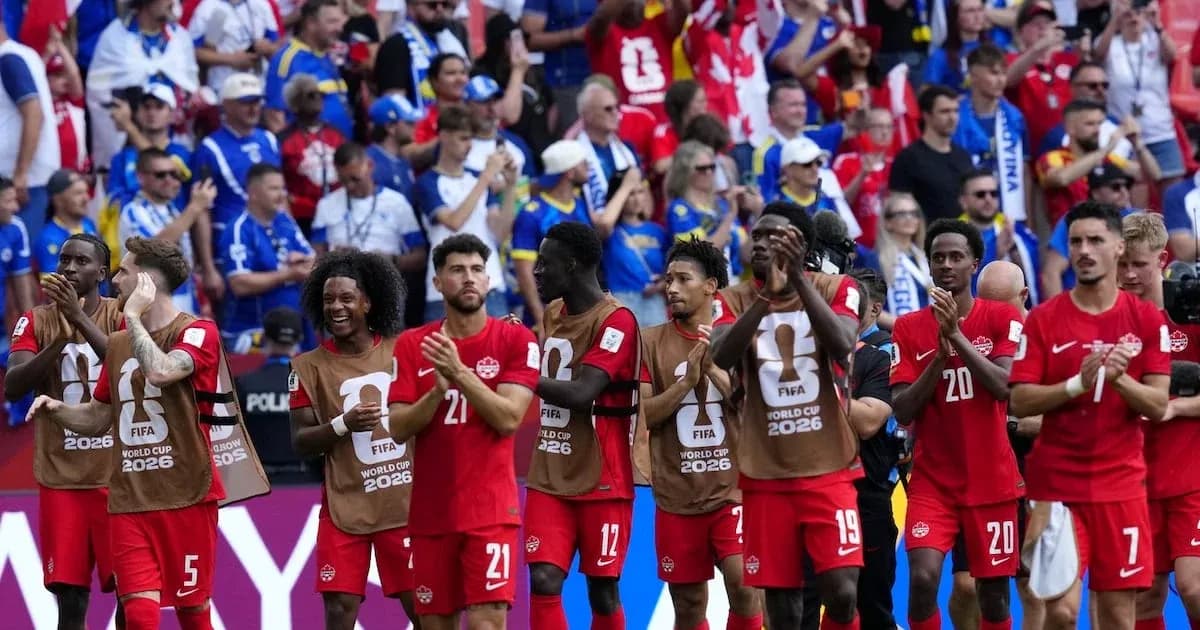
Jesse Marsch’s team have taken the scenic route to the Round of 32.
A 1-1 draw with Bosnia and Herzegovina to open. A ruthless 6-0 dismantling of a nine-man Qatar side. Then the setback – and the warning – in a 2-1 defeat to Switzerland on Wednesday.
That Swiss match could easily have rewritten this entire bracket. Canada trailed 2-0 early in the second half, roared back, and spent stoppage time hurling everything they had at an equalizer that would have given them top spot in Group B and a different path entirely.
Jonathan David called those dying minutes “kind of intense.” It was more than that. It was a team discovering what it looks like to chase a game with something real on the line.
“You try not to look at the clock, because the more you look at it, the quicker time goes,” David said. “But it’s garbage time. You have to just have to crash the box and get the crosses and make sure you make your chances happen, and put shots on target, and hopefully something falls. And we came really, really close.”
They didn’t get their reward. They did get a lesson in urgency they will need on Sunday.
The Alphonso Davies question
Hanging over all of it is the biggest variable in Canadian football: Alphonso Davies.
The captain has yet to play a minute at this World Cup because of a hamstring injury, and Marsch has turned his absence into a psychological game.
On Wednesday, the head coach admitted what many suspected: Davies was never going to feature in the group stage. He was a decoy.
“Alphonso wasn’t ready yet, but I wanted Switzerland to think about him and if you heard their press conference yesterday, they spoke about him a lot,” Marsch said. “He was never ready to play today, but I used him as a decoy.
“He will be ready for the next match, though. We didn’t want to be in a situation where he could be in danger, but he will be ready for the next match.”
Is that straight truth or another layer of gamesmanship? Canada shut down formal injury updates before the Qatar game, and little has emerged since. Opponents now have to prepare for both realities: a Davies-led Canada that can flip the tempo in an instant, or a version that has learned to live without him and spread the responsibility.
Canada also have other pieces edging back toward full involvement. Stephen Eustáquio came off the bench in the 58th minute against Switzerland and will be pushing to reclaim his starting spot in midfield. Moise Bombito could be in line for his first start of the tournament at centreback if he’s deemed ready.
If Davies does return, it’s not just a tactical boost. It’s a jolt of belief for a squad already riding the confidence of a historic group stage.
What waits beyond South Africa
Canada and South Africa kick off the Round of 32 on Sunday, with the winner earning six days to reset before a Round of 16 clash on Saturday, July 4.
The reward is brutal.
Waiting will be the survivor of a heavyweight tie between Group F winners the Netherlands and Group C runners-up Morocco. Both arrive unbeaten at 2-0-1. Both started this World Cup inside FIFA’s top 10: Morocco at No. 7, the Dutch at No. 8.
Morocco’s pedigree is fresh in everyone’s mind. Semifinalists at Qatar 2022, they have carried that form into this tournament with a 1-1 draw against Brazil, followed by a 1-0 win over Scotland and a 4-2 victory over Haiti.
The Netherlands, perennial contenders and perennial heart-breakers, have been free-scoring in Group F. A 2-2 draw with Japan, a 5-1 demolition of Sweden, a 3-1 win over Tunisia. They have not lost a World Cup match in regulation time since the 2010 final against Spain.
Whoever emerges from Canada–South Africa will not be eased into the deeper waters of this bracket. They’ll be thrown straight into the current.
And it doesn’t stop there. The top quarter of the draw is a gauntlet. Germany, already confirmed as Group E winners, are on one side. France, expected to clinch Group I with a result against Norway on Friday, are on the other. The two European giants are on a collision course for the Round of 16, a meeting between the world’s No. 3 and No. 10-ranked sides that would spit out an even more formidable quarter-final opponent.
That’s the path. Canada know it. They can see Germany and France, the Netherlands and Morocco, all lurking in the distance.
They also know none of it matters if they stumble at the first knockout hurdle.
One step into the unknown
This World Cup has already changed the way Canadian football sees itself. A first point. A first win. A first escape from the group.
Now comes the hardest part: proving that all of that was a beginning, not a peak.
Marsch didn’t flinch after the loss to Switzerland.
“We’re going to focus on the response,” he said. “We’re exactly where we want to be.”
On Sunday, against a scarred and stubborn South Africa, we find out if that belief travels into knockout football.