Chelsea vs Manchester United: Tactical Analysis of the Stamford Bridge Clash
Stamford Bridge under the lights, Michael Oliver in charge, and a meeting of two projects at very different stages of their evolution. Following this result, Chelsea remain a paradox: a side with top‑four attacking numbers but Europa League reality, beaten 1-0 at home by a Manchester United team that increasingly looks built for the grind of the run‑in.
I. The Big Picture – Styles Colliding at the Bridge
Heading into this game, the table framed the narrative. Chelsea, 6th in the Premier League with 48 points and a goal difference of +11 (53 scored, 42 conceded), had been living on the edge all season. Overall they scored 1.6 goals per game, but at Stamford Bridge that dipped to 1.4, with 23 home goals from 17 matches. Defensively at home they allowed 1.2 goals per game (21 conceded), underlining a team that rarely controls both boxes for 90 minutes.
Manchester United arrived in London 3rd, on 58 points with a goal difference of +13 (58 for, 45 against). Their attacking profile is slightly more consistent: overall 1.8 goals per game, with 1.9 at Old Trafford and 1.6 on their travels. Away from home they had 27 goals in 17 matches and conceded 26, numbers that suggest a side comfortable in open, transitional contests rather than sterile domination.
Both managers leaned into their most familiar shape. Liam Rosenior stuck with Chelsea’s season-defining 4-2-3-1, a system they had used 29 times in the league, while Michael Carrick mirrored it with his own 4-2-3-1, a departure from United’s more common 3-4-2-1 but one clearly tailored to the absences at centre-back.
II. Tactical Voids – Absences That Bent the Game
The team sheets told a story of compromise, especially in defence. Chelsea were without L. Colwill (knee), J. Gittens (muscle), R. James (hamstring), Joao Pedro (muscle), F. Jorgensen (groin) and the suspended M. Mudryk. The absence of Joao Pedro in particular stripped Rosenior of his most reliable cutting edge: 14 league goals and 5 assists overall, with 46 shots and 27 on target. Chelsea’s attack lost its reference point between the lines and in the box.
Instead, L. Delap led the line, with P. Neto, C. Palmer and Estêvão behind him. The double pivot of M. Caicedo and E. Fernández offered technical security and bite, but the front four lacked the penalty‑box instincts and off‑ball gravity Joao Pedro usually provides.
United’s defensive crisis was even more severe. P. Dorgu (hamstring), H. Maguire (suspended), L. Martinez (red card ban), L. Yoro (injury) and M. de Ligt (back injury) all missed out, forcing Carrick into an improvised back four of D. Dalot, N. Mazraoui, A. Heaven and L. Shaw ahead of S. Lammens. On paper, a soft centre. In practice, United’s structure in front of them – Casemiro and K. Mainoo screening – kept the makeshift pairing largely protected.
Discipline was always going to be a live subplot. Heading into this game, Chelsea’s yellow-card distribution showed a pronounced late‑game surge: 20.99% of their bookings came between 61-75 minutes and another 20.99% between 76-90, with 16.05% from 91-105. Red cards were spread dangerously across the match, peaking at 61-75 minutes with 28.57%. That pattern reflects a side that often chases games, stretching its structure and emotional control.
United, by contrast, saw 20.37% of their yellows between 76-90 minutes and 18.52% between 46-60, with their reds concentrated in the 46-60 window (66.67%) and a late‑game spike at 76-90 (33.33%). Both teams, in other words, tend to fray as fatigue and pressure build – a risk in a tight fixture like this.
III. Key Matchups – Hunter vs Shield, Engine Room vs Enforcer
With Joao Pedro absent, Chelsea’s “hunter” role shifted by committee. C. Palmer, starting as the central playmaker, became the de facto attacking focal point, drifting to combine with Estêvão and Neto. Yet the numbers underpinning Chelsea’s season hinted at the structural problem: at home they averaged 1.4 goals, and they had failed to score in 4 home matches overall. This became the fifth.
United’s defensive “shield” was less about individuals and more about layers. Casemiro, one of the league’s leading card collectors with 9 yellows and 1 yellow-red, again walked the tightrope between control and chaos. His season profile – 74 tackles, 24 successful blocks and 26 interceptions overall – explains why Carrick trusts him to anchor an exposed back line. In this match, his positional discipline limited the spaces Palmer and Fernández could exploit between the lines.
The true “hunter” for United was split between B. Mbeumo and B. Šeško. Mbeumo, with 9 league goals and 3 assists, operated from the right half-space, targeting M. Cucurella and the channel outside J. Hato. Šeško, also on 9 goals, offered the vertical threat that pinned W. Fofana and Hato deep. That combination allowed United to transition quickly once they broke Chelsea’s first press.
In the engine room, the duel between Caicedo/Fernández and Casemiro/Mainoo set the tone. Caicedo’s season numbers – 79 tackles, 14 successful blocks, 53 interceptions and 91% pass accuracy overall – mark him as Chelsea’s primary enforcer. Yet without Joao Pedro’s vertical runs and Mudryk’s raw width, his ball recoveries too often fed into sterile possession rather than penetration. Fernández, with 8 goals, 3 assists and 57 key passes overall, tried to accelerate play, but United’s compact 4-4-2 out of possession channelled him into crowded central zones.
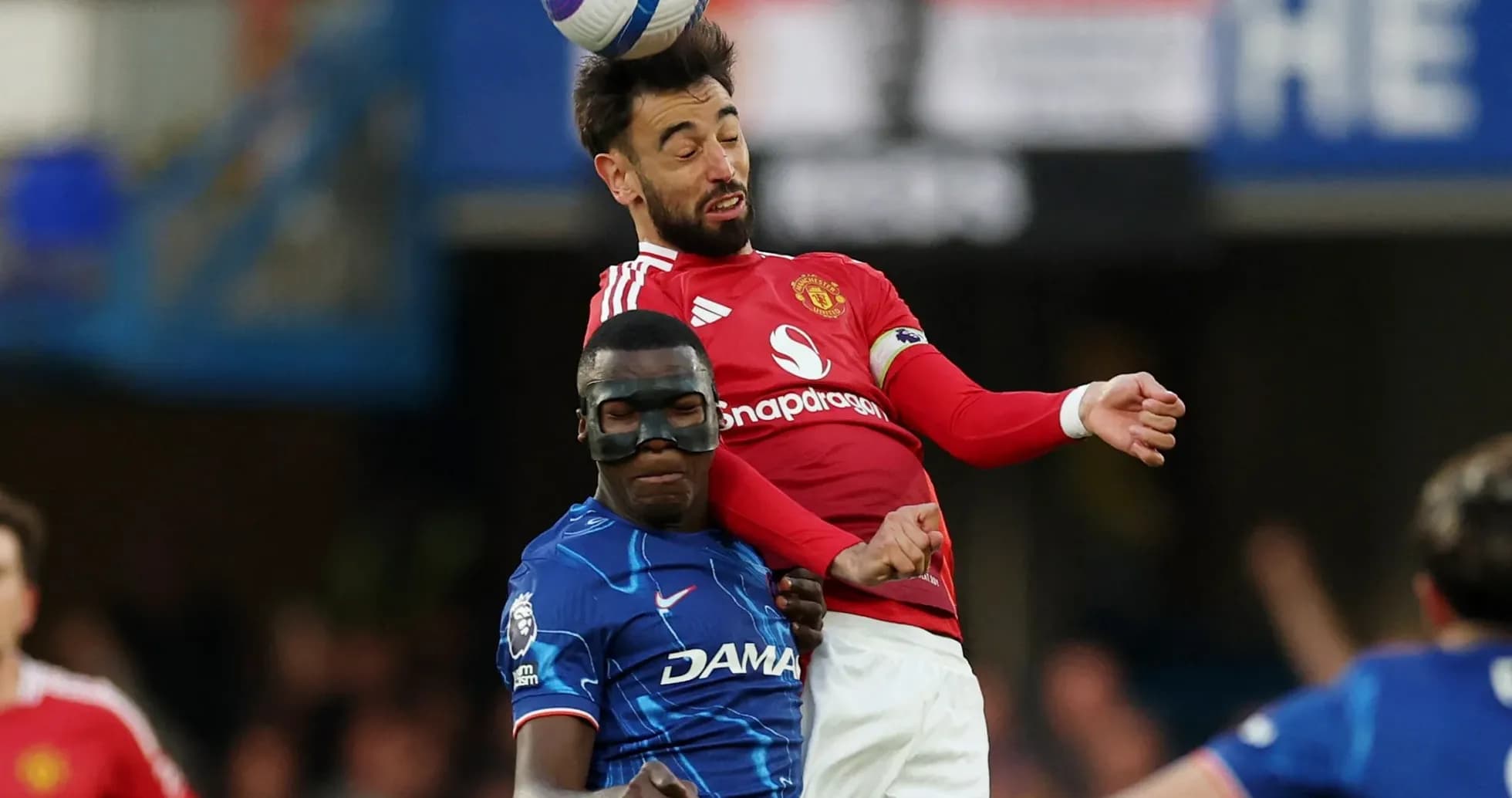
Further up, Bruno Fernandes dictated the game’s tempo with the authority of a league-leading creator. With 18 assists and 109 key passes overall, plus 8 goals, he is United’s offensive metronome and their most dangerous late‑runner into the box. Chelsea never fully solved his positioning between Caicedo and the centre-backs, and that subtle superiority in the half-spaces underpinned United’s decisive moments.
IV. Statistical Prognosis – Why United’s Structure Prevailed
Following this result, the numbers still paint Chelsea as an attacking side undermined by detail. Overall they score 1.6 and concede 1.3 per game; United sit at 1.8 for and 1.4 against. The goal differences – +11 for Chelsea, +13 for United – are close, but the context is not. United have 16 wins from 33 matches, Chelsea 13; United’s 10 draws suggest a team that can shut games down, while Chelsea’s 11 defeats reveal fragility when margins are thin.
Both sides are flawless from the spot this season – Chelsea have scored all 7 penalties overall, United all 4 – so the difference here was not set‑piece ruthlessness but open‑play clarity. United’s away record of 27 goals scored and 26 conceded on their travels shows a team comfortable trading chances; at Stamford Bridge, they needed only one clean strike and the defensive discipline to protect it.
In tactical terms, Carrick’s 4-2-3-1 proved more stable than Rosenior’s version. United compressed central spaces, trusted Mbeumo and Cunha to spring transitions, and leaned on Bruno Fernandes’ intelligence between the lines. Chelsea, without Joao Pedro and Mudryk, lacked a true penalty‑area predator and a consistent outlet to stretch the game wide.
The statistical prognosis from this snapshot is stark. Chelsea’s underlying attacking volume will continue to generate chances, but without their primary finisher and with a tendency to collect cards late – 20.99% of yellows in both the 61-75 and 76-90 windows – they are likely to keep dropping tight, nervy matches like this. United, with a clearer spine and an elite creator in Bruno, look better equipped to turn even injury‑hit nights into controlled, efficient wins on their travels.