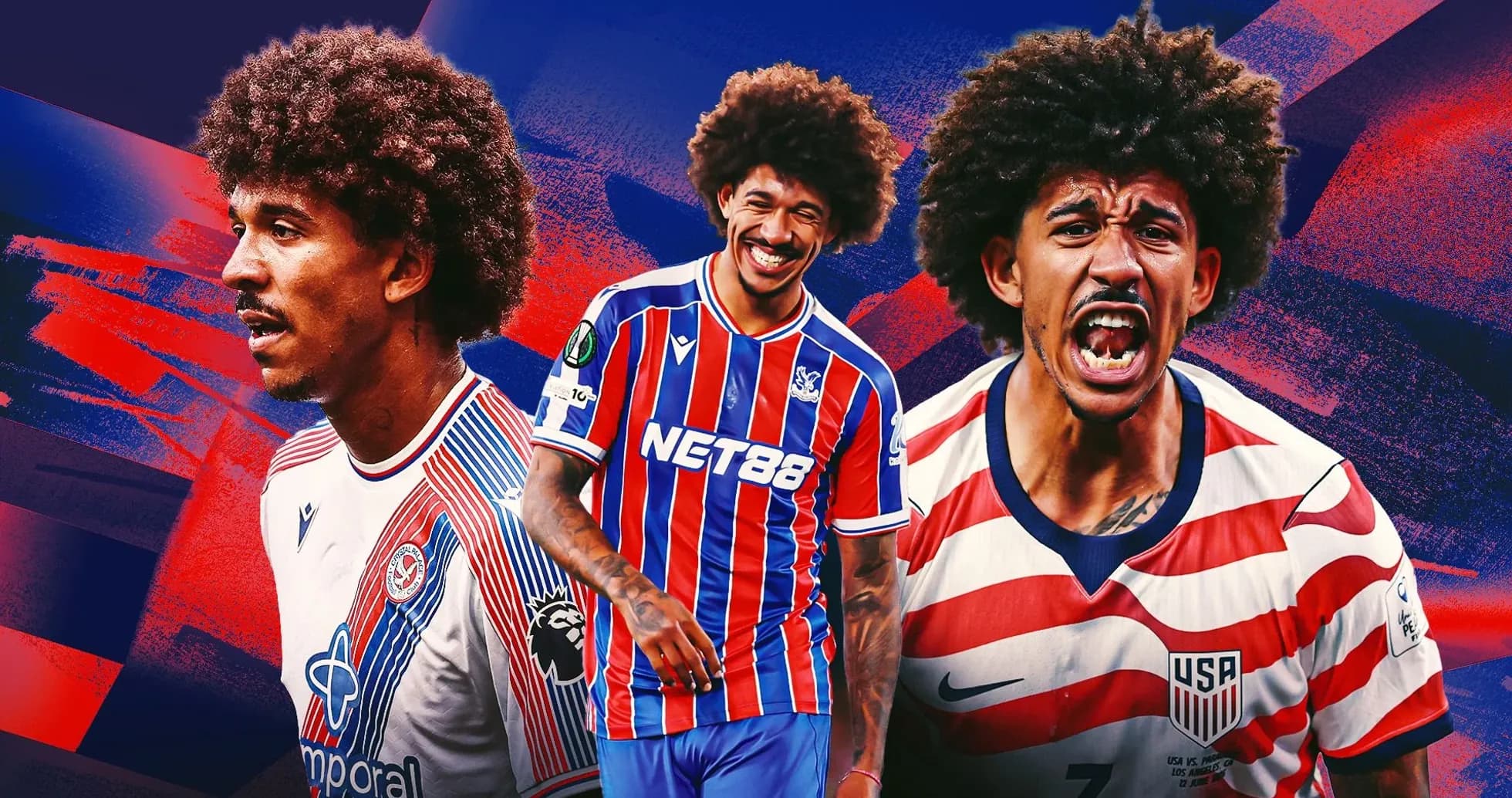
Chris Richards Reflects on World Cup Journey and Leadership at Palace
Chris Richards can still hear the drumroll.
The World Cup brought the noise, the flyovers, the anthems, the tackles that rattle your bones. But when he talks about it now, his mind jumps to a quieter corner of the tournament: a group of grown men standing outside, acting like kids as Christian Pulisic handed out watches.
“Christian got us all watches, and we did it outside,” Richards remembers. “We did a little drum roll, and everyone went up there and did something stupid before receiving it. Everyone remembers that moment because it was just everyone being a kid again and just enjoying each other.”
The tension before that first game was real. The nerves were there. That goofy little ceremony cut through it. It felt like a freeze-frame in a month that moved at sprint speed.
Around the camp, Richards found his people. Timothy Weah. Mark McKenzie. Late nights with trash TV like Pop the Balloon or Find Love, marshmallows over fire pits, music drifting through the air outside their rooms. No tactics boards. No video sessions. Just friends.
Those small, ordinary scenes are the ones that stayed with him.
“The main thing is we built that brotherhood, and it could never be taken away from us,” he says.
A World Cup that nearly slipped away
That brotherhood nearly formed without him.
Richards had already missed the 2022 World Cup. This time, an ankle injury in the build-up threatened to steal another one. For a few weeks, the question hung in the air: would he make it?
“I’ll say yes and no,” he admits now, smiling. He’d been here before. He knew the rehab grind, the line between pain and damage, the reality that a “pretty good painkiller” might be the price of a dream.
“For me, I mean, it didn't matter what it was gonna take. I was gonna play in this World Cup, especially after missing the last one. There was no way I was missing this tournament.”
In the end, he didn’t need the heavy meds. He did need a reset.
The scare forced him to confront the parts of his professional life that weren’t up to scratch.
“I've self-proclaimed it, but I think when I first joined Palace, I wasn't necessarily doing the most professional stuff when it came to recovery, nutrition and things like that,” he says. “Sometimes injuries are inevitable, but I’ve tried to incorporate things off the field that would help me on the field.”
He started tracking more. Thinking more. Growing up.
“I've actually been wearing the Stelo glucose biosensor, and it's been really good for, of course, stuff on the field, but I think the biggest difference I see is off the field because they go hand in hand… I think grew up a little bit. That metabolism starts slowing down a little bit, I'm not the same kid as I was!”
So when the USMNT’s summer ended with defeat to Belgium, he didn’t stretch out the holiday. No long tour of home comforts. No drifting.
“Going home, eating American food,” he says with a laugh, “it can do something to you.”
He went back to London quickly, back into a Crystal Palace side already in preseason, back into a dressing room full of players who knew exactly what he’d just lived through. Palace sent 13 players to this World Cup. Only five clubs on the planet had more.
The welcome felt different. Not overblown, but sharpened.
“I've felt, well, I think I’ve felt, a newfound kind of trust from the team,” he says. “I had a good World Cup, but I think everybody was watching everybody at the World Cup. You're watching your teammates play, and you come back, and everybody kind of has this newfound respect for the person next to you who did well, or performed at all at the World Cup.”
From prospect to pillar
Palace, though, is not the same club Richards joined.
Key players have gone. The spine that helped end a 119-year wait for major silverware by winning the FA Cup in 2025, then backed it up with a UEFA Conference League title, has been stripped back.
Marc Guéhi left in the winter. Maxence Lacroix followed this summer. Two-thirds of the central defensive core that anchored those historic runs have moved on.
Richards is the one still standing.
“Understanding that we've lost a few guys and potentially gaining some new guys, it's been good to step into that leadership role that I think I've done with the national team,” he says. “It's prepared me for this role with Palace. I think it's just about being more vocal…Guys are looking at me for guidance, not just in what I say, but also in what I do.”
He doesn’t pretend it’s easy.
“For me, I would say it's been a challenge, but not a challenge that I shy away from. I think it's just a new challenge and something that I really, in my career, really want to continue to learn from and grow from.”
The expectations around him have grown with the club’s own ambition. Palace are no longer satisfied with survival and the odd cup run. Two trophies in two years have rewired the place.
“Maybe four years ago when I first came into the club, these weren't goals that we thought were realistic or they weren't even things that we put on our board,” he says. “Now, we've won silverware two years in a row, and we have the taste of it now. We want to keep going, and so, for me, it's been really exciting.
“When you hear about new players signing here or just talking about the culture of the club, now they refer to us as a team that wins trophies…This is something that two years ago, three years ago, four years ago, wasn't necessarily on our radar and now that we've done it, we want to continue this and leave the club better than we joined.”
Richards is central to that plan. And he knows it.
A new cycle, a new kid, a new perspective
The World Cup used to be the end point in his mind. For most of his life, especially these last four years, everything funneled into that single target.
Now that box is checked, the horizon has shifted.
At Palace, the aim is clear: become a constant in a team that keeps changing. Be the leader who can drag a reshaped squad back to Wembley, back to Europe, back to nights that feel bigger than the club’s old reputation.
“I want to continue to be a leader here at Palace,” he says, “and hopefully be a big part of another season that brings this club a trophy.”
With the USMNT, the picture is different but just as demanding. Richards is 26, with 40 caps and a World Cup behind him. He is no longer the kid chasing his first call-up. He’s one of the names at the top of the depth chart, a genuine candidate to wear the armband through the 2030 cycle.
“When it comes to the national team, I would love to captain my country through the cycle and going to another big tournament in four years would be amazing.”
What’s kept the idea of another long, grinding cycle fresh is a teenager who just walked through the door at Palace.
Zavier Gozo arrived from Real Salt Lake this summer, another American in south London, another young talent trying to climb the same mountain Richards has already scaled. Richards didn’t know what to expect. Shared nationality doesn’t guarantee chemistry. It does come with responsibility.
“I think whenever a young kid comes into a team like this, you are a bit hesitant, especially when they're from your own country,” he says. “There's always like, ‘Oh, you have to take care of him’, but one thing that's been really amazing seeing him is that he doesn't fear anybody.
“I think a lot of the time, young kids play young. He actually plays very mature, and I think that's helped him.”
Gozo is chasing his first USMNT cap after a breakout in MLS that came just too late for the World Cup squad. The hunger is obvious. Richards recognises it instantly.
“You can see how he's looking at the national team as this ultimate goal,” he says. “For me to have the perspective of somebody who's looking to make his first cap, that's what's made it refreshing for me. It’s understanding that it is now ultimately going to be a new cycle. You have World Cup qualifiers, you have things like that that we didn't have to deal with last cycle.”
The kid’s ambition feeds the veteran’s. The roles have flipped, and Richards is embracing it.
The view from home
Away from Selhurst Park and national-team camps, life has its own kind of intensity.
Richards has a young daughter now. The goals there don’t come with a four-year cycle. They don’t end.
“I think personally, just continuing to watch my daughter grow,” he says. “I think that's been one of the best things in life: seeing a person that's half you and half your partner growing and becoming their own person. It's been amazing seeing her gain these little phrases, little haptics.”
They live in an apartment with a sweeping view of the London skyline. For his daughter, though, the landmark isn’t the Shard or the London Eye. It’s the planes.
“Every time an airplane flies by, she freaks out,” Richards says, laughing. “She'll stare out the window for 20-30 minutes, and she won't bat an eye. Little things like that, after tough days of work, make it easy to come home to and just enjoy yourself.”
Legacy isn’t something he’s ready to dissect. Not yet. He knows his place in Palace history is already secure, but he doesn’t want to live in it. The work, as he sees it, is still very much in progress.
What he does know is this: he wants his daughter to be proud of what her dad did with a ball at his feet and a crest on his chest.
“For me, I want to do something that I'm proud of, that makes my family proud, that I can show my daughter one day like, ‘Your dad did this’,” he says.
And if, two decades from now, they walk back through the doors at Selhurst Park and find a mural on the wall?
“Ultimately, if we come back to Palace in 20 years, and there's a Chris Richards painting with an afro somewhere, I think that'd be a pretty cool thing.”
The drumroll has stopped. The World Cup watches are tucked away. The next test is here: can he turn that brotherhood, that growth, that new responsibility into another chapter of trophies and nights that demand their own painting?