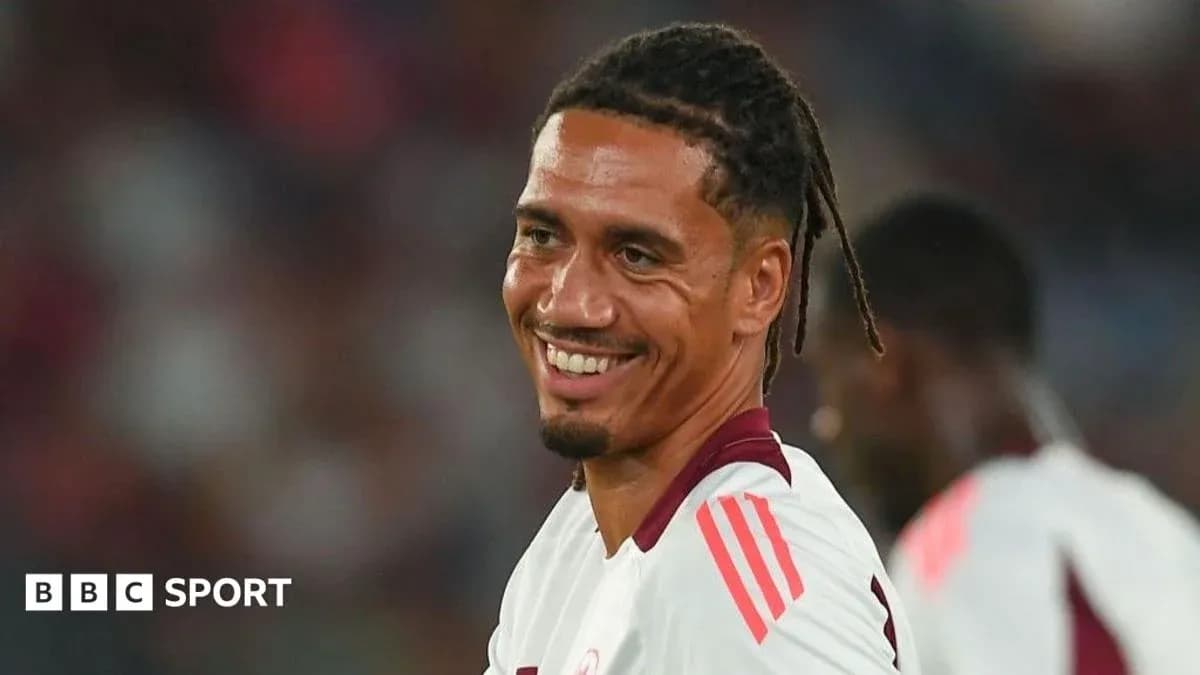
Chris Smalling: A Journey from Non-League to Elite Football
Chris Smalling pauses, smiles, and you can tell straight away: this is not a standard late-career footballer interview.
At 36, he has lived several football lives already. From non-league Maidstone to a Champions League final in three years. From Roy Hodgson’s Fulham to Sir Alex Ferguson’s Manchester United. From England caps to trophies in Manchester and Rome. From the Premier League to Al-Fayha in Saudi Arabia, where last season he played every single league game.
Now he is back in the north west of England with his family, quietly plotting the next move.
Still a player, not a nostalgia act
Smalling has ideas for life after football. He is already working on them. But he is not done yet.
“I know my body now better than when I was 26 and that's shown in the games I'm playing,” he says.
The way he talks about training sounds less like an ageing centre-back clinging on and more like a high-performance project manager.
“When you get beyond 30, each year is precious in terms of enjoying playing and being passionate about football.
“Actual training is a very short time. The longevity and recovery starts very early in terms of what I'm eating and doing between sessions, even down to my supplements now.”
He remembers Ferguson bringing in yoga for Ryan Giggs. That stuck. So did the idea that careers can be extended by detail, not just desire.
“In pre-season we have blood tests and the clubs make recommendations. I went one step further and kind of had genetics testing, which goes deep into everything. A lot of my supplements were changed because of that.”
The result? An ever-present season in the Saudi Pro League with Al-Fayha. At this stage of his career, he is proud of that as much as any medal.
From “plan D” to Sir Alex’s office
Wind back 18 years and none of this was mapped out. In fact, it barely existed as an idea.
“It wasn't even plan D,” he recalls.
“I was playing at Maidstone, but I was going to university to study financial economics.
“I had everything set out. I already had my A levels, and I was looking at other non-league clubs near Leicester because I still wanted to play.”
The professional dream was distant enough to feel hypothetical. Then, late in the summer, Fulham called.
“It was very late in the summer when the opportunity came around. I knew it was a slim chance even to be offered but I needed to do everything I could.”
Roy Hodgson watched one practice game. One. Then summoned him.
“It wasn't even a full week,” says Smalling. “I didn't have any time to get my head around it. I was just in total shock.”
That would become a theme with Hodgson: life-changing conversations delivered with little warning.
The hotel knock that changed everything
Fast forward to January 2010. Smalling is 20, part of the Fulham squad travelling to Blackburn. He does not play in the 2-0 defeat. The important moment arrives the night before.
“There had been a lot of talk about other clubs but not Manchester United,” he says.
“Roy pulled me off the coach, said Fulham had accepted a bid and Sir Alex was coming to the hotel in 45 minutes.”
Forty-five minutes’ notice to meet the most powerful man in English football. He called his mum. Then he sat alone, trying to script questions for a conversation that could change his life.
“Literally, we were there for about at least a couple of hours. He was so calming and reassuring.
“Even I was doubting it because they had all these great centre-backs. I wanted to develop and wondered 'how do I fit in?'.
“He told me I would get a chance and he believed in me.
“To be able to share the dressing room and the pitch and have conversations with him, is just incredible.”
The move went through. The university place stayed in the past.
Inside the minds of the great managers
Listen to Smalling and you quickly understand how highly he rates the human side of management.
To many on the outside, his relationship with Jose Mourinho is defined by a single public criticism in November 2016, when the Portuguese questioned his willingness to play through injury. Smalling sees a very different picture.
“For United or Roma, Jose picked me for most games because we had a good relationship and he trusted me.
“It's very easy to influence younger players but the beauty of Sir Alex and Jose is that they were able to create that belief in senior players.”
He leans into the idea. This is where he feels the separation lies between the good and the elite.
“A lot of managers can give good team talks but if you look at some eye-to-eye, see the passion and real belief that 'it's going to happen' senior players follow and the rest lock in. That's the beauty of top-class manager.”
That infamous toe injury? For him, it is a story of trust, not conflict.
“In that situation, I was having injections in broken toe because he had created that mentality in me that I could do anything, even if, maybe, I shouldn't. I had reached the limit of the amount [of injections] I could have, had to stop in a warm-up and he was disappointed.
“It gave me even more belief because it was easy to choose another centre-back but he wanted me.”
The respect remains. Smalling is still in touch with Mourinho and sent him a message of good luck when he took over at Real Madrid this summer.
Building the next chapter
Some former players are destined for the dugout. Smalling does not see himself there.
“I don't think it will be my route,” he says. “I'm quite comfortable with the next stage.”
That next stage is already taking shape. He is working on an education programme for young players, in partnership with the Global Institute of Sport.
“I'm working on an education programme for young players partnering with the Global Institute of Sport that's going to be coming out shortly. I've got three or four of these types of projects.
“Once my football career comes to an end, I can put more time to them but at the minute it's all focused on playing because I have that passion and drive and physically my stats are good.”
Whoever signs him now will not just be getting a centre-back. At Al-Fayha, he pushed standards off the pitch as well as on it, driving improvements to the gym to match what he believes an elite professional environment should look like.
He talks about that with the same pride he reserves for his performances. At each club, he wants to be remembered as someone who raised the level, not just filled a shirt.
No safety net, no regrets
All of this came from a single decision: to walk away from the “safe” option.
Turning down that university offer could easily have backfired. He knows it.
“It would have been the safer route,” he says.
“In that first year, I was not earning a lot of money. I was playing for the reserves and the 19th man for the first team, travelling around but not quite on the bench. There was no guarantee I was going to earn more money.”
The breakthrough did not arrive with a single contract, either. It came in stages, each new deal at Manchester United a reminder that he was progressing, but also a challenge to keep pushing.
“When I signed for United, it was a four-year contract. At the end of the first year, I signed a new one, another a year later and another 18 months after that.
“There was always this carrot. I never took anything for granted.”
Eighteen years on from Maidstone and that abandoned financial economics degree, Smalling is back where English football first made him, waiting for the next call, body fine-tuned, mind clear.
The safe route is long gone. The next risk, you sense, cannot come soon enough.