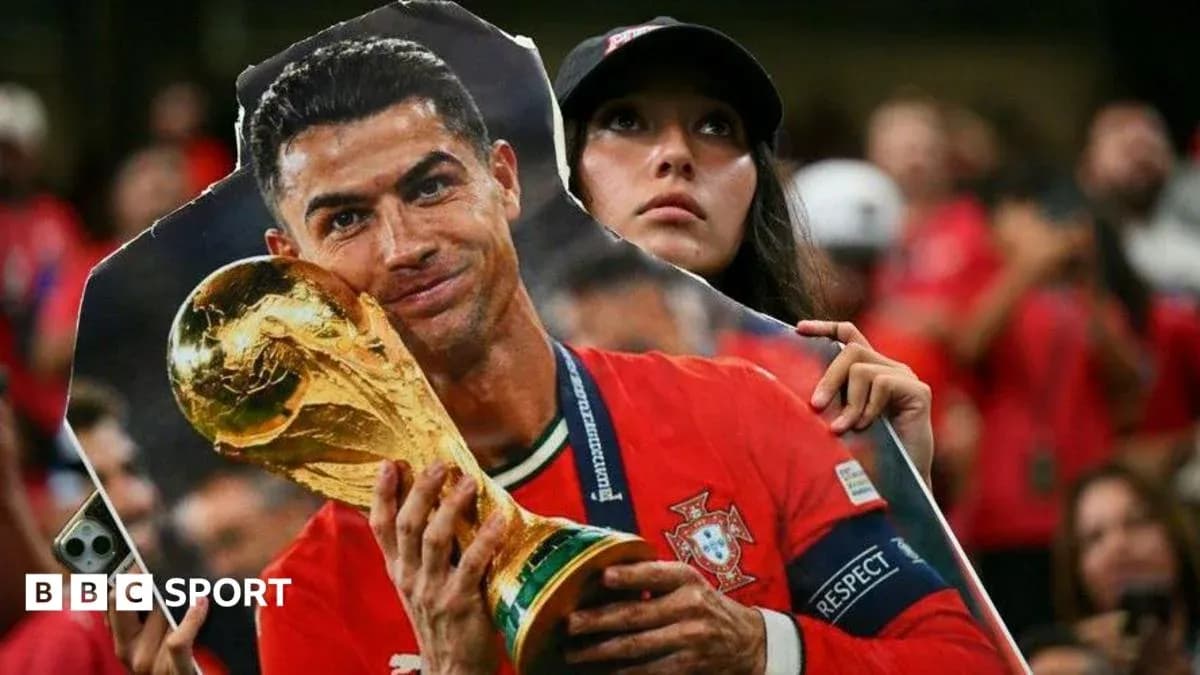
Cristiano Ronaldo Faces His Last World Cup Challenge
Cristiano Ronaldo sat down, looked the room in the eye and stripped away the myth.
"I am not the player I used to be."
No dodging, no softening the blow. On the eve of Portugal’s World Cup last‑16 tie with Spain in Texas, the 41-year-old captain walked straight into the debate that has followed him across the United States and Canada.
This is his last World Cup. He has confirmed it again. Seven months from turning 42, the end of an era is no longer a theory, it is a timetable.
And yet, he is still at the centre of everything.
‘You’ve been trying to kill me for 23 years’
Ronaldo’s tournament has split opinion. Three goals, yes. But long spells of anonymity, few touches, no chances created, and a Portugal side that has occasionally looked more fluid without him.
The questions came again on Sunday. His future. The criticism. His role.
"I'm not doing too bad," he shot back.
"You have been trying to kill me for the past 23 years, but you must have seen that is not worth it, it's a waste of time, but you try and try and try and try and try.
"As I said before, [I will stop] when I choose, not when you choose. You always ask the same question.
"This will be my last World Cup, but let's hope tomorrow isn't my last game."
He left the room to applause. Whatever the numbers say, the aura still fills the space.
Ronaldo knows what is being said. He leaned into it.
"I am not going to be more Cristiano Ronaldo or less because I win the World Cup," he added. "I even say thanks for the attacks I feel after I turned 40... the criticism is how you grow, so thank you for doing this.
"Whatever happens tomorrow, Cristiano Ronaldo will leave with a clear conscience -- not 100% but 1,000% because in life and football I gave everything."
A career on the clock
Ronaldo is the all‑time leading scorer in international football, with 146 goals. He has reshaped Portuguese football, its standards and its expectations, in a way no player before him managed.
For five World Cups, he has arrived as an untouchable. This time, he walks into a tactical argument.
Some want him to step back. Others want him to decide when the curtain falls.
"He doesn't play to win, he plays to be the main figure," said Antonio Simoes, part of the Portugal side that finished third at the 1966 World Cup. "Do you understand that it's the opposite of Eusebio? Let's call things by their name. I have nothing against him. I can still see, I can still hear and I can still think. But I can't run away from the reality of the facts."
The facts paint a complicated picture.
He has now scored at all six World Cups he has played in. The run started with a penalty against Iran in 2006, then a goal against North Korea in 2010. In 2014, his only strike came against Ghana. Russia 2018 brought the famous hat‑trick against Spain in Sochi and the winner against Morocco in Moscow. In Qatar in 2022, there was a penalty against Ghana.
This tournament, he has three more: two against Uzbekistan in Houston on 23 June and the nerveless penalty against Croatia in the last 32. Yet his overall impact is shrinking.
He has had 15 shots, almost twice as many as any of his team‑mates, but has not created a single chance. No other player at this World Cup has taken so many shots without fashioning an opportunity for someone else.
Touches? In three of Portugal’s four matches, he has had fewer than 25, including one appearance from the bench. Those are the lowest figures of his World Cup career, and he is averaging fewer touches per game than at any of his previous tournaments.
Against Croatia, in that wild, late win in Toronto, his only touch in the opposition box was the winning penalty.
His movement tells the same story. He is averaging 4.4 runs in behind per match, far below his output at the past two World Cups, even though he is still being used as the lone striker.
Yet the debate refuses to settle.
The Perisic scare and the Ramos question
For a few minutes against Croatia, it felt like football was about to deliver a brutal ending.
When Ivan Perisic struck in the 53rd minute, Ronaldo’s 232nd appearance for Portugal suddenly looked as if it might be his last. The stadium tightened. The cameras found him. The narrative wrote itself.
He grabbed it back.
From the penalty spot, he levelled – his first ever goal in the knockout stages of a World Cup. A small line in his colossal record, but a significant one. Then came Roberto Martinez’s decision.
The coach took him off.
Ronaldo’s face told its own story as he walked from the pitch, unhappy and unsmiling. The reaction outside Portugal was predictable: had the torch just been passed?
On came Goncalo Ramos, widely seen as his natural heir. In the chaos of the final minutes, Ramos sent Portugal through. One moment, one finish, and the selection debate exploded again.
Does Martinez keep faith with his captain against Spain? Or does he reward the young striker who changed the tie?
"His leadership and that work in the final third is still one of the best in the world," Martinez said when asked why Ronaldo continues to start.
The numbers under the Spaniard underline the trust. Since taking over in 2023, Martinez has picked Ronaldo in 36 of Portugal’s 44 games. When he has missed out, it has mostly been down to injury or suspension.
Yet Portugal’s two biggest wins in this cycle – a 9-0 thrashing of Luxembourg in Faro in September 2023 and a 9-1 demolition of Armenia in Porto last November – both came without him.
Every time that happens, the same conversation returns: are Portugal actually better, as a team, without their icon?
A country that still belongs to him
On the streets and in the stands, the answer sounds very different.
"I feel he should dictate whether he wants to stay on or not," said supporter Angelo before the Croatia match. "What he has done for Portugal as a nation, he should dictate that 100%."
That sentiment runs deep. Ronaldo is not just a forward nearing the end. He is the man who carried Portugal from the shadow of Eusebio into a new footballing age, the face on the shirts, the image on the billboards, the player who made a small country feel enormous.
Global icon, national treasure. The labels follow him from Madeira to Manchester, Madrid, Turin and now North America.
Any thought that Ronaldo‑mania might be fading has been blown away at this World Cup. In Toronto, Portugal shirts without his name on the back were the exception.
Before the Croatia game, excitement spilled into the city’s traffic. Fans clogged one of the main highways just to try to glimpse him. Police sirens, car horns, flags out of windows – all for a 41‑year‑old who may be playing his final games on this stage.
My taxi driver from the airport was not a football fan. He still knew Ronaldo was in town.
"The local TV and radio have been going nuts about him for days," he said. "He must be special."
One local supporter said she had spent a month’s wages on a ticket simply to see him play at a World Cup. Not Portugal. Not Croatia. Ronaldo.
Outside the stadium, the emotion was raw.
"On the world stage we didn't really have anyone after Eusebio," said Joao. "Ronaldo came in and made us dream."
Lucilia, another Portugal fan, put it bluntly: "People talk about Portugal because of him. He doesn't forget where he's from, he remembers the people. I love him. Ronaldo means more to Portugal than any politician."
Diana, standing nearby, was already braced for the day the retirement announcement finally comes.
"Of course I'm going to be sad," she said. "The whole world will be sad because it doesn't matter who you support. Ronaldo has had a wonderful career and been an exemplary player.
"I would say to him: 'Well done, Cristiano. Enjoy your retirement. You deserve it after entertaining the world.'
One more night, or the last dance?
This is the tension that hangs over Texas.
On one side, the cold data: fewer touches, fewer runs, no chances created, a team that has hit its highest gears without him. On the other, the weight of history, the leadership in the dressing room, the belief of a nation that their greatest player has earned the right to decide how it ends.
Ronaldo himself has accepted change. "I am not the player I used to be," he said. But he has not accepted irrelevance.
He still wants the ball. Still demands the stage. Still believes, with the conviction that built his career, that he can tilt a World Cup night his way.
Spain await. So does the verdict.
Will Martinez write Ronaldo’s name on the teamsheet for what could be his final World Cup appearance? Or has the moment already arrived when Portugal’s future has to start without the man who made them dream?