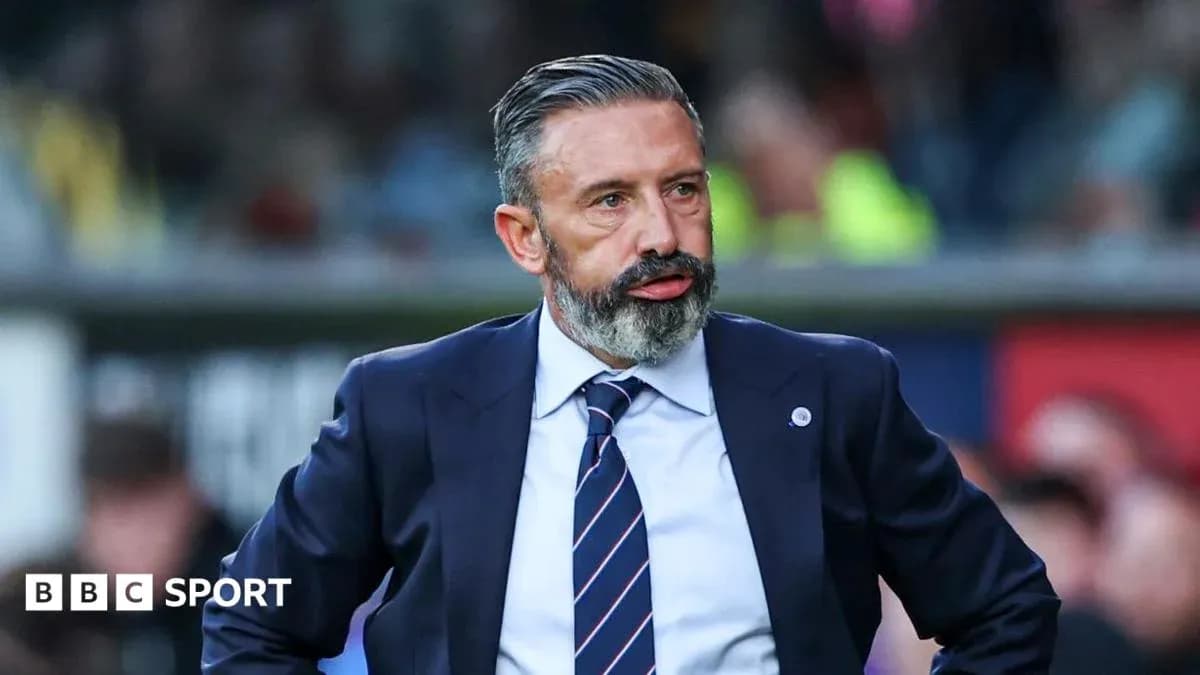
Derek McInnes Faces Rebuild Challenge at Rangers
Derek McInnes walked into this Rangers job knowing it would be a rebuild. On opening night at Tannadice, he was reminded just how big the job is.
Same scoreline as a year ago – 1-1 on the road – but a very different soundtrack. No public dressing down, no fury on the touchline. Just a blunt admission that this new Rangers side is miles from where it needs to be, and a manager who knows he’ll be judged later, not now.
A stuttering start to the McInnes era
Rangers never really settled in the first half. Dundee United were sharper, more cohesive, and they struck first through Lachlan Rose, whose opener underlined just how disjointed the visitors looked without the ball.
McInnes’ team shape didn’t convince. The back line never truly compressed the space, the midfield couldn’t close gaps, and United found room between the lines far too easily. For long spells, the hosts looked like the more complete side.
After the break, Rangers finally stirred.
Thelo Aasgaard, one of the few visiting players to consistently demand the ball and try to influence the game, grabbed the equaliser and briefly shifted the mood. The goal sparked a spell of pressure, a glimpse of what this side might become once the ideas bed in and the squad is closer to what McInnes wants.
But the pressure never turned into control. Rangers couldn’t turn the momentum into a winner, and they were almost punished late on when Jesse Randall broke through and lifted a tame finish straight at Ivor Pandur. On another night, that goes in and the narrative around McInnes’ debut darkens considerably.
He didn’t hide from the shortcomings.
“It’s disappointing – we’ve dropped a couple of points, but we weren’t good enough to get all three,” he said, the verdict as simple as the performance was complicated. The message was clear: trust the process, do the basics better, and the rest will follow.
Early days, but early concerns
The context matters. This is a Rangers side in transition, with a new manager, new ideas and a raft of new faces thrown straight into the fire.
Pandur, Ben Godfrey, Cammy Devlin and Lawrence Shankland all started. Dan Neil and Ross McCrorie came off the bench. It wasn’t so much a team as a sketch of what McInnes wants Rangers to become.
Former Rangers striker Steven Thompson urged calm, pointing to the venue and the stage of the season. A point at Tannadice, he argued, will not be the worst result anyone gets there this year. His view was shared by many: this is not the time for panic.
But the performance still raised questions.
Andy Halliday, another ex-Ranger, cut straight to the tactical issues. It didn’t matter how many defenders McInnes picked, he argued, because the basic defensive principle – compactness – was missing. Too many gaps. Too much space. Too many Dundee United players looking like the best footballers on the park.
Aside from Aasgaard, Halliday felt the standout individuals wore tangerine, not blue. That, more than the dropped points, will sting.
A squad still under construction
McInnes has been open about what this squad lacks and where he wants to strengthen. The evidence at Tannadice backed him up.
Out wide, Rangers never truly threatened. Djeidi Gassama started on the left but failed to impose himself and was withdrawn at half-time. By the end, Aasgaard and Mohamed Diomande were operating narrow, with no natural wide man stretching the game or isolating full-backs.
As the match opened up, the spaces were there. Rangers just didn’t have the players to consistently exploit them.
McInnes spelled it out afterwards: he wants a winger who can go past defenders, commit people, and force teams onto the back foot. Without that, the strikers live off scraps. The service wasn’t good enough, and the attack looked functional rather than frightening.
At the back, there are fresh worries. Godfrey’s hamstring issue adds another problem in a defensive unit already in flux, while uncertainty over Olwethu Makhanya’s visa ahead of the Europa League qualifier against Jagiellonia Bialystok only heightens the need for reinforcements.
Rangers will move in the market. They have to.
A long road ahead
McInnes’ message was steady, almost stubbornly so: it’s one game, and this team will get better. He doesn’t want to talk about what came before his arrival. He wants to be judged on what comes next.
For now, Rangers are exactly what he called them – a work in progress. Flashes of promise, long spells of frustration, and a manager already clear-eyed about the holes in his squad.
The season will not be defined by a draw at Tannadice. But nights like this, with points dropped and flaws exposed, will shape how quickly McInnes can turn Rangers from a project into a contender.
The question now is simple: how fast can he bend this team to his will before the demands of Ibrox, and of a title race, leave no room for patience?