Egypt's Heartbreak: Late Collapse Against Argentina in World Cup
LOS ANGELES — Egypt walked to the brink of history, stared down the world champions, and then watched the World Cup quarter-finals disappear in a blur of whistles, replays and raised arms.
From 2-0 up to a 3-2 defeat against Argentina, this was not just a collapse on the scoreboard. It was a night that left Hossam Hassan raging against what he called “injustice” and “cheating”, and a team convinced the system had swallowed their dream.
Egypt’s moment, ripped away
The script for an Egyptian epic felt almost complete.
Yasser Ibrahim’s header put the Pharaohs in front, a towering moment that rattled the defending champions and lit up the Egyptian end. When Mostafa Zico then finished to make it 2-0, Egypt stood on the verge of a first-ever World Cup quarter-final, staring down Lionel Messi and the holders with no hint of fear.
Even before that, though, the tension with the officials had already begun to simmer.
At 1-0, Zico thought he had doubled the lead earlier in the game, only to see his goal wiped out after a VAR intervention spotted a foul on Lisandro Martinez much earlier in the move. The Egyptian bench exploded in disbelief. The mood never really cooled.
Zico did eventually get his goal, and at 2-0 the story seemed to tilt decisively towards an African upset for the ages. Argentina, rattled, were chasing shadows. Egypt were organised, disciplined, ruthless on the break.
Then the match turned.
Messi’s penalty misery, Argentina’s response
Argentina were handed a route back when a penalty was awarded for a trip on Nicolas Tagliafico. Up stepped Messi, the eight-time Ballon d’Or winner, facing Mostafa Shobeir with the weight of a nation and a tournament on his shoulders.
Shobeir guessed right. He saved it.
Messi’s uneasy relationship with World Cup penalties deepened: four failures now from eight non-shootout spot-kicks on this stage, including two at this tournament alone. For a few seconds, Egypt’s belief roared back to full volume. They had denied the game’s biggest name at the game’s biggest event.
But Argentina, wounded and desperate, surged again. Cristian Romero dragged them back into it, reducing the deficit and shifting the entire atmosphere inside the stadium. Egypt, who had controlled the chaos so well, suddenly found themselves living inside it.
The pressure finally told. Messi, denied once from the spot, found his moment in open play. He smashed in the equaliser — his eighth goal of the tournament — and the defending champions were level. The noise, the momentum, the sense of inevitability: it all swung blue and white.
Egypt were now hanging on to something they had once held so firmly in both hands.
The flashpoint that broke Egypt
The decisive act came wrapped in controversy.
In the build-up to Enzo Fernandez’s winner, Egypt were convinced they should have had a penalty at the other end. They claimed Alexis Mac Allister pulled back Hamdy Fathy, a clear shirt tug they insist everyone saw — everyone, they argue, except the people who mattered most.
No VAR check. No trip to the monitor. No delay.
Argentina broke, Argentina scored, and Egypt’s World Cup dream lay on the turf.
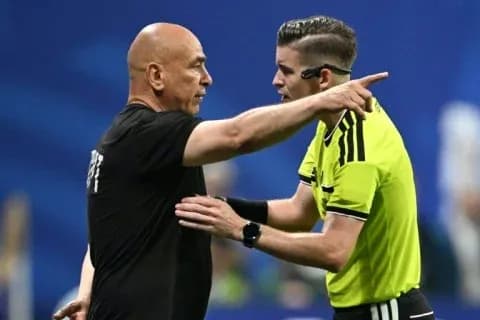
For Hassan, it was the final straw.
“I do not want to put it nicely and talk about hard luck. We have been cheated unfairly today, we have suffered injustice,” he said in a blistering press conference that crackled with anger.
“We haven't seen respect or fair play. There has not been respect or fair play.
“A penalty was ruled out, was not even checked by VAR. A second goal was remarkably disallowed. There has not even been a VAR check when we have all seen the image of the (shirt) being pulled back.”
The language was raw, unfiltered. This was not a manager quietly nursing grievances. This was a man convinced his team had been robbed on the sport’s grandest stage.
“Perhaps they wanted Messi to stay”
Hassan did not stop at individual decisions. He went after the wider picture, hinting at forces beyond tactics and talent.
“Perhaps they wanted to keep the world champions in the competition. Perhaps they wanted Messi to stay in the running,” he told BeIN Sports.
“In football, there are sometimes external factors that go beyond the technical aspects. The world champions received support at every level.”
These are explosive words in the context of a World Cup, aimed squarely at the integrity of the competition and the treatment of its biggest star. For Egypt’s coach, the pattern was too strong to ignore: the disallowed goal, the unreviewed penalty claim, the sense that every 50-50 leaned the same way.
On a night when Egypt had Messi on the ropes and Shobeir had saved his penalty, Hassan left the stadium believing the balance had been tilted back by something other than football.
Anger at the schedule
His fury was not reserved only for the officials.
Hassan also lashed out at the scheduling that had Egypt and Argentina kicking off at noon local time (1600 GMT), just four days after both had battled through their round of 32 ties.
“Whoever schedules those matches has never played football. You never schedule a game for 12pm. At noon you go for a walk or to eat brunch, you do not go to play football.
“When are the players supposed to eat? At 7.30am?
“There have been a lot of things to be questioned on and off the pitch.”
For him, it was all part of the same picture: a tournament that did not treat his team with the respect he felt they had earned.
A coach turning his back
By the time he left the podium, Hassan had gone beyond a standard post-match protest. He promised a personal boycott.
“I am not going to continue following the matches of this World Cup, watching the matches of this World Cup,” he said. “This is my own way of speaking up.”
Egypt leave with no place in the last eight, but with a performance that rattled the champions and a coach who chose confrontation over silence. Argentina march on, Messi stays in the tournament, and the bracket looks as the organisers might once have hoped.
But somewhere between a saved penalty, a disallowed goal and a penalty that never got checked, Egypt are left asking whether this World Cup will remember them as brave nearly-men — or as the team that paid the price for standing in the way of a giant.