Elche vs Alaves: Tactical Analysis of a Crucial La Liga Draw
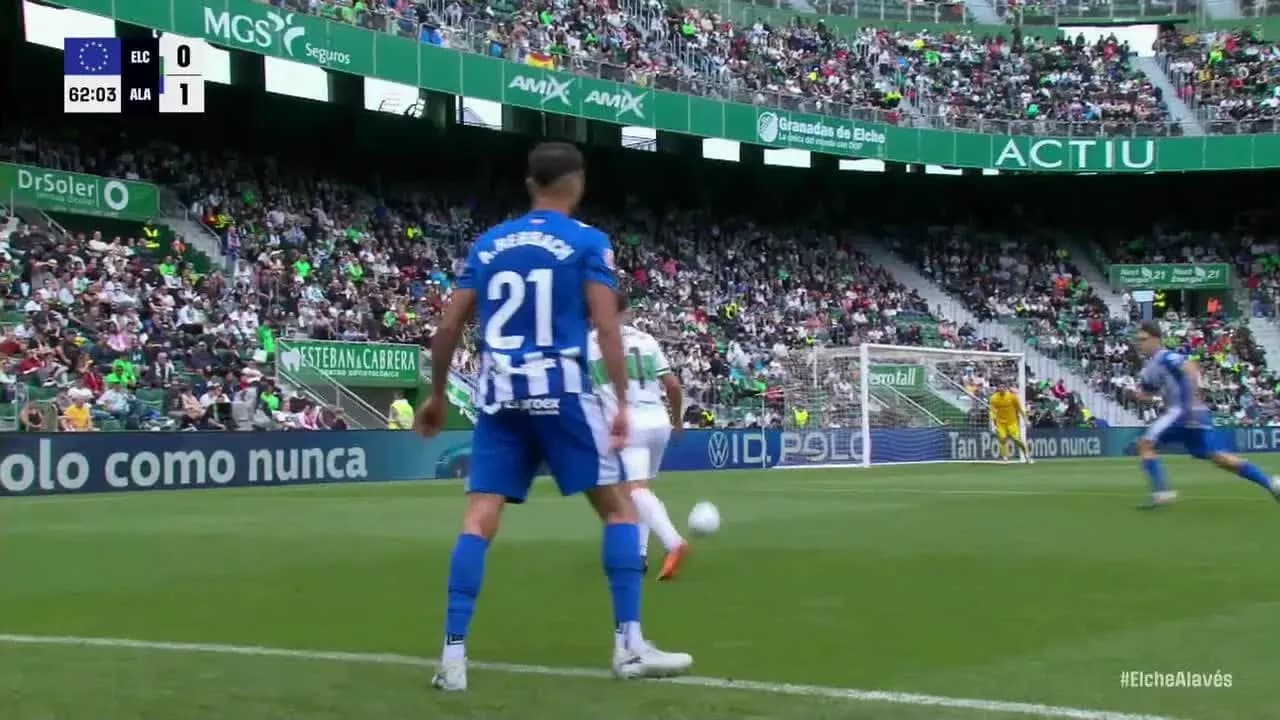
The Estadio Manuel Martínez Valero felt tight and tense long before kick-off. With La Liga survival on the line in Round 35, Elche and Alaves walked out knowing that every duel and every second ball might tilt the table. Following this result, the 1-1 draw leaves Elche 16th on 39 points and Alaves 18th on 37, the home side clinging to a narrow cushion while the visitors remain in the relegation zone.
I. The Big Picture – Structures, stakes, and season DNA
Elche leaned into their seasonal identity, rolling out Eder Sarabia’s favoured 3-5-2. It is a shape that has underpinned a solid home record: heading into this game they had played 18 times at home, winning 8, drawing 8 and losing only 2. At home they have scored 29 goals and conceded 19, an average of 1.6 goals for and 1.1 against. Overall, their goal difference of -8 is the product of 46 goals scored and 54 conceded across 35 matches, a profile of a side that suffers away but is stubborn in Elche.
Alaves arrived with a more reactive posture, Quique Sanchez Flores setting up a 5-3-2 that spoke of caution as much as necessity. Overall they had 41 goals for and 54 against, a goal difference of -13 that underlines a fragile defensive record, especially on their travels: away from home they had played 18, winning 3, drawing 4 and losing 11, scoring 18 and conceding 31 at an average of 1.0 for and 1.7 against.
The scoreline – 0-0 at half-time, 1-1 at full-time – mirrored those season-long tendencies: Elche usually find a way to score at home, Alaves rarely leave without scars, but both carry enough threat to punch back.
II. Tactical Voids – Absences and discipline
The team sheets told their own story of what was missing. Elche were without A. Boayar (muscle injury), R. Mir (hamstring injury) and Y. Santiago (knee injury). The absence of Mir in particular trimmed Sarabia’s options for a more direct, penalty-box presence from the bench, forcing him to lean heavily on André Silva and Álvaro Rodríguez as his primary attacking axis.
Alaves were hit even harder in terms of structural options. C. Alena was out through yellow-card suspension, removing a technical link between midfield and attack who could have helped them escape Elche’s press. L. Boye, sidelined by a muscle injury, stripped them of one of their most productive forwards, an attacker with 11 goals this campaign. F. Garces was also suspended, further narrowing the defensive and rotational choices in a game that always threatened to become attritional.
These voids were magnified by the disciplinary profiles of both squads across the season. Elche’s yellow-card distribution shows a clear spike between 61-75 minutes, where 23.94% of their yellows arrive, and another heavy band from 31-45 minutes (18.31%). Alaves are even more combustible late on: 20.88% of their yellows land in the 76-90 minute window, and 16.48% between 91-105 minutes. It is no surprise that the closing stages were fragmented, with tactical fouls and breaks in rhythm as both sides fought to protect what they had.
III. Key Matchups – Hunter vs Shield, and the Engine Room
Hunter vs Shield centred on Toni Martínez and André Silva, even if the scoreboard eventually settled on parity. For Alaves, Toni Martínez came into this fixture as one of La Liga’s most consistent forwards: 12 goals and 3 assists in 34 appearances, with 71 shots (33 on target). He is not just a finisher; 24 key passes and 455 duels (238 won) show a striker who lives in the fight, constantly asking questions of centre-backs.
His task was to unsettle a back three anchored by David Affengruber, Víctor Chust and Pedro Bigas. Affengruber, in particular, embodies Elche’s defensive steel. Across the season he has blocked 24 shots, a significant tally that underlines his role as the last-ditch shield. His red card earlier in the campaign is a reminder that his aggression can spill over, but it also hints at the edge Elche rely on in games like this. Against Toni Martínez’s relentless movement, Affengruber’s timing in stepping out of the line and his aerial dominance were crucial in limiting clear chances.
At the other end, André Silva carried Elche’s cutting edge. He arrived with 10 goals in 28 appearances, from 40 shots with 27 on target – an efficiency that complements Álvaro Rodríguez’s more all-action profile. Rodríguez, with 6 goals and 5 assists plus 32 key passes, is as much creator as finisher. Their pairing in the 3-5-2 gave Elche verticality and variety: Silva attacking the box, Rodríguez drifting into half-spaces and wider channels to connect with wing-backs and midfield.
Behind them, the Engine Room duel was defined by Aleix Febas for Elche and Antonio Blanco for Alaves. Febas has been one of the most influential midfielders in this league campaign: 2 goals, 2 assists, but more importantly 1,864 passes at 89% accuracy and 27 key passes. He is the metronome and the risk-taker, carrying the ball through lines and drawing fouls – 109 this season – at the cost of 9 yellow cards.
Blanco, with 1,738 passes at 85% accuracy, 91 tackles, 9 blocks and 51 interceptions, is the archetypal enforcer-playmaker hybrid. His 65 fouls committed and 9 yellow cards paint him as the anchor of Alaves’ midfield block. In this match-up, Blanco’s job was to disrupt Febas’ rhythm and deny him the pockets where he usually turns possession into penetration. For long stretches, the battle between their contrasting styles – Febas’ progressive passing versus Blanco’s screening and counter-pressing – dictated whether the game tilted towards Elche’s structured possession or Alaves’ counter-attacking lanes.
IV. Statistical Prognosis – xG logic and survival instincts
Even without explicit xG numbers, the season data frames how this kind of contest tends to play out. Overall, Elche average 1.3 goals for and 1.5 against per game, while Alaves sit at 1.2 for and 1.5 against. Both sides operate in narrow xG margins, living in one-goal games where set pieces, defensive lapses and late pressure swings the outcome.
Elche’s home resilience – 7 clean sheets at home and only 2 home defeats – suggests that their defensive xG against at the Manuel Martínez Valero is significantly lower than away. Alaves’ away record, with 11 defeats and only 1 away clean sheet, points to a side that typically concedes more and struggles to control territory.
Following this result, the 1-1 draw feels almost mathematically logical: Elche’s home attack good enough to find a goal, Alaves’ frontline – even without L. Boye – still carrying enough threat through Toni Martínez and I. Diabate to punish any lapse. Defensively, both teams conformed to their season-long patterns: organised but not watertight, capable of heroic blocks and desperate interventions but always living on the edge.
In tactical terms, the game reaffirmed that Elche’s 3-5-2, built around Febas’ orchestration and the Silva–Rodríguez partnership, gives them just enough structure and punch to stay ahead of the drop. For Alaves, the 5-3-2 provides a platform, but their survival will hinge on turning Toni Martínez’s volume of work into more consistent goals and tightening an away defence that, across 18 games, has conceded 31 times.
The margins remain thin, the narrative unfinished, but this 1-1 felt like a chapter written precisely along the statistical lines both teams have been tracing all season.