England Faces Hostile Conditions at Azteca in World Cup Clash
The lights of Mexico City were still flickering into life when the first waves of green shirts began rolling towards the Estadio Azteca. Horns, drums, fireworks, songs. This is co-host territory, and England are walking straight into the furnace.
Three hours from kick-off in their World Cup 2026 last‑16 tie, Thomas Tuchel’s squad are cocooned inside one of football’s most intimidating cities, juggling altitude, hostility and even the threat of lightning. The football is big enough. The backdrop is something else entirely.
Security, storms and a city on edge
England’s arrival in Mexico City has been anything but low-key. After earlier incidents in the tournament where fans targeted the Ecuador squad with loudspeakers, horns and motorbikes outside their hotel, the Mexican National Guard has been drafted in to tighten security around the England camp.
More than 100 riot police in bullet-proof vests now ring-fence the team hotel. Boos and jeers greeted the team bus on arrival, a reminder that this is not neutral ground and never will be. Yet Tuchel has been calm, describing England’s welcome as “respectful and emotional” and insisting there have been “no issues” so far.
The real disruption has come from elsewhere. Fifa’s handling of the kick-off time has drawn anger and disbelief. With stormy weather forecast and the threat of lightning around Mexico City, world football’s governing body explored moving the game forward by six hours, before abandoning the idea.
Gary Neville, speaking on ITV Sport, did not bother to sugar-coat his view.
“I would find it disruptive as a player,” he said. “Conditions are huge for England, playing at 12pm in Mexico vs playing at 6pm, it's very different, for our players, it's worse, let's be clear.
“It's a sporting disadvantage to England, there's a sporting integrity issue here. I've never seen a League Two game moved back, Fifa are just willy nilly making it up and moving a game, it feels strange.”
Neville pointed to existing protocols for bad weather in stadiums like the Azteca.
“You can put fan safety at the heart of it, this is a stadium that has had this type of conditions before, they have a procedure to deal with it,” he added. “I was there when my brother was managing Inter Miami. It can be disrupted for an hour, they go underneath, they get shelter. To move a game two days out, I've never seen that at any level of football ever."
The match now stays in its original slot. The storm threat remains in the air, literally and figuratively.
Azteca altitude: England’s invisible opponent
Then there is the ground itself. The Azteca is not just a stadium; it is a test of physiology and nerve. At 7,220ft (2,240m) above sea level, Mexico City’s thin air drags at the lungs and dulls the legs. England will breathe harder and get less back.
Tuchel knows it. His staff know it. Former players who have been here talk about the way it “catches you off guard” – the moment you think you’re fine, then realise your body is emptying faster than usual. For Mexico, this is home. For England, it is an uphill run from the first whistle.
The hosts have already shown how they can weaponise this place. Their last‑32 win over Ecuador turned wild after a weather delay, with Julian Quinonez and Raul Jimenez landing decisive blows to send the stadium into delirium. The noise that night felt like a warning of what awaits England.
Quansah’s big night and Tuchel’s right-back riddle
On the pitch, Tuchel’s selection puzzle has narrowed to one glaring issue: right-back.
Injuries and niggles have stripped England of comfort in that position. Jarell Quansah, back from his own fitness concerns, is now poised to start on the right of the defence, a centre-back pushed wide in one of the biggest games of his young career. Djed Spence is a doubt with a muscle problem, while Reece James is still edging his way towards full match readiness.
The strain has opened the door to a potential formation shift, with a back three an obvious solution on paper. But indications are that Tuchel will trust Quansah on the flank rather than rip up the entire structure.
Gary Neville, again on ITV Sport, captured the stakes succinctly.
“That means he didn't want to bring Stones at centre-back,” he said. “It's a big game for him, he's got to do the job, it's not ideal.”
Not ideal, but unavoidable. In a stadium where every mistake will be amplified by 80,000 voices, England are asking a lot of a defender still learning his trade at this level.
The one major boost is in midfield. Declan Rice has been declared fully fit, a significant lift for a side that will need every ounce of control and composure if they are to manage both the ball and their own energy at altitude.
A country riding the wave
Beyond football, Mexico is riding a broader sporting high. On Sunday’s second stage of the Tour de France, Tadej Pogacar gifted victory to his Mexican teammate Isaac Del Toro, allowing him to savour a landmark win on cycling’s biggest race.
Del Toro, overwhelmed, spoke of “full emotions” and his pride in performing at this level, especially for his country. He then turned his gaze to the night ahead, urging El Tri to finish the job against England.
“Of course we have these 11 guys ripping it up in the soccer,” he said. “They’re doing amazing.”
It was a neat snapshot of a nation locked in on the World Cup. Cyclists in Europe, fans in Mexico City, everyone pulling in the same direction.
Outnumbered and warned
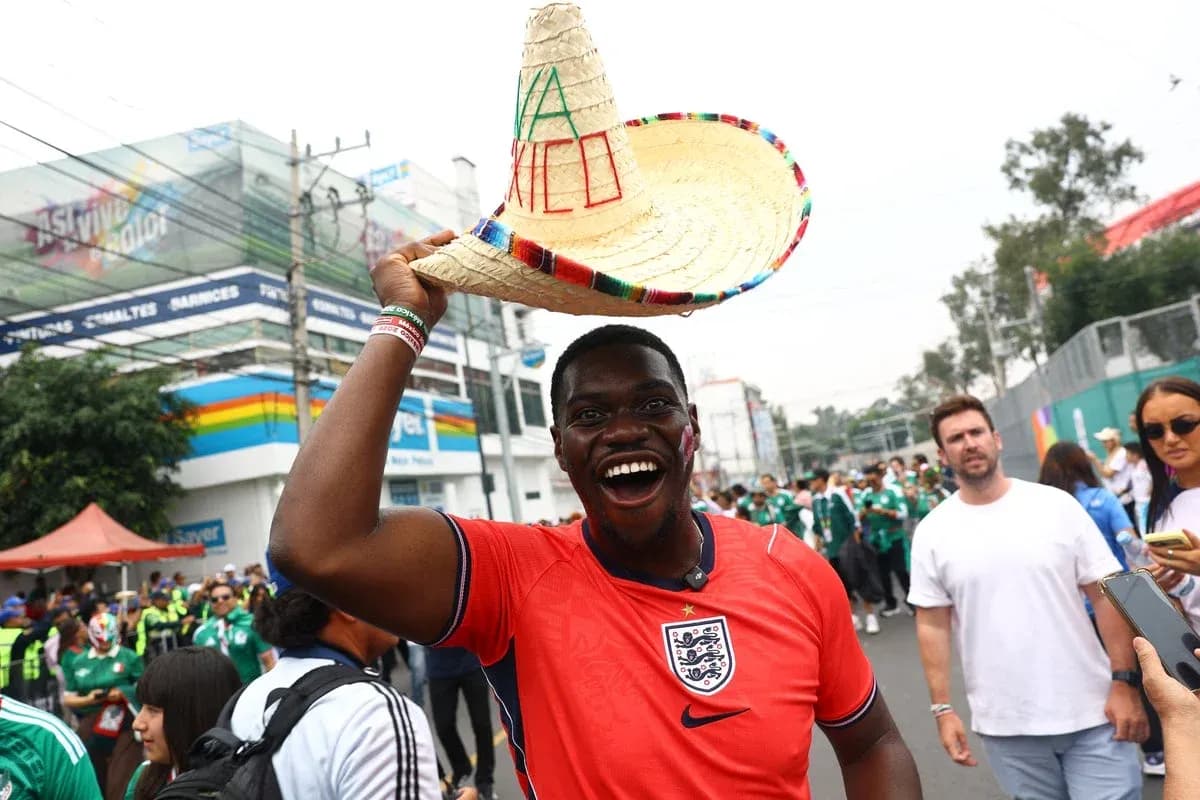
For England fans, the message has been stark. The UK’s top football police chief has warned travelling supporters that they will be “massively outnumbered” in Mexico City and urged them to “be sensible”.
Tensions have already flared in the capital. The crush that followed Mexico’s win over Ecuador earlier in the week, in which four fans died, hangs over this fixture as a grim reminder of how quickly celebrations can turn dangerous.
Security around the England team has tightened in response. The National Guard presence, the riot police, the constant noise outside the hotel – all of it feeds into a sense that this is more than just a football match. It is an event the entire city feels.
Inside the Azteca, the imbalance will be obvious. A pocket of England fans, dwarfed by a sea of green, trying to make themselves heard in a stadium that has seen it all, from Diego Maradona’s infamous hand to his immortal solo goal in 1986.
Confusion, controversy and a wider World Cup mood
The confusion over England’s kick-off time has not existed in isolation. Fifa’s decision-making has been under the microscope across this World Cup, not least in the United States’ last‑16 tie against Belgium.
There, Folarin Balogun’s one-match ban for a red card against Bosnia and Herzegovina was suddenly “suspended”, allowing the USA’s star striker to play. Belgium say they are “astonished” by the ruling. Fifa had previously confirmed there were no grounds for appeal, only for the picture to change just over 30 hours before kick-off.
The sense of rules being bent or rewritten on the fly has coloured the mood around the tournament. Neville’s fury at the attempted time change for England fits into that broader frustration over sporting integrity on the biggest stage.
Three hours to find out who handles the chaos
Back in Mexico City, the countdown is on. Less than three hours until kick-off, with the match dropping into the early hours for fans watching in the UK. Predictions are flying, nerves are tightening, and the Azteca is filling.
England have the talent to go deep in this tournament. They also have to survive this night first: the altitude, the hostility, the swirling weather and a patched-up right side of defence.
Mexico have the crowd, the conditions and the momentum of a country that believes this World Cup is partly theirs.
In a stadium built on drama, which of them handles the chaos better when the whistle finally blows?