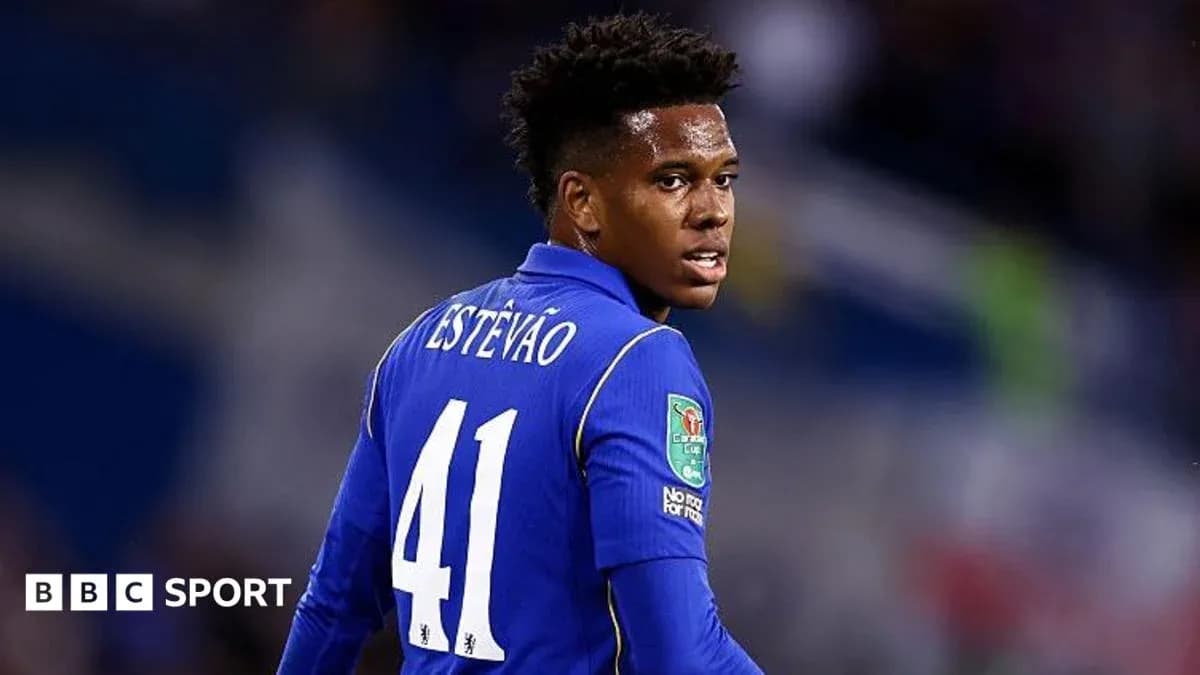
Estevao's Journey at Chelsea: A £51m Talent Waiting for Opportunities
The ball arced towards the top corner and, for a heartbeat, the away end at Emirates Stadium believed.
Estevao Willian had cut in from the right, shaped his body and whipped a curling shot that looked destined to drag Chelsea level at Arsenal on Sunday. David Raya’s fingertips said otherwise, pushing the strike away and preserving Arsenal’s lead.
The equaliser never came. The statement did.
For all of 19 years, Estevao offered a sharp reminder of why Chelsea consider him one of the pillars of their future, even as his present remains frustratingly bit-part.
A £51m talent waiting in the wings
Chelsea did not spend £51m to pluck Estevao from Palmeiras just to tuck him away. Yet four games into the season, that is largely where he has been: on the periphery, watching others define the early weeks of Xabi Alonso’s tenure.
Ninety-six minutes. That is his Chelsea season so far.
Eighty of those came against League One side Luton Town in the Carabao Cup, a low-pressure environment in which he could stretch his legs and show flashes of that Brazilian flair that made him one of the most coveted teenagers in world football.
The rest? Sixteen scattered minutes off the bench against Fulham and then Arsenal. He did not get on the pitch at all in the narrow win over Brighton, left to observe as Chelsea dug in and held on.
Back home, reports in Brazil have painted a picture of a young winger already unsettled by his lack of involvement. Inside Stamford Bridge, that narrative is being firmly rejected. Club sources and people close to Estevao insist he is not agitating, that he is excited by the project, including the arrival of another high-profile attacker, Morgan Rogers.
Chelsea’s stance is blunt: Estevao is not for sale.
He is grouped with Cole Palmer, Joao Pedro and Moises Caicedo in a small cluster of “untouchables” in the eyes of the ownership and Alonso. The plan is long term, and he sits right at the heart of it.
There have even been early conversations over a new contract, with Chelsea keen to reward key pieces of their core. Joao Pedro has already benefited from that approach. Estevao is expected to follow.
Alonso’s message: “I count on Este 100%”
If there is tension brewing, Alonso is doing his best to smother it. Asked directly whether Estevao’s limited minutes meant the teenager was unhappy, the Chelsea head coach was unequivocal.
“No, Este is ready, training well. The other day he had a great impact,” Alonso said.
“He is fully involved with a very good attitude every day. I count on Este 100% because of his potential. He is so young but he is learning and adapting quickly. The season is long.”
That last line matters. The season is long, and Estevao is coming off a serious setback.
Late last season he suffered a grade-four hamstring tear, a brutal injury that not only stalled his momentum but also cost him a place at the World Cup. Chelsea always expected his integration to be gradual, his workload carefully managed.
On Sunday, circumstance pushed that plan in a different direction.
A winger at wing-back, chasing the game
With Chelsea trailing at Arsenal and hunting an equaliser, Alonso turned to Estevao. But not in his natural role.
He replaced Pedro Neto, who has been used as a wing-back in Alonso’s new system, and was effectively asked to mirror that job. It is hard to imagine many other in-game scenarios where a 19-year-old flair winger would be thrown into such a physically and defensively demanding position.
Still, the gamble almost paid off. Estevao’s late effort forced Raya into that full-stretch save, the closest Chelsea came to salvaging a point.
In a fully functioning Alonso system, though, that is not where Estevao is supposed to live. His preferred space is the inside-right pocket, operating as a number 10, drifting between the lines and attacking the box. That territory currently belongs to Palmer.
And Palmer is not moving easily.
Alonso sees the England international as a leader in the dressing room and a central attacking weapon. Dislodging him from league line-ups will be a serious challenge for any teammate, let alone a teenager still adjusting to a new league and recovering from a major injury.
When Alonso has switched to a back four, Estevao and Palmer have shown glimpses of a promising partnership, dovetailing neatly in those inside channels. But that shape has been used only once so far: against Luton in the Carabao Cup.
For now, tactical preference and hierarchy mean Estevao’s path to regular Premier League starts is crowded.
A big squad, few games, and a shrinking window
Chelsea’s situation is unusual for a club of their size. No European football means fewer fixtures, fewer rotations, fewer natural openings for players on the fringes.
Alonso has responded by fielding close to his strongest XI even in the Carabao Cup. With limited matches to imprint his ideas, he has leaned heavily on continuity.
Palmer and Rogers have started every game. Joao Pedro has begun all three league fixtures. Danny Welbeck led the line against Luton. That leaves little oxygen for others.
Emmanuel Emegha, signed from Strasbourg in the summer, has made just one appearance on the bench. Aaron Anselmino is yet to play and has been named in only one squad, with both managing fitness issues.
Further forward, Geovany Quenda and Jamie Gittens have barely tasted action, logging just eight and 10 minutes respectively across four matches. Quenda, recruited despite strong interest from Manchester United in 2024, has been left out of two of Alonso’s matchday squads entirely.
Even with injuries to Moises Caicedo and Jordan Henderson thinning out the midfield at times, opportunities have been scarce. Summer arrival Valentin Barco has managed only one start and a substitute appearance, while right-back Malo Gusto has been repurposed in midfield. Wing-back Marco Palestra remains sidelined.
If Chelsea had a fully fit squad, the numbers would be even harsher: six outfield players would have to miss out on the matchday squad every game, with only 11 starters and nine substitutes permitted.
In that environment, a 27-man group quickly starts to feel cramped.
History backs the core, not the crowd
Chelsea’s approach under Alonso is not an outlier. Successful sides without European commitments often ride a tight core of trusted players.
Leicester City’s remarkable 2015-16 title win came with just 14 players making more than 15 appearances in all competitions under Claudio Ranieri. The following season, Antonio Conte’s Chelsea lifted the Premier League without European distractions, and only 13 players reached more than 1,500 minutes.
Even in the era of five substitutions, managers tend to cling to their mainstays. When Newcastle United qualified for the Champions League in 2022-23, only 14 of their players surpassed the 1,500-minute mark.
The most relevant comparison might be last season’s Manchester United. They finished third without European football and exited both domestic cups early. Only 13 players recorded more than 1,500 minutes across all competitions.
The pattern is clear. Depth looks impressive on paper. In practice, managers trust a core and sprinkle in the rest.
Leeds, the cups, and the stakes for Estevao
All of that funnels into one quietly pivotal night: Leeds United at Stamford Bridge in the Carabao Cup on Wednesday.
On the surface, it is a domestic cup tie early in the season. For Estevao and several of his young teammates, it carries far more weight.
If Chelsea go out, there will be no more cup football until the FA Cup in January. No extra midweek games. No softer landings to blood youngsters or hand fringe players meaningful minutes.
For a winger trying to turn cameos into something more permanent, that matters. A prolonged cup run could be the bridge between promise and prominence, the stage on which Alonso is forced to take notice, not just in training but under the lights.
Estevao has already shown, in one late swing of his left boot at Arsenal, how quickly he can change the temperature of a game.
The question now is simple: will he get enough chances this season to do it when it truly counts?