Fantasy Premier League 2026/27: Key Reclassifications Impacting Managers
The game inside the game has shifted. Fantasy Premier League has redrawn its tactical map for 2026/27, and a handful of versatile names now sit in very different positions – with potentially huge consequences for managers.
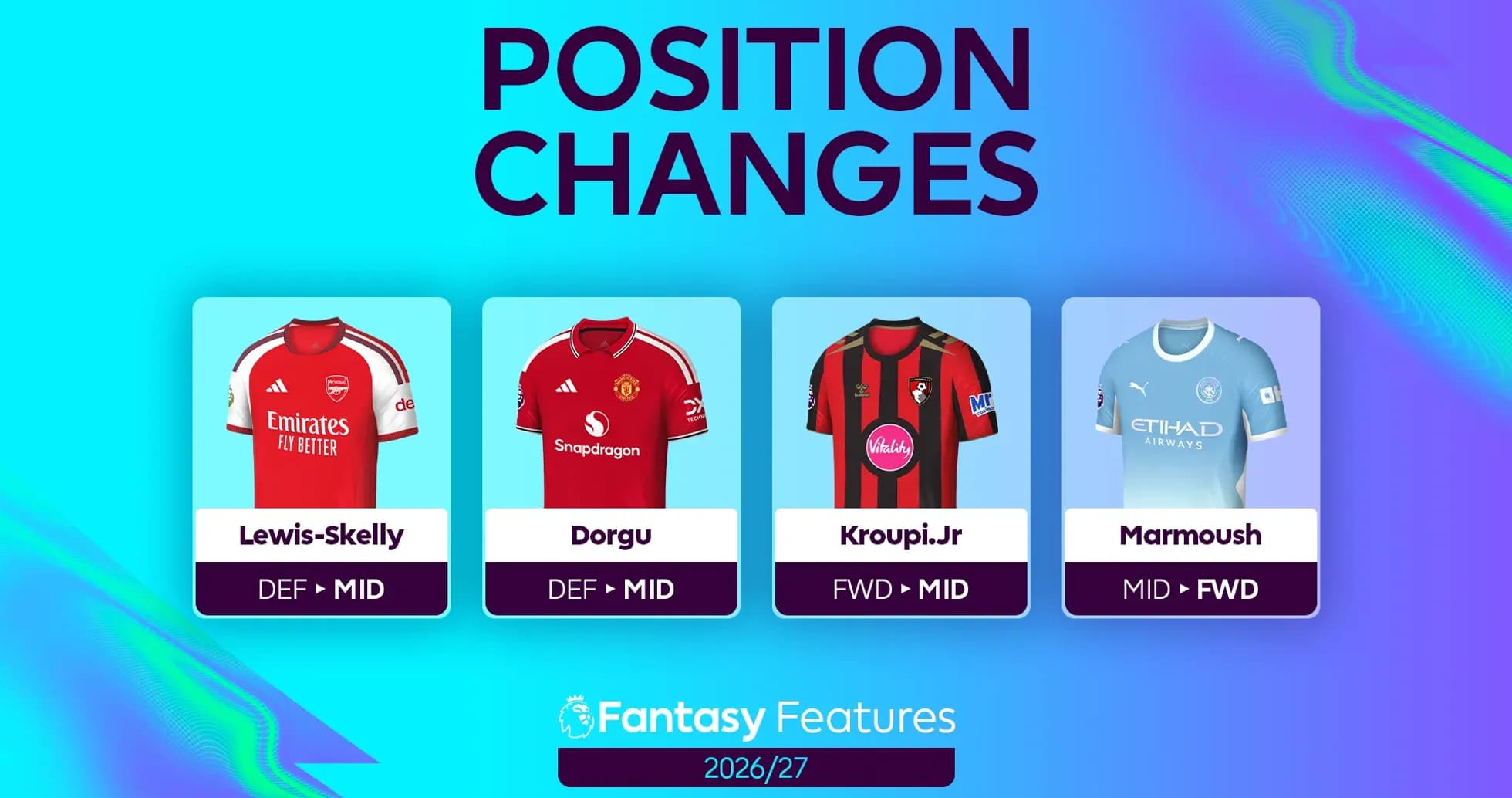
At the heart of it all: Junior Kroupi, Patrick Dorgu and Omar Marmoush, three players whose roles on the pitch forced FPL to rethink where they belong.
Kroupi: From finisher to Fantasy gold mine
Bournemouth’s Junior Kroupi is the headline act.
Listed as a forward last season, he now drops into midfield after spending most of 2025/26 operating as a No 10 behind Evanilson. The shirt number didn’t lie – he played as a central support act, but his output looked more like that of a ruthless striker.
Thirteen goals in 33 appearances tell their own story. Look closer and it gets even more eye-catching.
Kroupi scored once every 134.0 minutes. That was over 50 minutes quicker than Antoine Semenyo, who led Bournemouth’s regular midfield starters with an average of 188.2 minutes per goal. Kroupi wasn’t just efficient; he was one of the sharpest finishers in that entire Fantasy bracket.
Now he’s classified as a midfielder, those same goals are worth more. Add the extra point per clean sheet, and suddenly a productive No 10 turns into the kind of asset FPL managers build around, not around.
If his role stays the same, his reclassification could be one of the most important shifts of the new season.
Dorgu: Carrick’s winger gets a promotion
Over at Manchester United, Patrick Dorgu’s change is less about volume and more about intent.
He moves from defender to midfielder after Michael Carrick’s arrival in Gameweek 22 transformed how he was used. The Dane barely featured under the new manager in terms of minutes – just three starts – but those starts were revealing.
Each time, Dorgu played as a left winger. Each time, he scored.
He struck against Arsenal. He struck against Manchester City. Against Brighton & Hove Albion, he went one better: a goal and an assist in a single outing.
When you stack his numbers against United’s other midfielders under Carrick, the picture becomes even clearer. Compared with Matheus Cunha and Bryan Mbeumo, Dorgu led the way for frequency of shots, firing once every 33.2 minutes – the quickest rate of the trio. He also matched Cunha’s total of three big chances, despite playing over 800 minutes fewer than the Brazilian.
This is not a full-back sneaking forward on the overlap. This is an attacking winger who just happened to start the season with a defender’s tag. FPL has now caught up.
For managers, the question is simple: if Carrick trusts him with more minutes, how long can you afford to ignore a midfielder with defender’s instincts for space and a forward’s eye for goal?
Marmoush: Guardiola’s No 9, Fantasy’s new forward
Omar Marmoush travels in the opposite direction.
Manchester City’s Egyptian attacker has been pushed up the pitch in Fantasy terms, reclassified from midfielder to forward after Pep Guardiola consistently used him through the middle in his final season in charge.
Marmoush responded with three goals and three assists, a tidy return in a side brimming with attacking options. The numbers alone don’t make him a must-own, but his role does. He is no longer the wide or tucked-in midfielder; he is now recognised as part of City’s striking rotation.
The shift carries a trade-off. As a forward, Marmoush loses the extra point for goals and clean sheets that he enjoyed as a midfielder. But the reclassification more accurately reflects his reality on the pitch – a central attacker in one of the league’s most potent teams.
If City’s next manager keeps him at the tip of the attack, he becomes a live option in a position where nailed-on starters are scarce and every attacking return counts.
The quiet reshuffle around them
Beyond the headline trio, FPL’s reclassification list has a clear theme: defenders who spent too much time behaving like midfielders, and midfielders who dropped deep or pushed on.
- Myles Lewis-Skelly (Arsenal) and Lamare Bogarde (Aston Villa) both move from defence into midfield, a nod to how often they operated higher up the pitch.
- Keane Lewis-Potter (Brentford) also shifts from defender to midfielder, while Ryan Sessegnon (Fulham) and Eric Moreira (Nottingham Forest) make the same move.
- At Brighton & Hove Albion, Mats Wieffer goes the other way, dropping from midfield into defence, suggesting a deeper, more protective role.
- Georginio Rutter, also at Brighton, steps up from midfield to forward, recognised as part of the attacking line rather than a supporting runner.
- Crystal Palace’s Rio Cardines is now a defender after previously being listed as a midfielder, underlining a more fixed role at the back.
Each change is a small tweak on its own. Collectively, they redraw the edges of where Fantasy value might be hiding.
The numbers haven’t changed. The players haven’t changed. But their labels have – and in FPL, labels decide where the bargains live.
Kroupi now earns midfielder points for striker returns. Dorgu is finally treated as the winger his performances under Carrick suggested. Marmoush stands where he actually plays: in the front line of a superclub.
Managers who adjust quickest to this new map of positions may find their season defined not by the big-name premiums, but by how boldly they trust the reclassified few.