Ferencvarosi TC vs Twente: Tactical Analysis of 2-2 UEFA Draw
Ferencvarosi TC and Twente produced a tactically volatile 2-2 draw at Groupama Aréna in the UEFA Europa League 2nd Qualifying Round, a match that flipped from home control to a late Dutch recovery. Ferencvaros led 1-0 at half-time and extended to 2-0 despite going down to ten men before the break, but Twente’s structural adjustments and bench depth turned the final half-hour into sustained pressure that eventually yielded two late goals. With virtually no reliable team statistics beyond card counts, the tactical story is written almost entirely through shape, game state, and substitutions rather than possession or shot volumes.
I. Executive Summary
Both sides lined up in a 4-3-3, but used the system in contrasting ways. Ferencvarosi TC, under Balazs Borbely, built a midfield-heavy version with only one natural forward, prioritising compactness and second-ball control. John van den Brom’s Twente used a more orthodox front line with W. Weghorst as a central reference point. The turning point was the 36' red card for P. Rommens (Ferencvarosi TC — “Serious foul”), forcing Ferencvaros into a low block and counter-attacking approach for nearly an hour. Twente, aided by aggressive triple substitutions, eventually exploited the numerical superiority, with Weghorst and L. Vennegoor of Hesselink striking in the final ten minutes to rescue a 2-2 draw.
II. Scoring Sequence & Disciplinary Log
Goals (chronological, with running score):
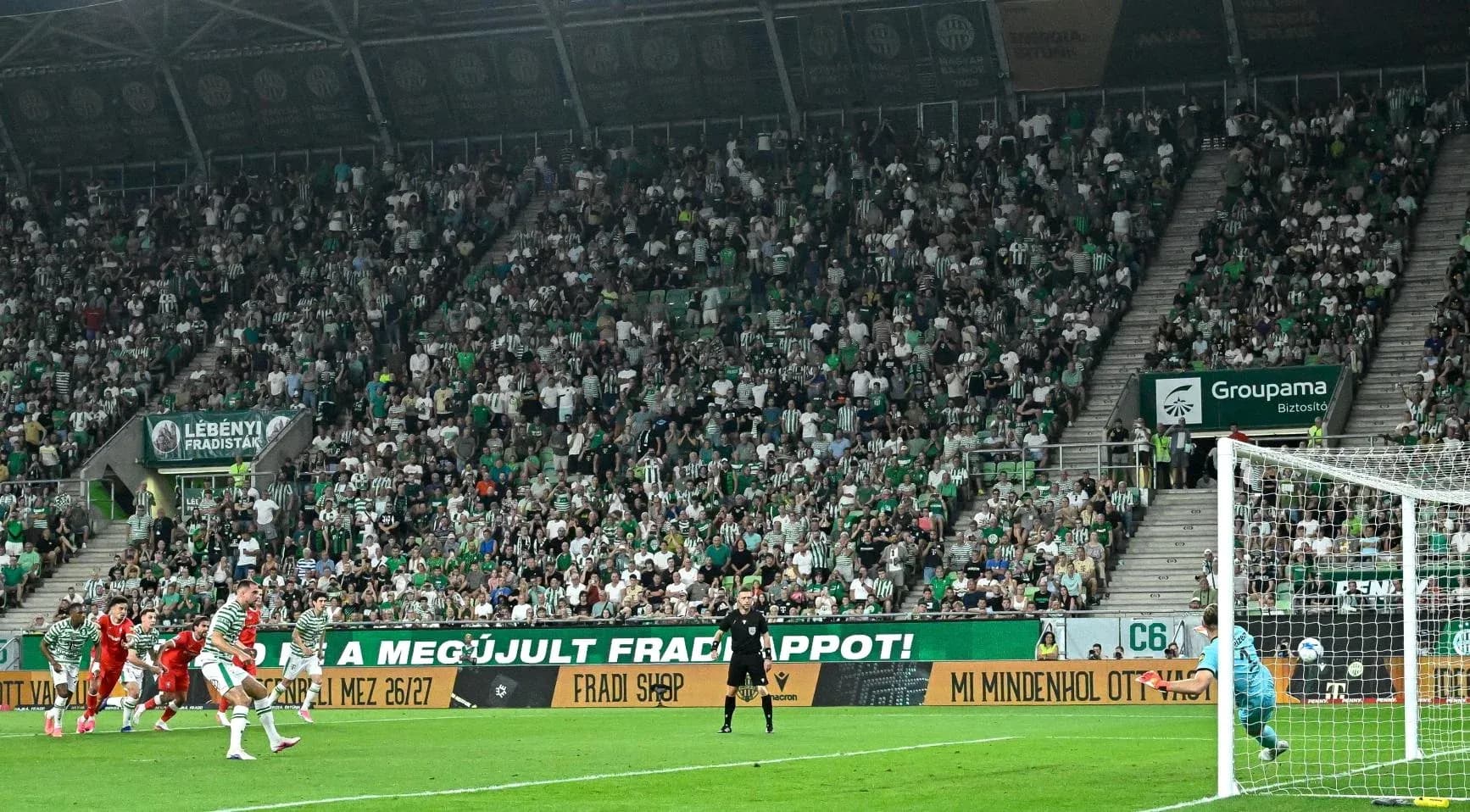
- 22' T. Raemaekers (Ferencvarosi TC) — Penalty, no assist → Ferencvarosi TC 1-0 Twente
- 50' L. Joseph (Ferencvarosi TC) — Normal Goal, no assist → Ferencvarosi TC 2-0 Twente
- 82' W. Weghorst (Twente) — Normal Goal, no assist → Ferencvarosi TC 2-1 Twente
- 86' L. Vennegoor of Hesselink (Twente) — Normal Goal, no assist → Ferencvarosi TC 2-2 Twente
Cards (all reasons verbatim, chronological):
- 36' P. Rommens (Ferencvarosi TC) — Serious foul (Red Card)
- 56' Cadu (Ferencvarosi TC) — Unsportsmanlike conduct (Yellow Card)
- 56' T. van den Belt (Twente) — Unsportsmanlike conduct (Yellow Card)
- 61' S. Lemkin (Twente) — Unsportsmanlike conduct (Yellow Card)
- 88' Y. Taha (Twente) — Foul (Yellow Card)
Card totals are therefore: Ferencvarosi TC: 1 yellow, 1 red; Twente: 3 yellow, 0 red; Total: 5 cards.
Substitutions (tactically relevant, chronological):
- 46' S. Lammers (IN) came on for K. Hlynsson (OUT) — Twente
- 46' D. Weidmann (IN) came on for A. Adelgaard (OUT) — Twente
- 63' Y. Taha (IN) came on for T. van den Belt (OUT) — Twente
- 72' M. Pjaca (IN) came on for D. Rots (OUT) — Twente
- 72' L. Vennegoor of Hesselink (IN) came on for S. Orjasaeter (OUT) — Twente
- 73' Dele (IN) came on for C. O'Dowda (OUT) — Ferencvarosi TC
- 78' N. Zohore (IN) came on for L. Joseph (OUT) — Ferencvarosi TC
- 88' J. Levi (IN) came on for Cadu (OUT) — Ferencvarosi TC
III. Tactical Breakdown & Personnel
Ferencvarosi TC’s 4-3-3 was built around a dense central structure. With D. Dibusz in goal, the back four of A. Osvath, M. Gomez, T. Raemaekers and Cadu had an asymmetrical feel: Cadu listed as a midfielder but starting in the second row suggests he often stepped into midfield zones, allowing a pseudo back-three in possession. Ahead of them, the trio of P. Rommens, G. Kanichowsky and M. Corbu formed a compact central unit, with K. Zachariassen and C. O'Dowda supporting lone forward L. Joseph from the half-spaces.
The early 22' penalty converted by T. Raemaekers reflected Ferencvaros’s willingness to push a centre-back into advanced zones on set plays, using Joseph and Zachariassen to occupy Twente’s central defenders while Raemaekers attacked secondary spaces. At 11v11, Ferencvaros looked structurally balanced: the midfield line of three could shuffle laterally to close Twente’s build-up, and the front three staggered their pressing angles to deny easy progression through R. Zerrouki.
The 36' dismissal of Rommens for “Serious foul” radically altered the plan. Borbely had to compress the pitch vertically, dropping the midfield line closer to the back four and essentially morphing the 4-3-3 into a 4-4-1 out of possession, with one of the wide players retreating to form a second line of four while Joseph remained the lone outlet. The 50' goal from Joseph, coming already at 10v11, underlined how Ferencvaros pivoted towards direct transitions: clearing lines early, using Joseph’s runs into the channels and the late arrivals of Zachariassen and O'Dowda to exploit the space behind an advancing Twente back line.
Twente’s initial 4-3-3 had L. Unnerstall in goal behind a back four of B. van Rooij, S. Lemkin, R. Nijstad and A. Adelgaard. The midfield of Zerrouki, K. Hlynsson and T. van den Belt supported a front three of D. Rots, Weghorst and S. Orjasaeter. Early on, this structure struggled to break down Ferencvaros’s compact mid-block, with Weghorst often isolated and service into the box limited.
Van den Brom’s double change at half-time was a clear tactical reset. Bringing on S. Lammers for Hlynsson and D. Weidmann for Adelgaard signalled a shift towards more attacking central presence and greater risk in the first line of build-up. With Lammers able to play off Weghorst, Twente increasingly used a two-striker dynamic, pinning Ferencvaros’s centre-backs and forcing the full-backs deeper.
The later introduction of Y. Taha, M. Pjaca and especially L. Vennegoor of Hesselink stacked Twente’s front line with aerial and penalty-box threats. By the final quarter-hour, Twente were effectively in a 4-2-4 or 3-3-4 shape in possession, with full-backs and midfielders pushing high, and multiple targets attacking crosses. The 82' goal by Weghorst and the 86' equaliser by Vennegoor of Hesselink were the logical outcome of this structural overload against a tiring, numerically inferior Ferencvaros block.
On the Ferencvaros side, the substitutions of Dele for C. O'Dowda and N. Zohore for Joseph were primarily about maintaining vertical threat and fresh legs up front to relieve pressure. The late introduction of J. Levi for Cadu at 88' suggested a final attempt to stabilise the right side and add ball retention in midfield, but by then Twente’s momentum and numerical advantage were decisive.
IV. The Statistical Verdict
From the available data, only disciplinary metrics are concrete. Ferencvarosi TC finished with 1 yellow and 1 red card, Twente with 3 yellows. That imbalance, particularly the red card to Rommens at 36', is the single most important “statistical” driver of the match narrative, forcing Ferencvaros into a low block and ceding territorial initiative to Twente for nearly an hour.
With no reliable numbers for possession, shots, passes or xG, we infer tendencies from structure and events rather than raw metrics. Ferencvaros’s two-goal lead, achieved with limited attacking resources after the dismissal, points to high efficiency in transition and set-piece situations. Twente’s late double, fuelled by a series of attacking substitutions and a shift towards a more direct, cross-heavy approach, indicates sustained territorial dominance in the final phase, even if the exact shot count is unknown.
In season-long terms, a 2-2 home draw from 2-0 up, especially in Europe and after a red card, reads as both a missed opportunity and a demonstration of resilience for Ferencvaros. For Twente, recovering from 2-0 down away in a qualifying tie, leveraging squad depth and tactical flexibility, is a strong indicator of overall form and attacking ceiling, even if defensive control and discipline (three yellows) remain clear areas for refinement.