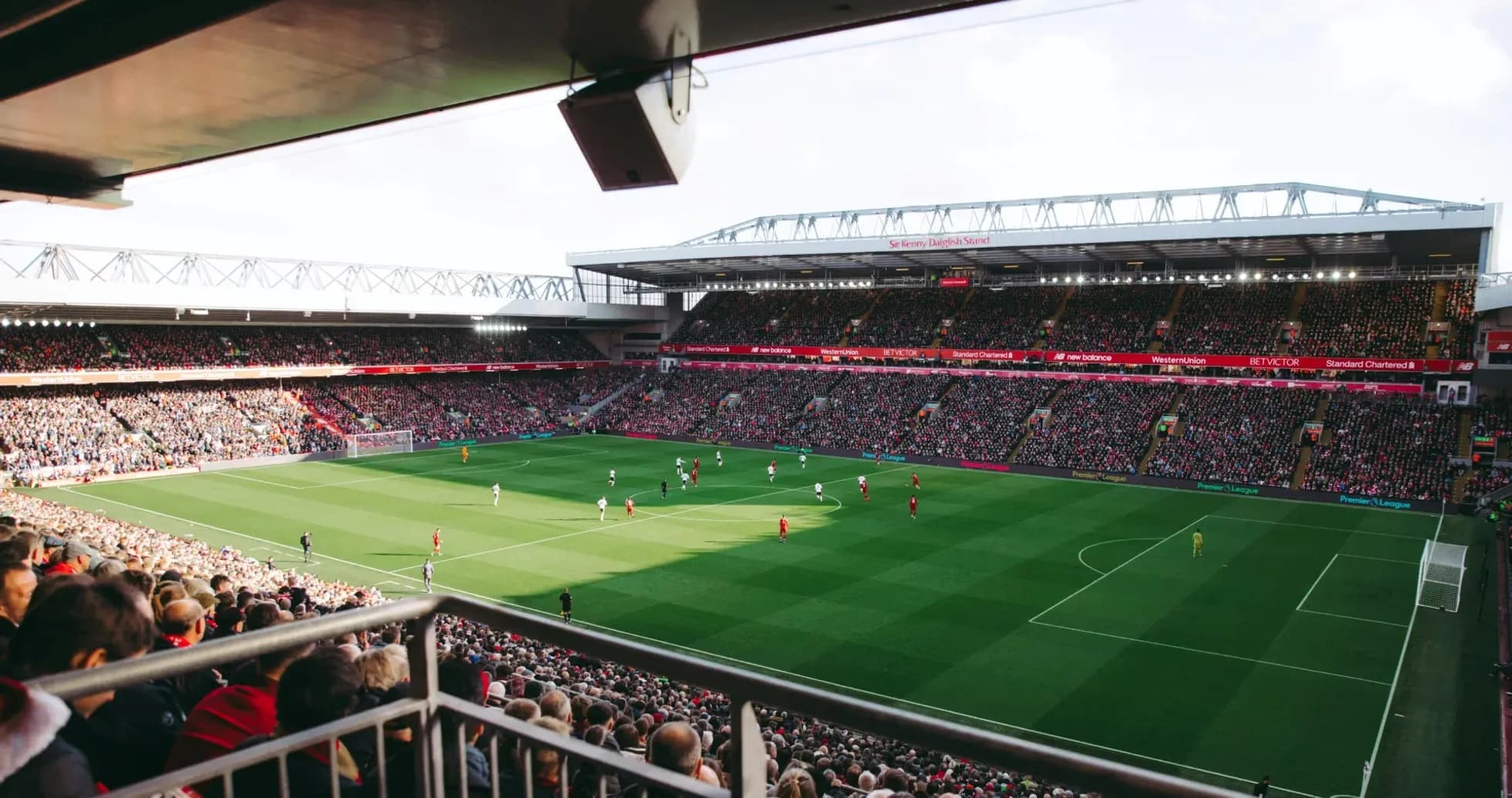
Ferencvarosi TC Dominates Vojvodina with 3-0 Victory
Ferencvarosi TC’s 3-0 win over Vojvodina at Groupama Aréna was built on structural superiority and ruthless exploitation of the visitors’ early indiscipline. Both sides nominally lined up in a 4-3-3, but the game state was effectively reshaped by Kornél Szűcs’ red card at 9 minutes, which left Vojvodina’s back line and midfield constantly in emergency mode. From that point, Ferencvaros controlled territory and tempo, turning their extra man into layered occupation of the half-spaces and wide channels, while Vojvodina were forced into a low, narrow block with very limited counter-attacking threat.
Ferencvarosi TC’s 4-3-3 had a clear ball-progression spine. M. Gomez and T. Raemaekers formed the central defensive pairing, with Cadu and A. Osvath nominally listed as midfielders but functionally operating as hybrid wide defenders/half-space outlets on either side. In front of them, the trio of G. Kanichowsky, Naby Keïta and M. Corbu provided the positional rotations: Keïta as the main tempo-setter in central zones, Kanichowsky stepping higher between the lines, and Corbu often dropping to support the first phase. This structure allowed Ferencvaros to keep rest defense in place against a numerically reduced opponent while still committing numbers forward.
Up front, the attacking triangle of K. Zachariassen, L. Joseph and Dele was decisive. Zachariassen’s role was especially influential: he started as a right-sided midfielder/inside forward but continually attacked the right half-space, combining with Joseph and Dele and arriving into the box as a late runner. That movement underpinned the opening goal at 27 minutes, when L. Joseph (Ferencvarosi TC) scored, assisted by K. Zachariassen, for 1-0. The pattern encapsulated the tactical idea: Zachariassen dragging defenders out of the line, Joseph attacking the space that opened.
The second goal at 34 minutes deepened that theme. K. Zachariassen (Ferencvarosi TC) scored, assisted by Cadu, to make it 2-0. Here, Cadu’s advanced positioning on the left side of the structure was key. Listed as a midfielder, he effectively behaved like an attacking full-back, stepping high to deliver the final ball. With Vojvodina already down to ten, their 4-3-3 flattened into a 4-4-1 out of possession, and the far-side full-back was repeatedly overloaded. Zachariassen’s timing into the box punished that imbalance, and the 2-0 scoreline at half-time accurately reflected Ferencvaros’ ability to turn positional dominance into end-product.
Out of possession, Ferencvarosi TC were rarely stretched. The front three initiated a controlled press, with Joseph leading and Dele curving runs to screen passes into midfield. Behind them, Keïta and Corbu maintained compact vertical distances to prevent Vojvodina from playing through the central corridor. The fact that Vojvodina’s only early flashpoint was Szűcs’ red card for “Foul” at 9 minutes speaks to their difficulty in sustaining any structured possession high up the pitch; they were more often reacting to Ferencvaros’ circulation than constructing their own.
Vojvodina’s 4-3-3, on paper, had a balanced spine: D. Rosic in goal, a back four of L. Nikolic, K. Szűcs, D. Crnomarkovic and Lucas Barros, and a midfield three of L. Randjelovic, I. Djakovac and N. Petrovic. Ahead of them, P. Sukacev and D. Zukic supported central forward A. Vukanovic. However, the early dismissal forced continuous reshuffling. With Szűcs sent off, the visitors had to compress their back line and sacrifice one attacking reference to restore defensive stability. The substitutions on the hour — M. Vidosavljevic (IN) for D. Zukic (OUT) and D. Kokanovic (IN) for A. Vukanovic (OUT) — further underlined a shift towards ball retention and midfield legs rather than direct threat in behind.
From 60 minutes onward, the match became about Ferencvaros managing energy and structure. On 61 minutes, E. Acolatse (IN) came on for Dele (OUT), and Z. Gruber (IN) came on for G. Kanichowsky (OUT), refreshing the front line while keeping the same positional framework. Acolatse offered vertical runs from wide, while Gruber operated as a flexible forward, dropping between lines and attacking the box when the ball went wide. This paid off at 71 minutes, when Z. Gruber (Ferencvarosi TC) scored, assisted by Cadu, for 3-0. Once again, Cadu’s advanced role on the flank was crucial, providing delivery from high wide zones against a tiring, undermanned defense.
The later substitutions by Balazs Borbely were about load management without compromising control. At 74 minutes, K. Lisztes (IN) came on for K. Zachariassen (OUT) and E. Sevikyan (IN) came on for L. Joseph (OUT), maintaining the intensity of the press and the ability to attack spaces between full-back and center-back. At 82 minutes, O. Nagy (IN) came on for A. Osvath (OUT), allowing Ferencvaros to close out the game with fresh legs in wide defensive zones.
Vojvodina’s changes at 76 minutes — S. Mitrovic (IN) for L. Randjelovic (OUT) and M. Kolarevic (IN) for P. Sukacev (OUT) — and at 84 minutes — L. Peranovic (IN) for I. Djakovac (OUT) — were attempts to inject energy and perhaps find transitional outlets, but by then the pattern was fixed. Reduced to ten men, with limited time on the ball, they could not create the multi-player combinations required to unbalance Ferencvaros’ settled block.
Discipline further shaped the tactical tone. Vojvodina finished with 1 yellow card and 1 red card, Ferencvarosi TC with 2 yellow cards; total cards: 4. The full disciplinary log, in chronological order, was:
- -5' Siniša Tanjga (Vojvodina) — Yellow Card (no reason provided)
- 9' Kornél Szűcs (Vojvodina) — Red Card — Foul
- 69' Cadu (Ferencvarosi TC) — Yellow Card — Foul
- 82' Ifet Đakovac (Vojvodina) — Yellow Card — Foul
- 88' Naby Keïta (Ferencvarosi TC) — Yellow Card — Foul
The clustering of Vojvodina’s cards around defensive incidents (“Foul”) reflected their reactive posture and repeated need to break Ferencvaros’ rhythm with last-ditch interventions. In contrast, Ferencvaros’ bookings for Cadu and Keïta came with the game largely under control, more as isolated duels than systemic strain.
Statistically, many advanced metrics are unavailable, but the known data on discipline aligns with the tactical picture: Ferencvarosi TC, with 2 yellow cards and no reds, could maintain their structure and press throughout, while Vojvodina’s 1 yellow and 1 red meant they defended long stretches a man down and with key defensive personnel compromised. The 3-0 final score, following a 2-0 half-time lead, is consistent with a match in which the home side translated numerical superiority and coherent positional play into repeated high-quality attacking patterns, while the visitors, structurally damaged by the early dismissal, were left to contain rather than contest.