FK Crvena Zvezda Dominates Plzen in 3-0 Victory
FK Crvena Zvezda’s 3–0 win over Plzen at Stadium Rajko Mitić was built on a clear structural superiority within Albert Riera’s 4-3-3 against Martin Hysky’s 4-4-1-1, more than on raw volume of chances. With both sides splitting possession at 50% each, the difference lay in how effectively Zvezda converted their territorial phases into high-quality shots and how they controlled transitions once ahead.
Riera’s shape was very positional. The back four of Seol Young-Woo, D. Luckassen, M. Veljkovic and T. Elsnik had a natural asymmetry: Elsnik, listed as a midfielder but deployed in the back line, gave Zvezda an extra playmaking angle from deep on the left, while Seol offered a more orthodox right-back presence. In front of them, the midfield triangle of M. Ivanic, R. Krunic and V. Kostov provided both verticality and circulation. Ivanic, notionally the more advanced of the three, repeatedly found pockets between Plzen’s double pivot and back line, which proved decisive for the first two goals.
High up, the front three of O. Bukari, M. Arnautovic and M. Cham stretched Plzen’s 4-4-1-1 horizontally. Bukari and Cham stayed wide enough to pin A. Memic and M. Doski, preventing them from stepping into midfield. That locked Plzen’s full-backs deep and left their wide midfielders, T. Ladra and C. Souare, having to choose between helping centrally or protecting the flanks. Zvezda exploited this indecision by playing early into Ivanic’s feet between the lines, with Krunic and Kostov close enough to counter-press whenever possession was lost.
Plzen’s 4-4-1-1, with P. Adu ahead of P. Hrošovský, was designed to be compact and direct. However, they struggled to turn their 5 shots on goal into sustained pressure. Their two blocked shots show that when they did reach the edge of the box, Zvezda’s centre-backs and the dropping midfielders were quick to close down shooting lanes. The structure often left Adu isolated; vertical connections into him were sporadic, and once he received, the support from the second line arrived too late to destabilise Zvezda’s back four.
Goals
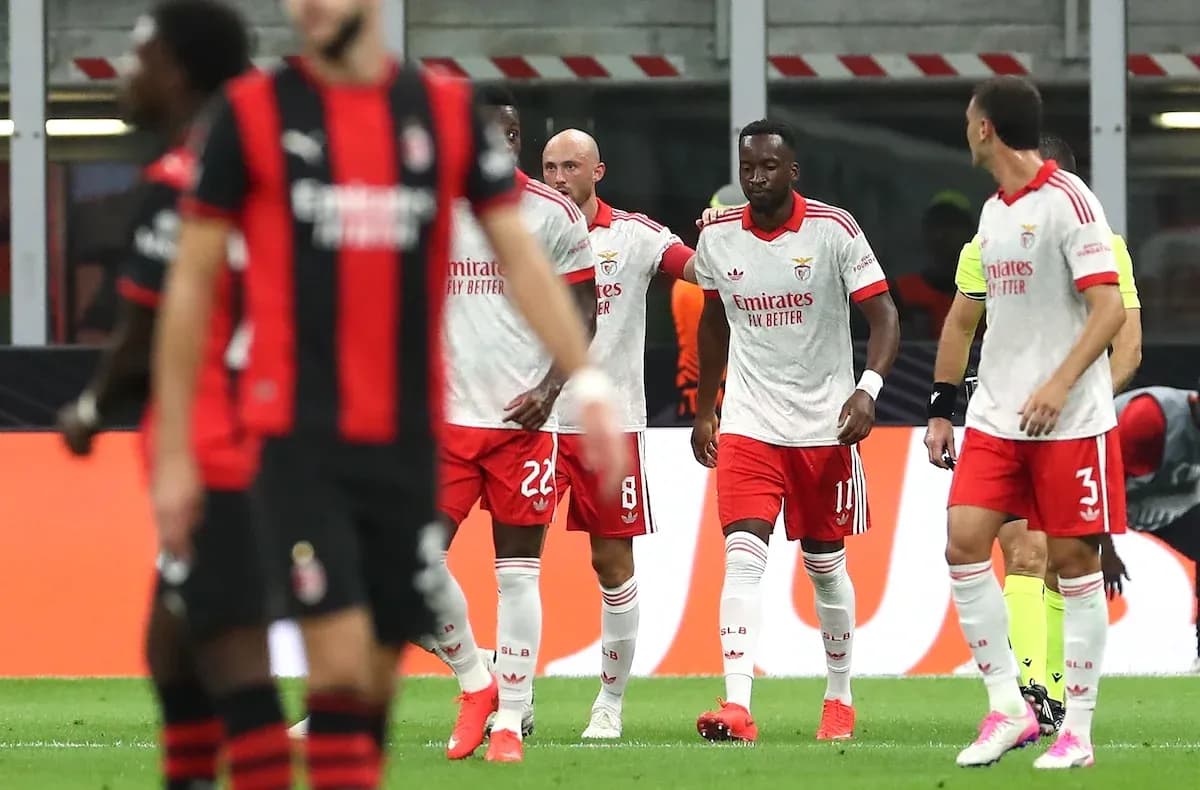
The first Ivanic goal at 36’ encapsulated Zvezda’s plan: a midfield runner from deep (Elsnik with the assist) finding the advanced eight (Ivanic) in a channel opened by wide occupation from the front three. Once ahead, Zvezda could compress the game into zones where their technical superiority in tight spaces told. The second Ivanic strike at 53’ came in a similar pattern of exploiting the half-space, confirming Plzen’s inability to adjust their line heights or add an extra body centrally.
Substitutions did not alter the basic tactical script but rather reinforced it. For Plzen, the early second-half change of C. Souare (OUT) for C. Kabongo (IN) at 46’ was a clear attempt to refresh the wide threat and add more direct running, but the structure remained 4-4-1-1. Later, T. Ladra (OUT) for S. Pirgic (IN) at 61’, and then F. Prebsl (OUT) for D. Visinsky (IN) plus P. Adu (OUT) for M. Vydra (IN) at 73’, suggested a shift toward more attacking profiles, but without a significant reconfiguration of the base shape. The lack of an extra central midfielder or a second player between the lines meant Zvezda’s midfield triangle was rarely outnumbered.
Riera’s changes were more about game management. At 72’, M. Arnautovic (OUT) for J. Enem (IN) and M. Ivanic (OUT) for A. Katai (IN) allowed fresh legs up front while maintaining the same positional blueprint: a central reference point and a creative presence in the left half-space. Later, V. Kostov (OUT) for M. Bajo (IN) at 84’ and D. Luckassen (OUT) for F. Tebo Uchenna (IN) at 85’ added energy and defensive security. The final change, O. Bukari (OUT) for L. Loizou (IN) at 90’, was a classic late rotation to preserve intensity in wide pressing.
The third goal, Katai’s penalty at 89’ confirmed by VAR at 90’, was more about game state than structure: Plzen, chasing the game, had to open up, and Zvezda’s attackers were able to attack more space and provoke errors in the box. By then, the tactical battle was effectively decided.
Statistics
Statistically, the match underlines Zvezda’s efficiency. They produced 7 shots on goal to Plzen’s 5, despite both teams registering the same 50% share of possession. Zvezda needed fewer total attacking phases to generate clear attempts, a reflection of how well their 4-3-3 manipulated Plzen’s lines. The hosts’ 1 blocked shot versus Plzen’s 2 also hints at cleaner shooting opportunities for Riera’s side, while Plzen were often forced into more congested, lower-quality efforts.
Discipline tilted slightly against Plzen, who collected 4 yellow cards to Zvezda’s 2. While no explicit reasons are recorded, the distribution aligns with the tactical story: a trailing side committing more interruptions to break Zvezda’s rhythm and counter-attacks. Fouls were close (6 by Plzen, 5 by Zvezda), but the card count indicates that Plzen’s infringements were more often in situations the referee deemed worthy of sanctions, likely in higher-risk zones or in stopping promising moves.
Neither team’s passing metrics or xG are available, but the pattern of shots on goal and the 3–0 scoreline suggest that Zvezda’s possession was of higher attacking value. With no recorded goalkeeper saves data, we cannot quantify the contributions of Matheus (FK Crvena Zvezda) or F. Wiegele (Plzen), yet the shot profile implies that Matheus faced danger but within a controlled defensive structure, whereas Wiegele had to deal with more incisive, well-constructed attacks.
Overall, this was a textbook example of a 4-3-3 outplaying a 4-4-1-1 through superior use of half-spaces, better spacing between the lines, and more coherent in-possession mechanisms, turning a level-possession match into a comfortable 3–0 victory.