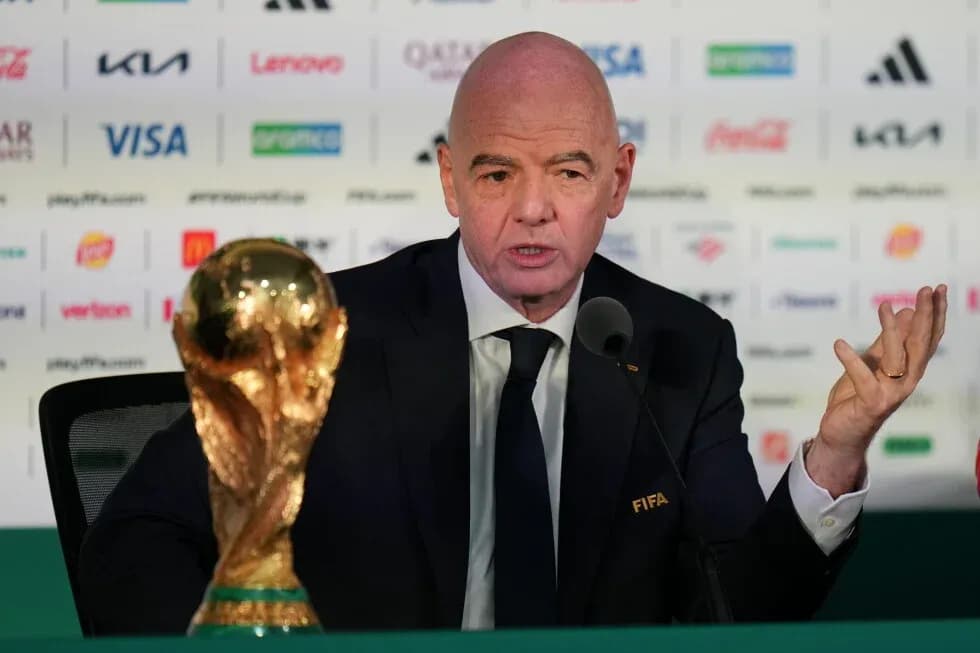
Gianni Infantino's Bold Proposal: $20 Million Each for FIFA Federations
Gianni Infantino has never been shy about pushing boundaries. On Wednesday in Geneva, he shoved world football to the edge of its latest fault line.
The FIFA president has given the organization’s 211 member federations a stark choice and a tight clock: accept a one-off $20 million payout each by Sept. 19 as part of a plan to sell a stake in the World Cup and other flagship competitions to private investors, or walk away and settle for half that amount.
At the heart of the proposal is a new $20 billion FIFA subsidiary, tentatively titled FIFA Forward Enterprise, 20% of which would be sold to outside investors. The project is anchored by Thrive Capital, the investment firm of Joshua Kushner — brother of Jared Kushner — and would hand a 12‑year slice of FIFA’s commercial future to Wall Street and its partners. J.P. Morgan has been lined up to lead the process.
Infantino sold it in a letter to federations as a “singular and unique funding opportunity,” insisting, “It is my duty and responsibility as FIFA president to present such game-changing opportunities to you, our members.”
The backlash was instant, and fierce.
UEFA leads the revolt
In Europe, the alarm bells started ringing the moment the plan became public. UEFA, already blindsided by the announcement, moved to convene its 55 member federations for an emergency online meeting, likely on Thursday.
“UEFA knows there is significant and growing opposition to FIFA’s scheme,” the organization said in a pointed statement, adding a line that cut to the core of the argument: the World Cup “is not FIFA’s to sell.”
The anger in Nyon is not just about money. It is about power, control, and the shape of the global calendar. UEFA, which runs the Champions League and European Championship, sees a direct threat to its own competitions if FIFA is incentivized to stage more World Cups and Club World Cups, with more teams, more often, to feed investor expectations.
One option sits on the table, unspoken in public but very real in private: a boycott. European federations have used that threat before. In 2021, UEFA‑led resistance helped kill Infantino’s plan to hold the men’s World Cup every two years instead of four.
The European Football Clubs group, which has a joint venture with UEFA to manage the Champions League, made clear how shut out it felt this time. It “learned about this proposal in the same way as most global football stakeholders — without warning and through the media.”
That sense of being railroaded has become a recurring theme of Infantino’s presidency.
A pattern of power plays
This is not the first time Infantino has tried to drag the game into a new commercial era with limited consultation.
In 2018, he attempted to push through a secretive $25 billion private equity deal to create expanded men’s competitions. UEFA resisted and the project stalled. He launched a FIFA Peace Prize, then awarded it to Donald Trump in December at the World Cup draw. He was also central to a process that allowed United States forward Folarin Balogun to feature at the World Cup, with Trump intervening along the way.
Now, he is again courting money from the orbit of the former U.S. president, aligning FIFA with Joshua Kushner’s Thrive Capital in a move that would lock in private investors for more than a decade.
This week’s proposal has rattled not only Europe but other confederations that usually tread more carefully in public.
CONCACAF, the North and Central American and Caribbean body, said it was “deeply concerned by the lack of due process.” The Asian Football Confederation, based in Kuala Lumpur, said it was “disappointed that a matter of such significance entered the public domain before the AFC family had been afforded the opportunity to examine and discuss it.”
The message from across the map was clear: the world’s biggest decisions are being made in Zurich, then dropped on everyone else as a fait accompli.
The money on the table
Infantino’s pitch is brutally simple.
If the new FIFA Forward Enterprise is approved by a majority of the 211 members, each federation would receive $20 million from the four-year commercial cycle tied to the men’s 2030 World Cup. If the plan is rejected, they get the previously promised $10 million over the next four years.
Over 12 years, the difference is stark. Infantino’s letter suggests a total of about $86 million per federation under the new model, compared with roughly $36 million if the private equity plan is turned down.
For dozens of smaller federations — many with no realistic chance of qualifying for a World Cup, whose best players rarely reach elite club competitions, and which depend heavily on FIFA money just to function — that extra $50 million is transformative. Training centers, pitches, staff, youth programs: it all costs, and FIFA’s dollars keep the lights on.
This is where Infantino’s political calculus comes in. FIFA’s one-member, one-vote system means that the global heavyweights on the pitch can be easily outvoted by nations that rarely appear on the biggest stages. The president has long understood that promising more money to those members is the surest route to securing power.
He did it in 2016 when he first won the job, centering his election-day speech on increased funding. He did it again, unopposed, in 2019 and 2023. Now, with a fourth and final term in sight through 2031, he is betting that cheques will once more beat criticism.
The cost of commodifying the World Cup
Not everyone is looking at the balance sheet. Some are staring at what this does to the sport itself.
Sports governance scholar Antoine Duval warned that inviting private investors into FIFA could “incentivize FIFA to further commodify the World Cup (think more hydration breaks and dynamic pricing) in a drive to increase its revenue.”
That is the crux of the unease. Once investors own a slice of the World Cup’s commercial rights, the pressure to squeeze every last cent from the product will intensify. More matches. More teams. More tournaments. More stoppages. Ticket prices that fluctuate with demand. The World Cup as a financial instrument, not just a football festival.
UEFA’s reaction to the rushed Sept. 19 deadline captured that suspicion. The haste, it said, “says everything you need to know about this plan.” The parting shot was even sharper: “FIFA cannot continue to use our sport to enrich themselves and their friends.”
Political fire from Britain
The resistance has not been confined to football’s corridors of power.
In Britain, Prime Minister Andy Burnham moved quickly to condemn the proposal. His government is preparing to back a joint bid from England, Scotland, Wales and Ireland to host the 2035 Women’s World Cup, a tournament FIFA is expected to award at an online meeting in November.
“Football does not belong to investors,” Burnham, a long‑time fan, said in a video message on Instagram. “Once you have sold a piece of (the World Cup), you have sold out. Football belongs to the fans. It always has, and it always will.”
British politicians have form in this arena. In 2021, threats of legislation from then‑Prime Minister Boris Johnson helped crush the European Super League, a breakaway that posed an existential threat to the Champions League and was quietly encouraged by Infantino. Now, the same political muscle could be flexed against FIFA’s latest project.
Infantino’s endgame
Behind the numbers and the outrage lies a more personal question: what does Gianni Infantino want his role in football to be?
Officially, he is on course for a final term as FIFA president, ending in 2031. Unofficially, some observers have long suspected he is eyeing a more corporate, longer‑term position at the heart of the game’s commercial engine — something closer to a CEO or commissioner role within a powerful FIFA subsidiary like the proposed FFE.
If that entity controls competitions, events and billions in revenue, it becomes more than just a side project. It becomes the beating financial heart of global football. And whoever runs it, runs a lot.
This week’s move has stirred frustration with Infantino’s leadership far beyond the usual critics in Europe. With almost four months left before the Nov. 18 deadline to register candidates for the next FIFA presidential election — scheduled for March 18 in Rabat, Morocco, a key Infantino ally and co‑host of the 2030 World Cup — there is, for the first time in years, open talk of a challenge.
The federations now face a stark decision: take the money and accept a future in which the World Cup is part‑owned by private investors, or reject the deal and risk standing in the way of the man who has made himself the game’s most powerful figure.
The clock is ticking to Sept. 19. The question is whether football’s leaders will cash in, or finally decide that some things in this sport are not for sale.