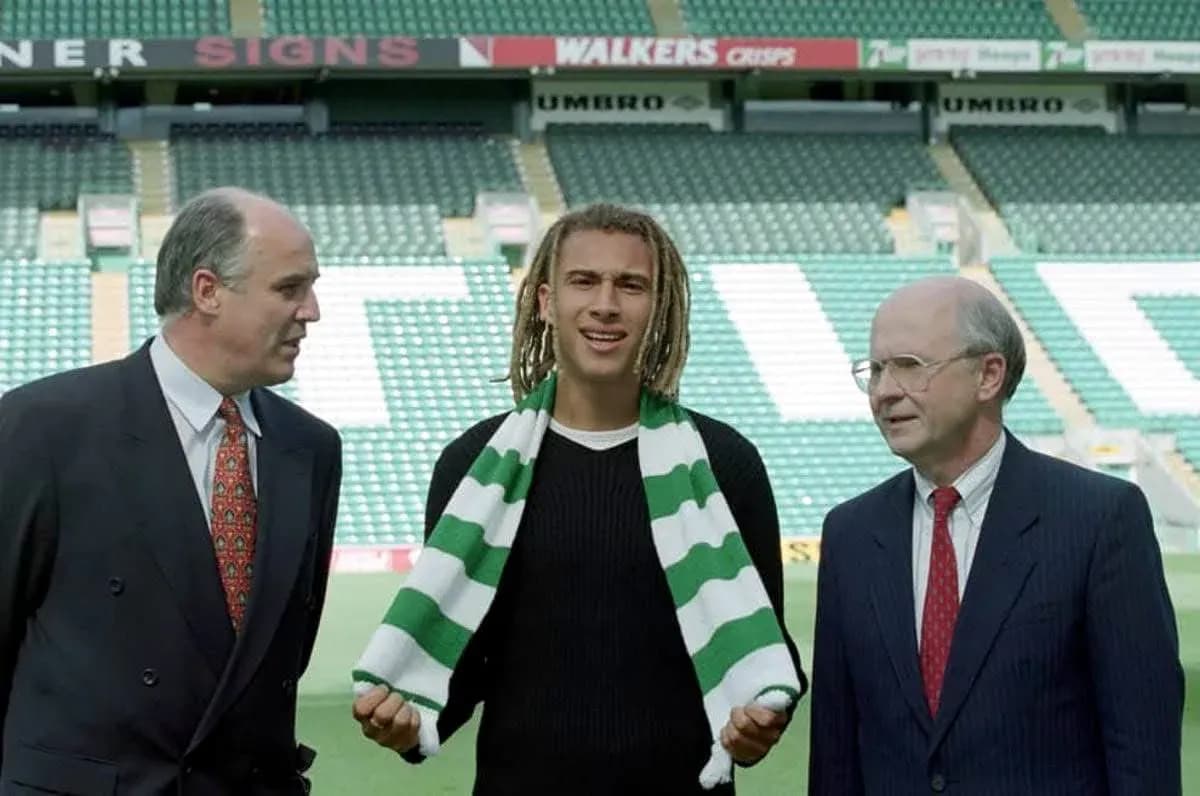
Henrik Larsson: The King of Kings at Celtic
On a warm July day in 1997, a slight, dreadlocked forward in a Hoops top and denim strolled onto the Celtic Park turf and changed the club’s modern history.
Henrik Larsson had arrived.
A Bargain That Rewrote the Record Books
Celtic paid just £650,000 to bring Larsson from Feyenoord, a fee that even then felt shrewd. New manager Wim Jansen knew exactly what he was doing. He had signed Larsson for the Dutch club a few years earlier and understood the clause in his contract that made him attainable.
It turned out to be one of the great bargains in British football.
Larsson did not glide into Glasgow as a ready-made idol. His first competitive outing is remembered for the wrong reason: a misplaced pass at Easter Road that helped Hibernian to an opening-day win. For a moment, the whispers began.
They didn’t last long.
Game by game, goal by goal, the Swede won over a support desperate for a new hero. The dreadlocks, the work-rate, the eye for goal – it all began to click. By the end of that first season, Celtic had a League Cup in the cabinet and, far more importantly, a first league title in a decade.
They had stopped Rangers’ bid for ten in a row. Larsson was at the heart of it.
From Shaky Start to Complete Striker
If his debut campaign announced him, the next one defined him. Under Dr Jozef Venglos, Larsson evolved from clever forward into complete striker. He scored 38 goals in that second season, a staggering haul that showcased the full range of his finishing – headers, volleys, tap-ins, solo runs.
He was no longer just a good signing. He was the focal point of a team being rebuilt around him.
Then came Lyon.
A horrific leg break in European competition threatened to halt everything. For many players, that kind of injury leaves a permanent mark, physically and mentally. Larsson refused to let it write his story. He came back leaner, sharper, somehow even more ruthless in front of goal.
That period of instability at Celtic, which contributed to John Barnes’ short reign ending abruptly, only underlined Larsson’s importance. When the club wobbled, he remained the constant.
The O’Neill Era and a Ruthless Partnership
Martin O’Neill’s arrival in 2000 lit the fuse on Celtic’s modern golden era, and Larsson stood at the centre of it. Paired with Chris Sutton, he formed a devastating partnership that bullied defences at home and abroad.
The numbers from O’Neill’s first season still stop you in your tracks. Larsson scored 53 goals as Celtic swept to a domestic treble – league, Scottish Cup, League Cup – the club’s first clean sweep in 32 years.
He wasn’t just scoring. He was dictating the biggest games, dragging Celtic through them. The 6–2 demolition of Rangers at Celtic Park in August 2000, with Larsson’s impudent chip over Stefan Klos, remains one of the defining images of that era. It summed him up: audacious, clinical, utterly sure of himself.
Europe Takes Notice
The domestic dominance was one thing. The European run that followed cemented his reputation beyond Scotland.
Larsson’s goals powered Celtic all the way to the UEFA Cup Final, a stage that had felt distant when he first pulled on the shirt. In Seville, against Porto, he rose to the occasion again, scoring two world-class headers in a breathless final that went to extra-time.
Celtic lost, but Larsson’s performance on that night only reinforced his status as a forward who belonged on the biggest stage. He was no longer just a hero in Glasgow. Europe had taken note.
A Legacy Written in Goals
By the time he left Celtic in 2004, the numbers were almost surreal. Larsson scored 242 goals in 313 appearances, placing him third on the club’s all-time scoring list in its unbroken history.
Those are the cold facts. They don’t quite capture the feeling.
He bowed out as a Scottish Cup winner, scoring in the 2004 final victory over Dunfermline. It was a fitting farewell: one more big occasion, one more decisive contribution, one more reminder that when Celtic needed him, he delivered.
For many supporters, he is not just a legend. He is the legend.
The King of Kings
Older generations will rightly invoke Jimmy Johnstone and the Lisbon Lions, names etched into the very fabric of Celtic. Those who grew up in the 1970s will point to Kenny Dalglish, another King who went on to become Liverpool’s greatest ever player.
Yet ask the majority of Celtic fans who have filled the stands from the late 1990s onwards, and one name dominates the conversation.
Henrik Larsson.
The King of Kings.
Twenty-nine years on from the day he first walked across that turf in a Hoops top and denims, his place in Celtic’s story is unshakeable. Not just as a scorer of goals, but as the man who helped drag the club out of a dark period and into a new age of belief.
The question now, as every new forward is measured against his shadow, is simple: will Celtic ever see his like again?