Iran's World Cup Challenge Amidst Political Tension
The World Cup has seen troubled teams before. Few have walked into it carrying this much weight.
Iran arrive in the United States with a squad, a game plan – and the shadow of a conflict that was still active until days ago. Until this week, the host nation and Iran were at war. On Sunday, an agreement to halt hostilities and reopen the Strait of Hormuz finally came. It cooled talk of escalation. It did not cool the atmosphere.
On Monday night at SoFi Stadium in Los Angeles (Tuesday, 02:00 BST), Iran will open their World Cup against New Zealand. It will be a football match staged in the middle of a political storm.
A World Cup under strain
From the moment Iran qualified, nothing has been straightforward. The team’s build-up has been cut by visa complications, security concerns and a late change of base camp. Months of uncertainty ended with a move from Tucson, Arizona, to Tijuana on the Mexican border, a decision born not of sporting logic but of necessity.
Head coach Amir Ghalenoei did not pretend the disruption had passed unnoticed.
"Without any doubt, this kind of behaviour has impacted the spirit of football," he told the BBC. For him, a World Cup should be about nations and cultures coming together, about joy. Instead, he has been trying to patch together preparations in a climate where politics keeps barging through the dressing-room door.
He spoke of late arrival, of little time to adjust, of a squad forced to adapt on the fly. Then he circled back to what he can control.
"I have tried to make sure the players concentrate on strategy and performance," he said. "I know how committed these players are to performing."
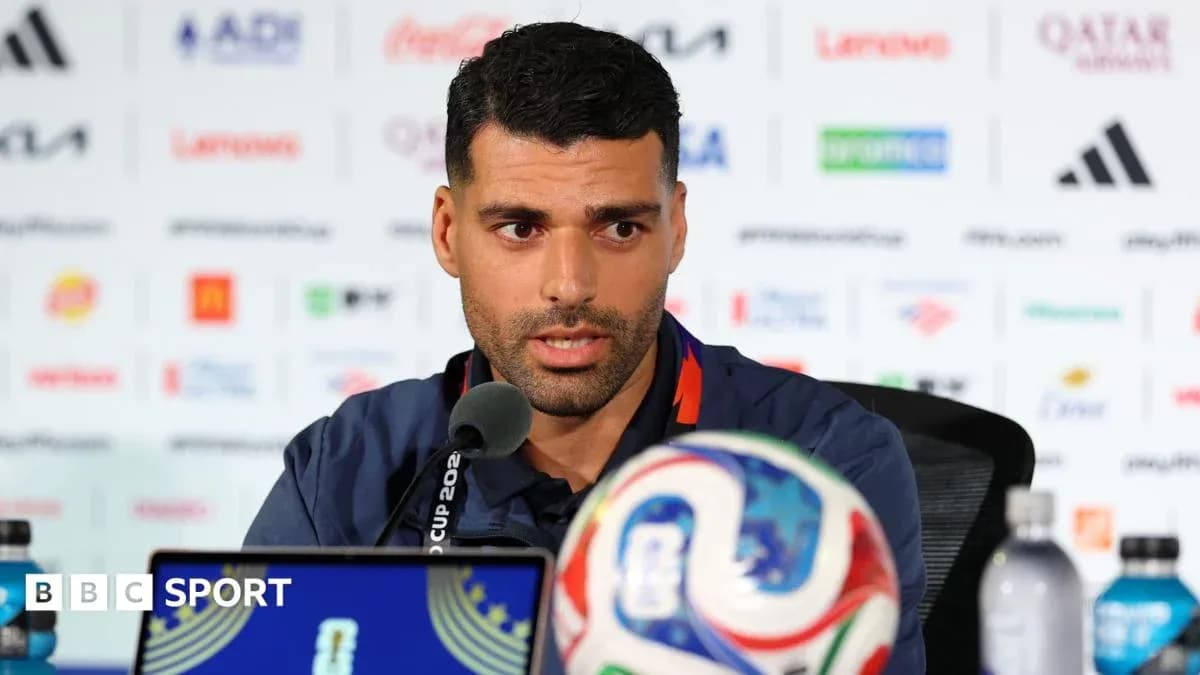
His striker, Mehdi Taremi, felt the strain the moment they landed.
"I felt the tension from the first moment we arrived," he said. "The tension started even before we got here."
Tehrangeles, and a divided crowd
Los Angeles is often called "Tehrangeles", a nod to the vast Iranian community that has made the city its own. The nickname drew a smile from both Ghalenoei and Taremi at the news conference. They know what awaits them.
SoFi Stadium will not just be a venue. It will be a meeting point for one of the world’s largest Iranian diasporas, many of whom fled or left after the revolution, many of whom remain fiercely opposed to the regime in Tehran.
Plenty will come with flags and banners. Not all of them will come to cheer.
Fifa’s decision to ban the pre-revolutionary Lion and Sun flag – a powerful emblem for many Iranians abroad – has lit a fresh fuse. For sections of the diaspora, it is not a technical ruling. It is an affront.
"You don't come to Los Angeles and tell us we can't fly the Lion and Sun flag," said activist Arezo Rashidian, who is helping organise demonstrations outside the stadium. "This is the largest Iranian community outside Iran. Many of us came here after the revolution. We're opposing Fifa's ban and standing in solidarity with the people of Iran."
Her words cut to the core of the tension. Many in the diaspora view the national team not as a neutral sporting entity but as an arm, however unwilling, of the Islamic Republic.
"It's unfortunate that the regime turns athletes into mouthpieces," Rashidian said. "We want athletes to remain athletes."
Yet even with that anger, she and others will still walk through the turnstiles.
"We understand the pressure they're under," she said. "We'll carry our colours. We'll cheer for Iran – the country – held captive by the Islamic Republic."
So the scene is set: protests outside, divided loyalties inside, a team caught in the middle.
A squad squeezed from all sides
Inside the Iranian camp, the message is consistent. The players insist they are here to play football, not politics.
"As players of the national team, we play for every single Iranian, whether in the diaspora or in Iran," Taremi said. He talked of unity, of bringing joy, of respecting the right to different opinions. Then he drew a line.
"We don't get involved in politics."
That is the ideal. The reality looks very different.
Investigative football journalist Samindra Kunti captured the dilemma in stark terms.
"There is no winning for Iran's team," he said. "Given the circumstances, the political pressure, the location of the matches and the diaspora in Los Angeles, they're under enormous pressure. It's impossible to avoid the politics. Everything becomes a reminder of their situation."
Pressure from home. Pressure from the host nation. Pressure from a diaspora determined to be heard. All of it converging on a group of players who have barely had time to settle, let alone breathe.
On Monday, when Iran walk out at SoFi Stadium, the scoreboard will say Iran v New Zealand. The noise around it will say something far louder: can this team possibly play a simple game of football when every pass, every anthem, every flag in the stands carries a meaning far beyond the pitch?