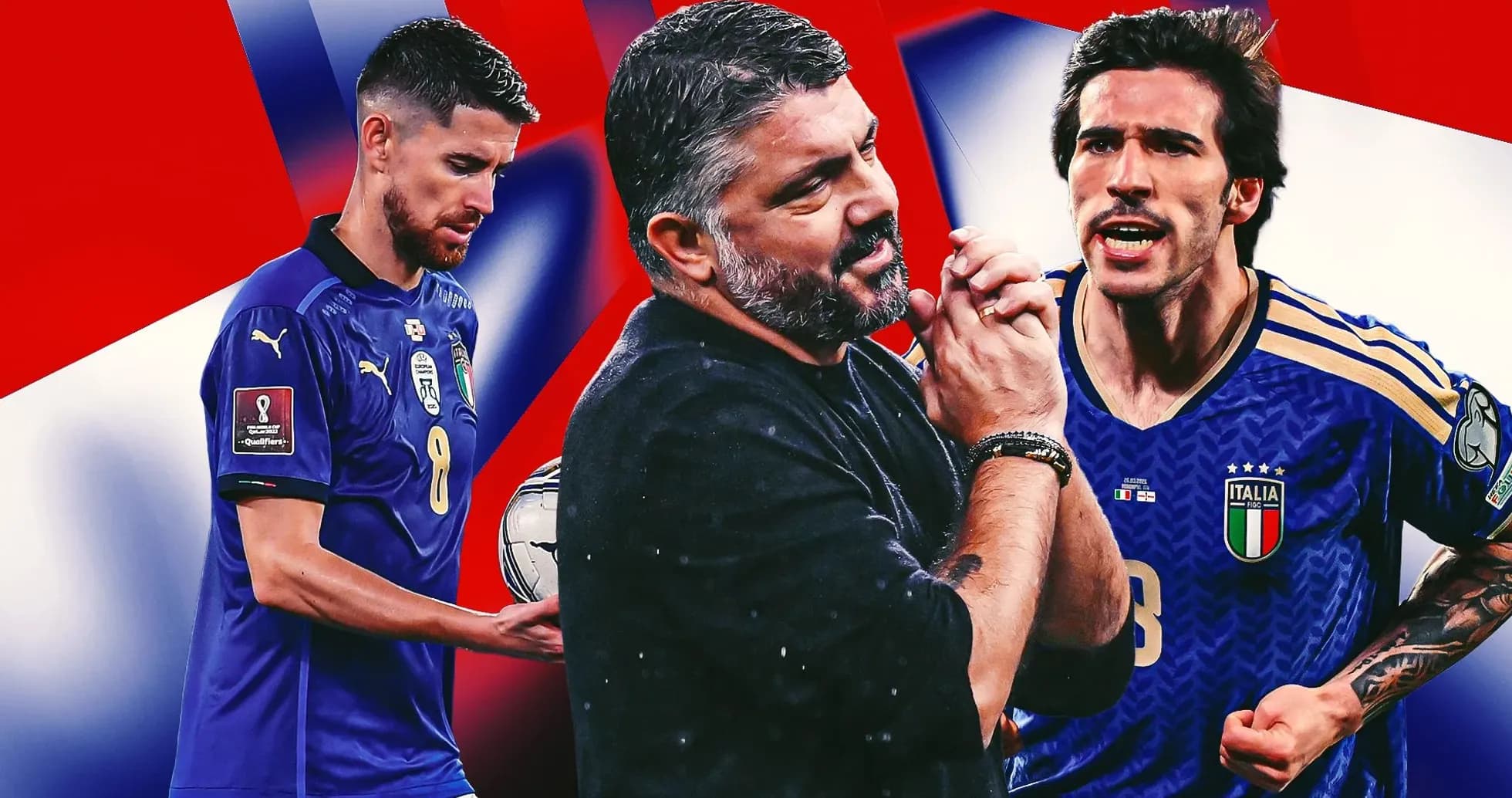
Italy's Struggles Under Spalletti and Gattuso's Challenge
Italy were not just drifting; they were sinking.
When Luciano Spalletti walked away last summer, he left behind a national team stripped of conviction and stripped of ideas. The man who had been hailed as the perfect heir to Roberto Mancini – fresh from delivering Napoli’s first Scudetto since Diego Maradona – departed with his reputation battered by a wretched Euro 2024 campaign.
He had done the bare minimum by getting Italy to Germany. What followed was a title defence in name only. A squad light on star quality was made to look even weaker by a series of muddled tactical calls and baffling selections. Italy scrambled out of the group only thanks to a 98th-minute equaliser against Croatia, then folded with barely a whimper against Switzerland. It was the kind of meek exit that lingers.
Spalletti needed a blazing start to the 2026 World Cup qualifiers to steady everything again.
He got the opposite.
On June 6 in Oslo, Norway tore Italy apart 3-0. The margin flattered the visitors. From first whistle to last, Spalletti’s side were unrecognisable as a major football nation: no structure, no resistance, no personality.
“I have no words,” Gigi Donnarumma said afterwards, visibly stunned. “All I can say is that our fans don't deserve this, and we have to find strength from somewhere, because we're Italy and these types of matches are not acceptable."
Spalletti could only agree. “We need to find something more,” he admitted. “Otherwise, something has got to change.”
Something did. Him.
The FIGC decided his time was up after the humiliation in Oslo, though he was allowed to remain on the bench for a 2-0 win over Moldova three days later to soften the shock. The result barely mattered. Italy’s qualification hopes looked fragile, and the list of credible successors looked even thinner.
Claudio Ranieri, the romantic choice, stayed true to his word and refused to abandon his new advisory role at Roma after retiring from coaching at the end of 2024-25. Stefano Pioli chose the project at Fiorentina. The federation had to think differently.
They turned to the past.
The idea was simple: revive the spirit of 2006 by handing the reins to one of Marcello Lippi’s World Cup winners. Daniele De Rossi and Fabio Cannavaro were discussed. Gabriele Gravina, though, chose Gennaro Gattuso – the snarling heartbeat of that Berlin triumph, but a coach with a mixed record.
“He has the qualities, the determination and above all the desire to achieve something great for the Azzurri and our country,” Gravina insisted. He spoke of sacrifice, professionalism, preparation. What impressed him most was Gattuso’s instinct to put “us” before “I”. This was not about nostalgia alone; Gravina was convinced he had hired a “man of results”, someone who knew the pressure-cooker of Italian football from Napoli to Milan and had a track record of working with young players.
Gattuso, as ever, did not hesitate. He jumped in.
Whether he can drag Italy all the way back to a World Cup remains unanswered. What is clear is that he has at least dragged them to the brink – somewhere they have not been since 2014.
The numbers can mislead. Italy’s group campaign began and ended with heavy, three-goal defeats to Norway. In November at San Siro, once Erling Haaland and his teammates cranked up the tempo, Gattuso’s side collapsed again in a 4-1 loss. The coach admitted as much: when the pressure rose, Italy buckled.
So, has anything really changed?
Look closer. The trajectory is different. The two meetings with Israel tell the story. In Debrecen, Italy were chaotic and exposed in a wild 5-4 win, clinging on more than controlling. By the time they met again in Udine in October, the Azzurri were almost unrecognisable: disciplined, compact, secure in a 3-0 victory.
The most striking shift under Gattuso is intangible but obvious: unity.
Sandro Tonali spoke about it after the win over Northern Ireland. The mood had changed, he said; the squad had “been feeling positive since the coach arrived”. Gattuso’s tactical ideas still divide opinion, but his energy and emotional clarity have clearly bound this group together.
“The coach has so much love for the Azzurri shirt,” Moise Kean told Sky Sport Italia. “He pushes us to never give up.”
That passion, though, is not the whole story. Against Northern Ireland in the play-off semi-final, Gattuso also showed a sharp eye and a cool head.
He started with the venue.
Rather than the cavernous, unforgiving Stadio Giuseppe Meazza, he pushed for the more intimate New Balance Arena in Bergamo. He knew exactly what he was doing.
“If there had been 70,000 in the stands, trust me, a good 30 percent would've started jeering at half-time,” he said later, knowing the game had been goalless at the break. In Bergamo, the crowd stayed with them. “We did well to pick Bergamo, because the fans helped us and they were fundamental in not putting more pressure on my players.”
The first half was, in Gattuso’s own words, “a struggle”. The stakes were suffocating. Kean admitted he felt the weight of the World Cup on his shoulders until he finally struck the second goal. Tonali confessed there was “a lot of tension” before he broke the deadlock in the 56th minute.
“There was some nervousness at the start of the second half,” the Newcastle midfielder told RAI Sport, “but after taking the lead, we really started to feel free of pressure with our mentality.”
That release did not happen by accident. In the dressing room at half-time, Gattuso cut through the anxiety with a simple reminder: this was never going to be easy. He also made a key tactical adjustment, instructing Manuel Locatelli to push higher instead of holding a deep position.
“I had the feeling on the pitch that I could help the team more from there,” the Juventus man said, “but the coach told me to get into a more advanced role, and we did better in the second half.”
Even in victory, Locatelli’s words carried a warning. “We haven’t taken a weight off our shoulders yet,” the 28-year-old said. “Because we still have a play-off final to play.”
That final will be in Zenica, not Cardiff. For Italy, that matters.
On paper, beating Wales away would have been a far tougher assignment than facing Bosnia and Herzegovina. So it was no surprise to see members of Gattuso’s squad quietly celebrating when Sergej Barbarez’s side won their shootout in Cardiff.
Bosnia and Herzegovina are ranked 66th in the world by FIFA. Italy, despite everything, sit 12th. The Balkan side still leans heavily on 40-year-old captain Edin Dzeko, their record scorer and appearance leader. Yet this is no walkover. Bosnia came within 13 minutes of automatic qualification before Austria turned their final group game around, and in Cardiff they showed their steel by recovering from a deficit in both the match and the shootout.
They will not fear a wounded giant.
All of the pressure, though, lies on the Azzurri.
Italian football is hurting. The national team has missed two straight World Cups for the first time in its history. Serie A’s status has taken another hit after a season in which no Italian club reached the Champions League quarter-finals. The country that once set the standard now watches others dictate the pace.
Still, there is a flicker of optimism around this decisive night. Tonali is playing like the midfielder every Premier League scout covets. Alessandro Bastoni has returned from injury at just the right moment to bolster the defence. Across the pitch, man for man, Italy possess more quality than Bosnia.
They also have a coach who has stitched back together some of the trust torn apart by Sweden and North Macedonia. Those play-off failures came with stronger squads, but weaker bonds.
Fabio Capello put it bluntly in an interview with Gazzetta dello Sport. Against Northern Ireland, he said, Italy finally looked like a side that “put its heart and soul into it”.
They will need at least that in Zenica. They are not only facing Bosnia and Herzegovina; they are confronting what Tonali called their “demons” – the ghosts of those nights when everything fell apart.
“I’m not saying we were scared,” Tonali admitted, “but, unfortunately, it can happen to think about those past defeats.”
There is no room for that now.
“There’s no option but to win,” Tonali said. He is right. Italy owe it to themselves, to Gattuso, to a football culture that has lost too much ground. Above all, they owe it to a generation of children who have grown up without knowing what it feels like to see the Azzurri walk out at a World Cup.
Zenica will decide whether that wait finally ends – or becomes the defining scar of an era.