Jacob Bergström: From Subway to Champions League Star
On a quiet stretch of Sweden’s southern coast, where fishing boats outnumber floodlights and the Baltic wind does most of the talking, Jacob Bergström is living a story that should never have happened.
At 22, he was still playing amateur football and making sandwiches at Subway. No academy pedigree, no golden-boy tag, no agent whispering promises. Just a tall, burly forward from Karlskrona trying to squeeze football in around work shifts.
He did not become a full-time professional until he was 24.
Now, at 31, he’s scoring in the Champions League and preparing to go up against a dugout led by Yaya Touré – a man who once ruled midfields for Barcelona and Manchester City, and lifted the European Cup in Rome.
From third tier to Europe. On a bike.
From Subway shifts to Swedish champion
Bergström’s journey with Mjällby began in 2018, when the club were in Sweden’s third division. For him, just signing felt huge.
“I was so happy to sign. It was so big to me then,” he told BBC Sport. Back then, dreams didn’t stretch to Champions League nights. They barely stretched beyond the next contract.
He kept working at Subway to pay the bills. Training, work, games, repeat. No shortcuts, no safety net.
Only later, at 24, did football finally become his full-time job.
The payoff has been staggering. Over the past year, Bergström has helped Mjällby win the Swedish championship and the Swedish Cup – the first major trophies in the club’s 87-year history. A small coastal team from Blekinge County, with a village home base of fewer than 1,000 people, suddenly turned into the most unlikely of double winners.
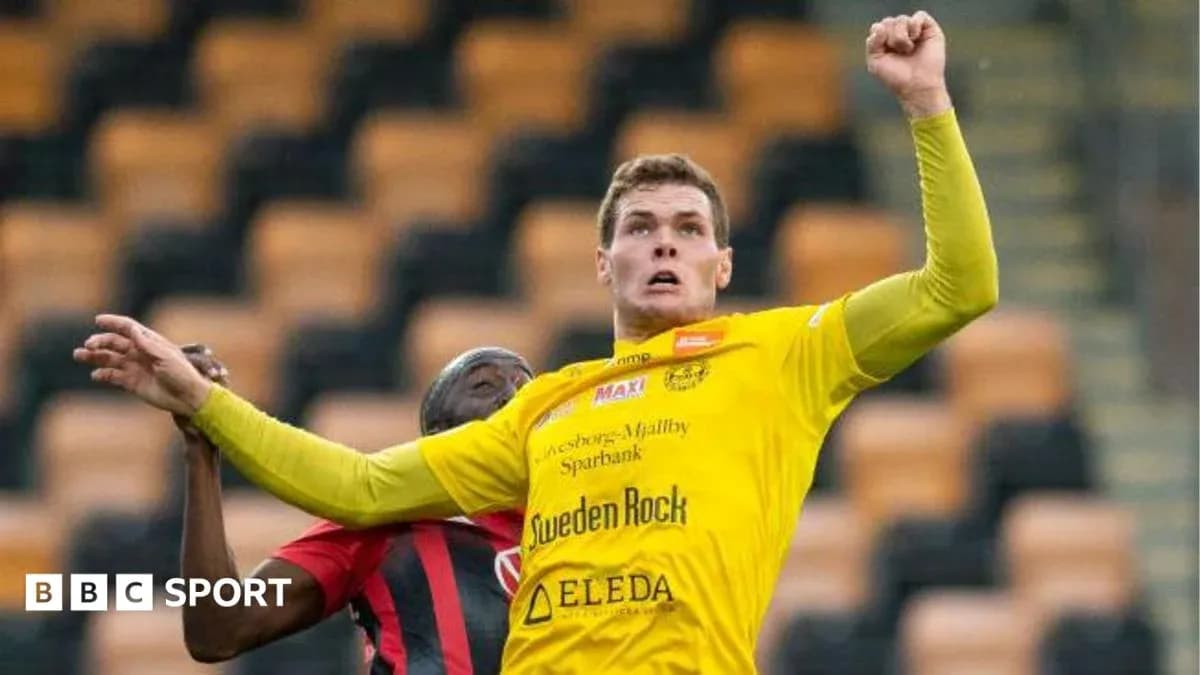
Then came Europe. Bergström scored on his Champions League debut, adding another layer to a story that already felt improbable.
Now the target man is eyeing up Slovan Bratislava in the third qualifying round – and with them, Touré, the new head coach of the 24-time Slovak champions.
For a player who never saw a youth academy from the inside, it is surreal territory.
“I never dreamed of anything like this,” he said. “For me to be here now is crazy, and to do it with Mjällby as well is amazing.”
Hallevik: the village that crashed the Champions League
Part of the fascination with Mjällby’s rise lies in where they come from.
The club is based in Hällevik, a small fishing village in southern Sweden. Fewer than 1,000 people live there year-round. In winter, it’s quiet, almost sleepy. In summer, holidaymakers flood in and the population can quadruple.
Yet this tiny place now hosts Champions League qualifiers.
Mjällby are the strongest football team in Blekinge County and draw support from across the region. Last season they averaged home crowds of around 5,000 – five times the population of their home village.
Bergström, who grew up an hour’s drive north in Karlskrona, fits the club’s story perfectly. He left for a brief spell with Djurgården in Stockholm, then came back in 2023. This time, he and his wife moved properly into the Mjällby world. They brought their two children to Hällevik and made it home.
He cycles to training. He cycles to games. Strandvallen, the club’s home ground, sits just 100 metres from the Baltic Sea, tucked between woods, a campsite and an outdoor swimming pool. On some days it feels more like a holiday park than the gateway to Europe.
“You have the ocean and the people,” Bergström said. “It’s so beautiful by the water and the beach.
“In the winter there’s not many people here, so it doesn’t fit for everyone, but it fits for us.”
The village seems to agree. Fans now see him as one of their own, not just a centre-forward but a symbol of the club’s underdog spirit.
Beer showers, megaphones and a cult hero
At 6ft 3in, Bergström is built like a classic target man, but it’s his edge that has turned him into a cult figure.
He once celebrated a goal in front of Malmö fans and stood there as they drenched him with beer. He didn’t flinch. Later, he simply said “it tasted very good.”
After a win away to Mjällby’s big-city rivals last season, he grabbed a megaphone and led the travelling support in a chant: “Whoever doesn’t jump is a Malmö pig.”
It was raw, partisan, and exactly what supporters wanted to see from a player who lives among them.
Despite the sudden fame, very little has changed in his daily life. He still rides his bike to Strandvallen. He still shops locally. Fans can bump into him in the supermarket, just as BBC Sport did the day after last month’s Champions League qualifier.
For all the headlines, he remains recognisably “one of us.”
A village in yellow and black
Mjällby’s first European home game, against Lincoln Red Imps of Gibraltar, turned Hällevik into a festival.
A jazz band greeted 3,500 supporters at Strandvallen. Another 2,300 people gathered at the marina, carrying deckchairs and cool boxes, to watch on a big screen. For a village this size, it felt like the entire map of the place had been redrawn in yellow and black.
“[Playing in Europe] is special for the whole village and for everyone here at the club,” Bergström said.
“Every time I take my bike to the game, I see all the people in their yellow and black shirts. Everyone has flags in their garden. It’s so fun to see everyone get together.
“They are so proud to be part of this journey we’ve made together.”
A 0-0 draw in Gibraltar was enough to push Mjällby into the third qualifying round. No away goals drama, no chaos. Just a controlled step into another level of opposition.
Now comes Slovan Bratislava, and with them a man who knows the Champions League inside out.
Yaya Touré comes to Strandvallen
Touré, 43, took his first managerial job in June. His playing career needs no introduction: the driving force in Manchester City’s midfield, the man who helped Barcelona win the 2009 Champions League final at the Stadio Olimpico in Rome.
He has seen the game at its most glamorous, under the brightest lights.
Tuesday’s first leg at Strandvallen will be different. Kick-off at 17:00 BST, in a ground pressed up against the Baltic, reached by a long drive through farmland where the main landmarks are tractors flying Mjällby flags.
Many visiting teams do not enjoy the trip. The journey feels endless. The surroundings are modest. The welcome, once the whistle blows, is anything but.
The home crowd is always loud, but for European nights the atmosphere tightens even more. Mjällby’s most passionate fans are moved into the biggest seated stand, concentrating the noise and turning a small stadium into a pressure cooker.
Touré has already noted something unusual about this place. He said Mjällby have “something that other teams don’t have” – a nod, perhaps, to that mix of isolation, unity and sheer defiance that has carried them this far.
What’s at stake is simple: a place in the Champions League play-offs. For Slovan Bratislava, it’s another step in a competition they know well. For Mjällby, it’s the next chapter in a story that keeps stretching belief.
And even if they fall short, the journey doesn’t end. They are guaranteed at least a spot in this season’s Conference League. More European nights, more big names, more chances for Bergström to test himself against players whose posters once covered bedroom walls far from Hällevik.
From a Subway counter to the edge of the Champions League groups, still cycling through a fishing village to work. The question now is not how Jacob Bergström got here.
It’s how much further this unlikely ride can go.