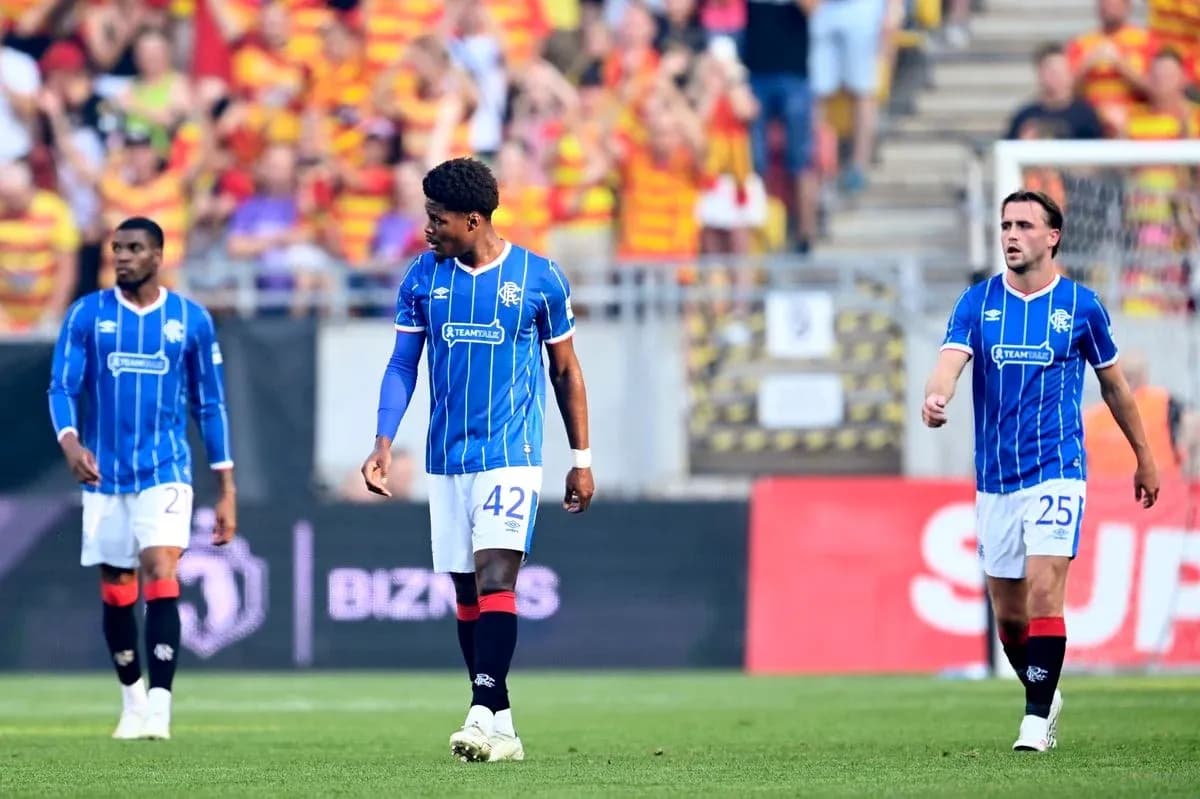
Jagiellonia's Tactical Masterclass Against Rangers in UEFA Europa League
Jagiellonia’s 2-1 win over Rangers at Chorten Arena was built on structural clarity and a ruthless exploitation of early chaos, rather than sheer volume of chances. In a tie framed by the 3rd Qualifying Round context of the UEFA Europa League, Adrian Siemieniec’s 4-3-3 delivered control in key zones and a superior shot profile, while Rangers’ 4-2-3-1 never fully translated their territorial intent and set-piece volume into sustained threat.
The opening phase underlined the tactical storyline. Jagiellonia’s 4-3-3 had a clear double function: out of possession, it resembled a compact 4-1-4-1 with T. Romanczuk screening in front of the back four; in possession, the three midfielders created triangles to progress through the half-spaces. With 52% of the ball, Jagiellonia did not dominate possession overwhelmingly, but used it more purposefully. Their 7 shots on goal from a relatively modest overall shot count underline a focus on shot quality and central access rather than speculative efforts.
Rangers’ 4-2-3-1, on paper, offered a strong central spine with D. Neil and T. Chukwuani as the double pivot and M. Diomande operating higher. In practice, the structure skewed wide. The full-backs, particularly Tuur Rommens on the left, were encouraged to advance, with D. Yokota and T. Aasgaard (before his substitution) tucking inside to form pockets between the lines. This helped Rangers generate 5 corners to Jagiellonia’s 1, but their final-third play produced only 3 shots on goal. The wide focus yielded territory and restarts, not clear central looks.
The own goals at 4' and 13' were not just freak incidents; they revealed how both sides were trying to build and press. G. Montoia’s own goal under Rangers’ pressure hinted at Jagiellonia’s willingness to circulate across the back four, accepting risk to draw the press and open lanes into midfield. Conversely, E. Fernandez’s own goal for Rangers reflected the away side’s attempt to defend higher and compress space, but with an unstable rest-defence shape that left them vulnerable to balls turned into their own box under pressure.
Jagiellonia’s midfield was the decisive platform. Romanczuk anchored, while S. Lozano and K. Szmyt offered different vertical angles. Szmyt, nominally advanced as part of the midfield line, became the key third-man runner. His 21st-minute goal was emblematic of Jagiellonia’s plan: create central overloads, then exploit the gap between Rangers’ back line and double pivot. Even without granular passing data, the shot pattern — 7 on goal with no blocked efforts — suggests Jagiellonia were consistently finding clear shooting lanes rather than being forced into traffic.
Out wide, N. Wojtuszek and G. Montoia stayed relatively conservative, supporting possession and protecting against Rangers’ transitions rather than constantly overlapping. This caution was justified by Rangers’ 4-2-3-1, where both wide attackers, Yokota and Aasgaard, looked to break quickly once possession was regained. The 11-15 foul split (Jagiellonia committing 11, Rangers 15) shows a game with frequent tactical interruptions, with Rangers slightly more reactive and forced into more defensive actions as they chased the scoreline.
Rangers’ attacking structure was never fully coherent. With only 3 shots on goal and 1 blocked shot, they struggled to convert flank progress into central finishing positions. The double pivot often sat deep, and when the full-backs advanced, the distances between lines grew. That left Chermiti and Diomande isolated for stretches, especially once Jagiellonia dropped into a more compact mid-block after taking the lead. The five substitutions from Derek McInnes — especially the triple change at 46' and further adjustments at 76' and 85' — were a clear attempt to inject energy and alter the central dynamics, but the statistical output barely shifted: Rangers’ possession remained slightly lower, and their shot quality did not significantly improve.
Siemieniec’s substitution pattern was more conservative and control-oriented. Removing R. Conceicao and S. Lozano on 65' for J. Agbonifo and A. Klynge, then later J. Imaz and N. Prelec for D. Drachal and Y. Sylla at 80', indicated a desire to refresh legs in midfield and attack without disrupting the defensive structure. The fact that Jagiellonia did not concede after the break, despite Rangers’ personnel churn, speaks to the stability of their 4-3-3/4-1-4-1 shape and their ability to manage space between the lines.
Discipline added another layer. Rangers finished with 3 yellow cards to Jagiellonia’s 1, reflecting their greater need to break up play and halt transitions as they pushed forward. While the event data does not specify reasons, the timing — early and mid-half cautions for Rangers, then a late booking for Jagiellonia at 88' and another for Rangers at 90+2' — fits a narrative of an away side increasingly stretched and resorting to interruptions, while the hosts largely maintained composure until the closing stages.
Without explicit goalkeeper statistics, the defensive picture must be read through shots and structure. Jagiellonia allowed only 3 shots on goal and 1 blocked shot, an indication that their back four, shielded by Romanczuk, effectively limited Rangers to low-yield opportunities, many arriving via wide play and set pieces rather than open-play penetrations. Rangers, by contrast, conceded 7 shots on goal from a team that did not dominate possession excessively, suggesting that their high line and aggressive full-backs were repeatedly exposed when the first line of pressure was broken.
Statistically, the verdict is clear: Jagiellonia produced more shots on goal (7 to 3), conceded fewer corners (1 to 5), and yet held a slight edge in possession (52% to 48%). The foul count (11 vs 15) and card distribution (1 vs 3) underline a home side that controlled tempo and transitions more cleanly, while Rangers’ structural risks at the back were not compensated by sufficient attacking payoff. In a two-legged European context, this kind of home performance — compact without the ball, efficient when creating chances, and tactically disciplined in game management — is exactly the profile that travels well.