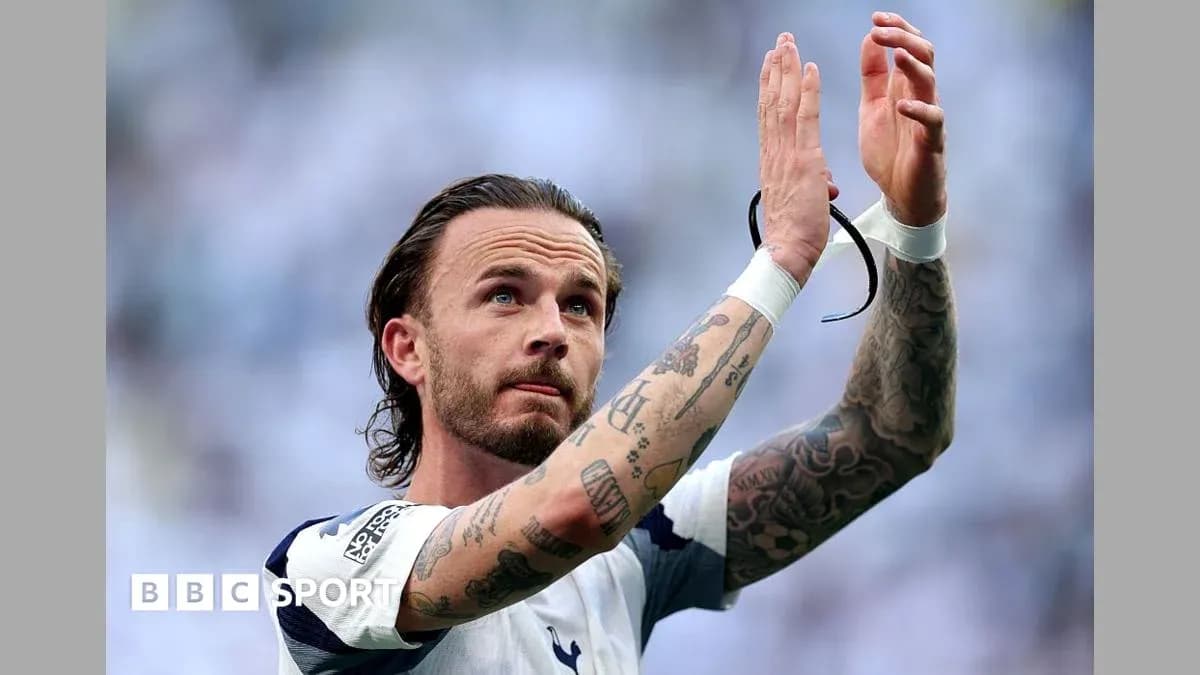
James Maddison's Toughest Year: Family, Injury, and Recovery
James Maddison leans back in his chair and laughs as he says it, but the line lands with weight: he and his partner have been "in the trenches" at home.
Five children. All aged four and under. Two sets of twins. And in the middle of it all, a ruptured anterior cruciate ligament that ripped away almost an entire season of his career.
This is the James Maddison who sits down with Kelly Somers for the first episode of the new series of The Football Interview, airing on BBC One at 12:45 every Saturday during the Premier League season and available on BBC iPlayer, BBC Football YouTube and the BBC Sport website and app. Not the swaggering playmaker in full flow, but a 29-year-old who has just come through what he calls "the toughest year of his life".
A brutal year on and off the pitch
Maddison’s season effectively ended last August when he suffered a serious ACL injury. It cost him almost the entire 2025-26 campaign and left him watching from the sidelines as Tottenham lurched through a relegation scrap, surviving only on the final day and finishing two points above the drop.
At home, life was no gentler.
During his rehab, his partner gave birth to their second set of twins. Recovery sessions and sleepless nights blurred into one.
"A lot of nappies flying about, a lot of accidents at home, but it'll all be worth it," he says. The chaos clearly hasn’t put him off. "We still love it. I wouldn't change it for the world."
He leans on that family chaos as a lifeline as much as a challenge. The injury was traumatic. The distraction was necessary.
"I needed that positive distraction of my partner being pregnant and having to be there for her and forget about myself, even though I was going through a traumatic experience through my knee," he tells Somers.
‘Did you leave Spurs, Dad?’
His absence was so long that it altered how his own son saw him.
"I missed a year of football, and a year in a child's life – from three and a half to four and a half – it's obviously massive," he says.
His eldest, Leo, stopped seeing him as Tottenham’s No 10 and started seeing him as something else entirely.
At one point, Maddison explains, Leo assumed his dad had actually left Spurs. The memories of walking out at Tottenham Hotspur Stadium, of watching his father pull the strings, had simply faded.
"He couldn't even remember over a year ago when he was at all the games," Maddison says. That stings more than any scan result.
"It would be nice for him to come to the games again and actually remember Dad playing instead of just Dad sat at home watching him with a machine on his knee."
The image is stark: the playmaker immobilised, strapped to rehab equipment, reduced to a spectator in his own house while his club fought for its life.
Watching Spurs suffer
On the pitch, Tottenham’s season unravelled. The club scraped survival on the final day, and for a player who has built his reputation on creativity and influence, watching from the sofa was torture.
"We probably struggled a little bit for creativity and I'm watching the games thinking, 'what would I be doing there?'," he says.
This wasn’t a star angling for credit. It was a footballer who knew exactly where he would have been standing, which pass he would have tried, how he might have changed the rhythm of a move. Instead, he could only watch the danger grow.
The frustration was obvious. The helplessness, even more so.
De Zerbi changes the mood
Then came a shift. In March, Italian head coach Roberto de Zerbi walked through the doors at Tottenham Hotspur Stadium and, as Maddison tells it, immediately went to work on the atmosphere as much as the tactics.
"He's very clever. He's very tactical. He's obsessed with football, you can see that," Maddison says.
Yet De Zerbi’s first steps weren’t to overload players with instructions or diagrams. They were about feeling.
"But to be honest, when he first came in – in comparison to pre-season and what we're training now – he didn't want to make it too complicated. He just wanted us to get the love back for playing football."
So he did something simple. Something old-school.
One of his first moves was to organise a team meal. No strict curfews. No dry table.
The 29-year-old recalls De Zerbi telling the squad: "We're all going to be drinking alcohol, we're all going to be having a good night."
The message was clear. Relax. Breathe. Be human again.
"He wanted us to have a night where we all just relax," Maddison explains. "That feeling that we got made everyone feel more knitted together, straight away."
The night out didn’t magically fix a season, but it loosened shoulders and reconnected a group that had been playing under tension.
Back on the bench – in slippers if needed
De Zerbi’s man-management went beyond dinners. He also wanted Maddison, still in recovery, back in the matchday environment as soon as possible.
Another early call was to put the midfielder on the bench, even before Maddison felt ready.
"I was almost like, 'I'm not ready to play yet, boss'," he says.
De Zerbi’s response was blunt and telling. He told Maddison he could come on the bench in his slippers if he wanted. The point wasn’t minutes. It was presence.
"He just wanted me around the group and he thought that would benefit the group," Maddison says. "I took that as a massive compliment and just acted as if I was part of the bench, part of the team."
Tottenham did, in the end, pull themselves away from danger. Maddison won’t claim credit. "I'm not saying that's the reason why, but we managed to steer clear of the danger, which was a good feeling."
For a player who had spent months feeling powerless, even that small role mattered.
Eyes on a different kind of season
Maddison finally returned to action against Leeds on 11 May, a symbolic step after so many lonely days in the gym. He has not been risked in pre-season so far, with the club clearly wary of undoing months of careful work.
He sounds anything but timid about what comes next.
"I'm working so hard to try and be fully fit and available for the majority of the season," he says. The goal is simple, almost understated, but loaded with intent.
"I want just a fully fit, healthy season where I can just enjoy football. Because if I'm fully fit and I'm healthy, then I know what I'm capable of. And I know that I can affect games more than a lot of players in this league. So, let's just hope for that."
No grand declarations. Just a player who has seen what it looks like when the game is taken away from him, now desperate for something basic that suddenly feels huge: a full season, his family in the stands, and his son finally able to remember him as more than the dad with a machine strapped to his knee.