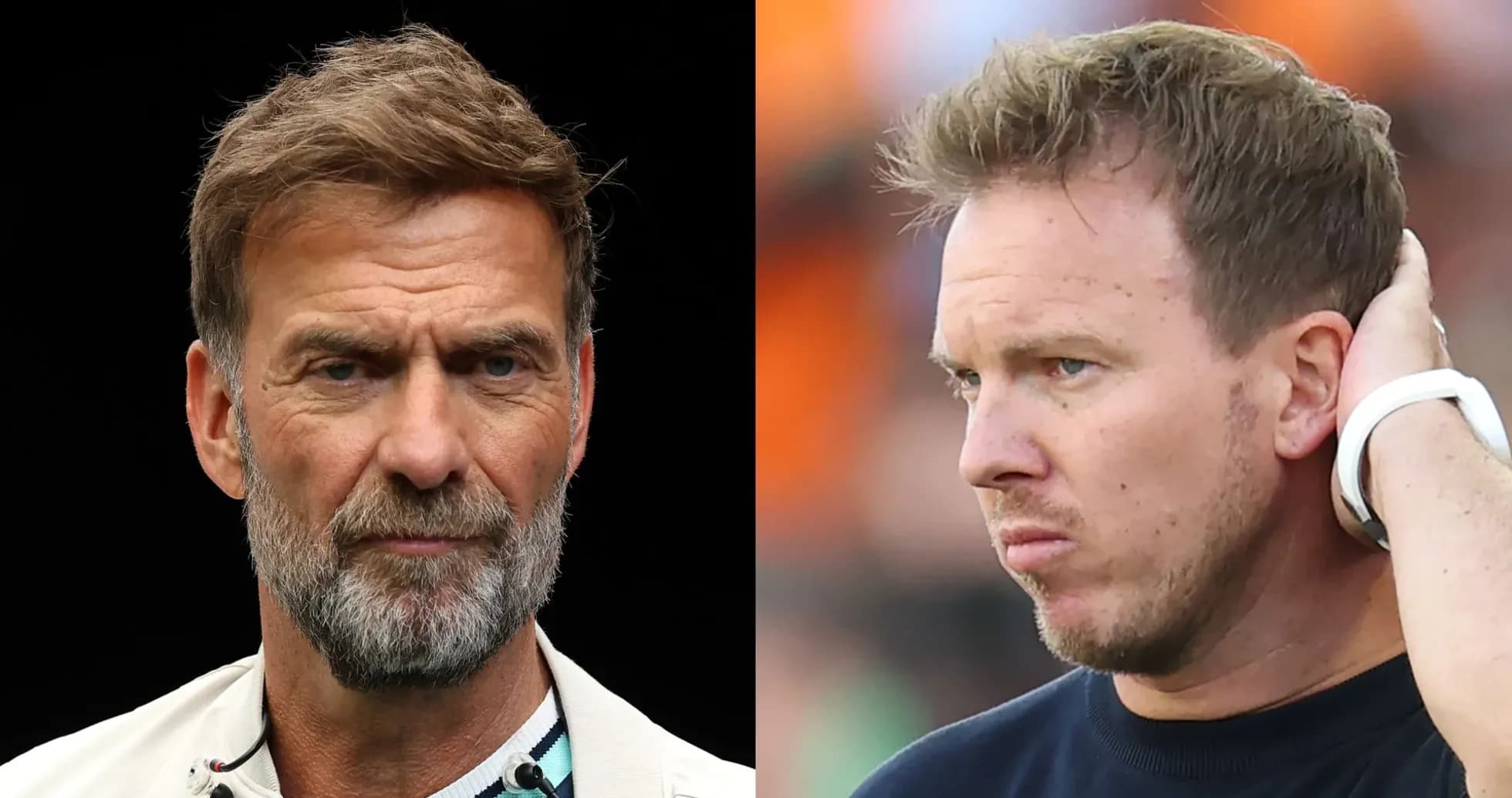
Jürgen Klopp Addresses Controversial 'Still' Comment as Germany Coach
Jürgen Klopp has never been afraid of a microphone, but one four-letter word still makes him wince.
“Still.”
As he faced the media at his unveiling as Germany head coach, the 59-year-old moved quickly to address the lingering story from the World Cup and his relationship with Julian Nagelsmann. The answer was blunt, almost disarming in its simplicity.
"I've had no contact since the World Cup," Klopp said, as quoted by Sky Sport. "I respect Julian Nagelsmann enormously. The day with the 'still' comment was one of the worst days of my life. I could have done without it, but it happened now. I wish Julian nothing but the best."
The word that wouldn’t go away
The controversy was born in a split second, live on German television. Working as a pundit during Germany's opening game against Curacao, Klopp let the sentence roll off his tongue: "Luckily, Julian Nagelsmann is still picking the team."
That “still” detonated back home.
In a country hypersensitive to any hint of instability around the national team, the implication — unintended or not — landed heavily. Was Klopp suggesting Nagelsmann’s position was under threat? Was he hinting at internal doubt? The debate raged before the game had even cooled.
No one felt the weight more than Klopp himself.
"I’ve already found the most hated word of the year: ‘Still’," he admitted afterwards. "I could have punched myself in the face for that, but it was already too late and I was on TV. It just slipped out so casually and has absolutely no relevance."
He didn’t leave it there. On air, directly addressing Nagelsmann, Klopp went into full damage-limitation mode, but with the same raw honesty that has followed him from Mainz to Dortmund to Liverpool and now to the national team.
"There’s one more thing I have to say… we still need to make time for this. We’re also informally part of the team, we’re absolutely on your side. What I’ve realized is: I’ll be 59 the day after tomorrow and I’m still an idiot. We are completely on your side, whatever you do. Nothing was intended to come of it to disrupt the process here."
No spin. No lawyered statement. Just Klopp, calling himself an idiot on live television.
Closing the Nagelsmann chapter
Now, with Nagelsmann gone and Klopp in the job, the old clip has resurfaced, inviting easy narratives of tension or awkwardness between the two coaches.
Klopp refused to fuel any of it.
There has been no private clearing of the air, no quiet coffee away from the cameras. Just a firm line: respect, regret, and a desire to move on.
For him, the episode belongs to the past. The job in front of him could not be more present.
Rebuilding a fallen giant
Germany’s exit in the round of 32 at the 2026 World Cup shook the country. A nation that measures itself in trophies and tournament runs suddenly looked ordinary, out of rhythm with the modern game and stripped of its old tournament aura.
Klopp has been hired to change that.
His first priority is not tactics on a whiteboard or slogans on a wall. It is people.
"I don't know what my daily routine will be like yet; I'm almost glad it doesn't start tomorrow," he said at Friday’s press conference. "I live in Wiesbaden and will certainly be in Frankfurt often. I'll watch games in every country our players are in. I think it's more important to have more contact with the players than just watching them play. I'll try to get in touch with the players quickly."
That is classic Klopp: relationships before systems, trust before structure. At Liverpool, players spoke about how he made them feel ten feet tall. Germany now needs that same surge of belief.
He wants to be visible, present, restless. From Wiesbaden to Frankfurt, from Bundesliga grounds to stadiums across Europe, he plans to track his squad in their club environments, not just on highlight reels. Conversations, not just scouting notes.
The message is clear. The national team shirt is no longer a distant, occasional duty. It is part of a continuous connection with a coach who intends to be in their lives, not just on their screens.
The “still” saga belongs to a different chapter. The only word that matters to Germany now is simpler, sharper, and far more demanding.
Again.