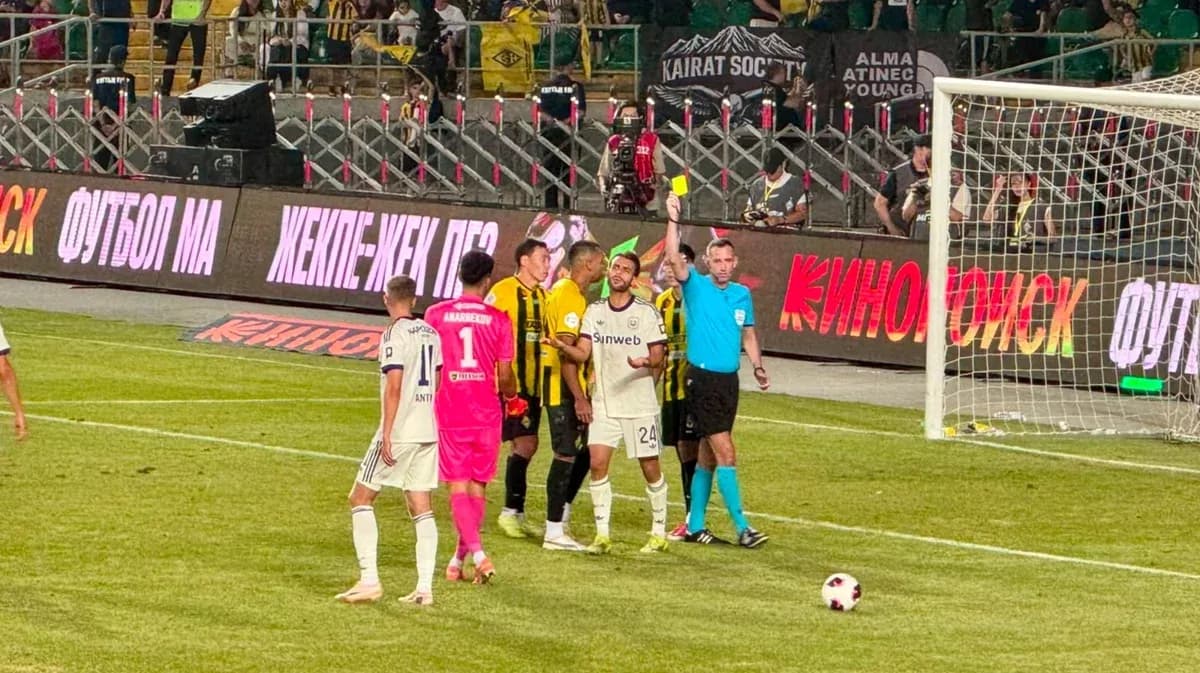
Kairat Almaty vs Anderlecht: Tactical Collapse in 0-3 Defeat
Kairat Almaty’s 0-3 home defeat to Anderlecht at Central Stadium was defined by structural imbalance and game-state collapse rather than sheer volume of chances. The visitors controlled possession (67% to 33%), built calmly from a 4-3-3, and forced Kairat’s 4-4-1-1 to defend ever deeper, with the early own goal and subsequent red card destroying any hope of a controlled contest.
Rafael Urazbakhtin set Kairat up in a compact 4-4-1-1, with T. Anarbekov in goal, a back four of L. Mata, Lucas Africo, Aleksandr Shirobokov and E. Tapalov, and a midfield line built to screen rather than press. J. Oksanen and O. Jukkola were key central references, with G. Mendonsa and A. Mrynskiy providing width, M. Gual operating between the lines and Edmilson as the lone striker. On paper, the structure aimed to compress space centrally and break through Gual and Edmilson once possession was regained.
The tactical plan unraveled almost immediately. On 2 minutes, Oksanen’s own goal gifted Anderlecht a 0-1 lead, instantly flipping the game state: Kairat’s low block now had to chase the match without the ball. With only 33% possession and just 2 shots on goal plus 2 off goal (5 attempts including 1 blocked), Kairat never generated sustained attacking pressure. The front two were repeatedly isolated, and the wide midfielders were pinned so deep that transitions became long, low-percentage counters rather than structured attacks.
Anderlecht, under Vitor Bruno, exploited this with a controlled 4-3-3: C. Coosemans in goal behind a back four of L. Augustinsson, G. Biancone, L. Petrot and A. Maamar, a midfield of L. Ambros, E. Llansana and M. Kana, and a front line featuring M. Cvetkovic, D. Sikan and J. Nga Kana. Their 67% possession was not sterile; they produced 4 shots on goal and 2 off goal, plus 5 blocked shots, indicating consistent pressure around and inside Kairat’s box.
The midfield triangle was decisive. Ambros in particular dictated tempo and broke lines, and his influence was underlined by his goal at 24 minutes to make it 0-2. With Kana often dropping to form a temporary back three in build-up and Llansana shuttling to connect with the full-backs, Anderlecht created overloads in wide channels. This pinned Kairat’s wide midfielders and full-backs, forcing the home side’s back four into constant lateral shifts and reactive defending.
The turning point in terms of any remaining Kairat resistance came on 39 minutes, when Shirobokov’s red card reduced the hosts to ten men. Already trailing 0-2 and starved of the ball, Kairat’s defensive line had to narrow even further, abandoning most forward ambition. The numerical inferiority, coupled with the psychological blow of the early own goal, left Kairat defending their box in emergency mode rather than in a coordinated mid-block.
Anderlecht capitalized before the break: at 45 minutes, Sikan added the third, assisted by Ambros, for a 0-3 scoreline that effectively ended the contest. From that point, Anderlecht could manage tempo, rotate personnel and protect their structure without overcommitting. Their foul count (17 to Kairat’s 11) reflects a willingness to break transitions and reset shape rather than any loss of control.
The substitution patterns underlined the tactical narratives. At 46 minutes, Kairat tried to inject fresh energy: O. Baybek (IN) came on for A. Mrynskiy (OUT), suggesting a search for more ball security or vertical running from midfield. Anderlecht simultaneously brought on T. Degreef (IN) for M. Cvetkovic (OUT), a like-for-like adjustment in the attacking line to maintain pressing intensity from the front.
On 60 minutes, Kairat reshaped their front line with A. Tuyakbaev (IN) for M. Gual (OUT) and I. Bekbolat (IN) for Edmilson (OUT). This double change effectively reset the attacking pair, but with 10 men and so little possession, it did not translate into sustained threat; Kairat still finished with only 2 shots on target and 2 off target. Anderlecht’s response at 63 minutes — O. Antman (IN) for J. Nga Kana (OUT) — maintained fresh legs in the wide channels, preserving their ability to stretch Kairat horizontally.
Further Kairat changes at 72 minutes — L. Kurgin (IN) for L. Mata (OUT) and A. Sadybekov (IN) for J. Oksanen (OUT) — looked like an attempt to stabilize the back line and refresh central midfield after the red card and heavy defensive workload. Yet Anderlecht remained in control and continued to rotate intelligently: M. Winkler (IN) for A. Maamar (OUT) at 74 minutes, then N. Ojea (IN) for E. Llansana (OUT) and A. Bertaccini (IN) for D. Sikan (OUT) at 84 minutes. These changes preserved structural integrity while managing minutes, with no tactical gamble required at 0-3.
Discipline tilted slightly towards Anderlecht numerically — 4 yellow cards to Kairat’s 1 — but the single red card against Kairat was the more decisive event. The visitors’ higher foul count and bookings were the cost of aggressive pressing and game management, whereas Kairat’s dismissal directly deepened their tactical problems.
With no recorded goalkeeper saves or passing data, the clearest statistical story is territorial and structural dominance: Anderlecht’s 67% possession, 4 shots on goal, 5 blocked shots and 8 corners versus Kairat’s 33% possession, 2 shots on goal, 1 blocked shot and 2 corners. Combined with an early own goal and a first-half red card, the numbers align with what unfolded on the pitch — a one-sided tactical contest in which Anderlecht’s 4-3-3 controlled every phase, and Kairat’s 4-4-1-1 never had the platform to compete once the game state turned against them.