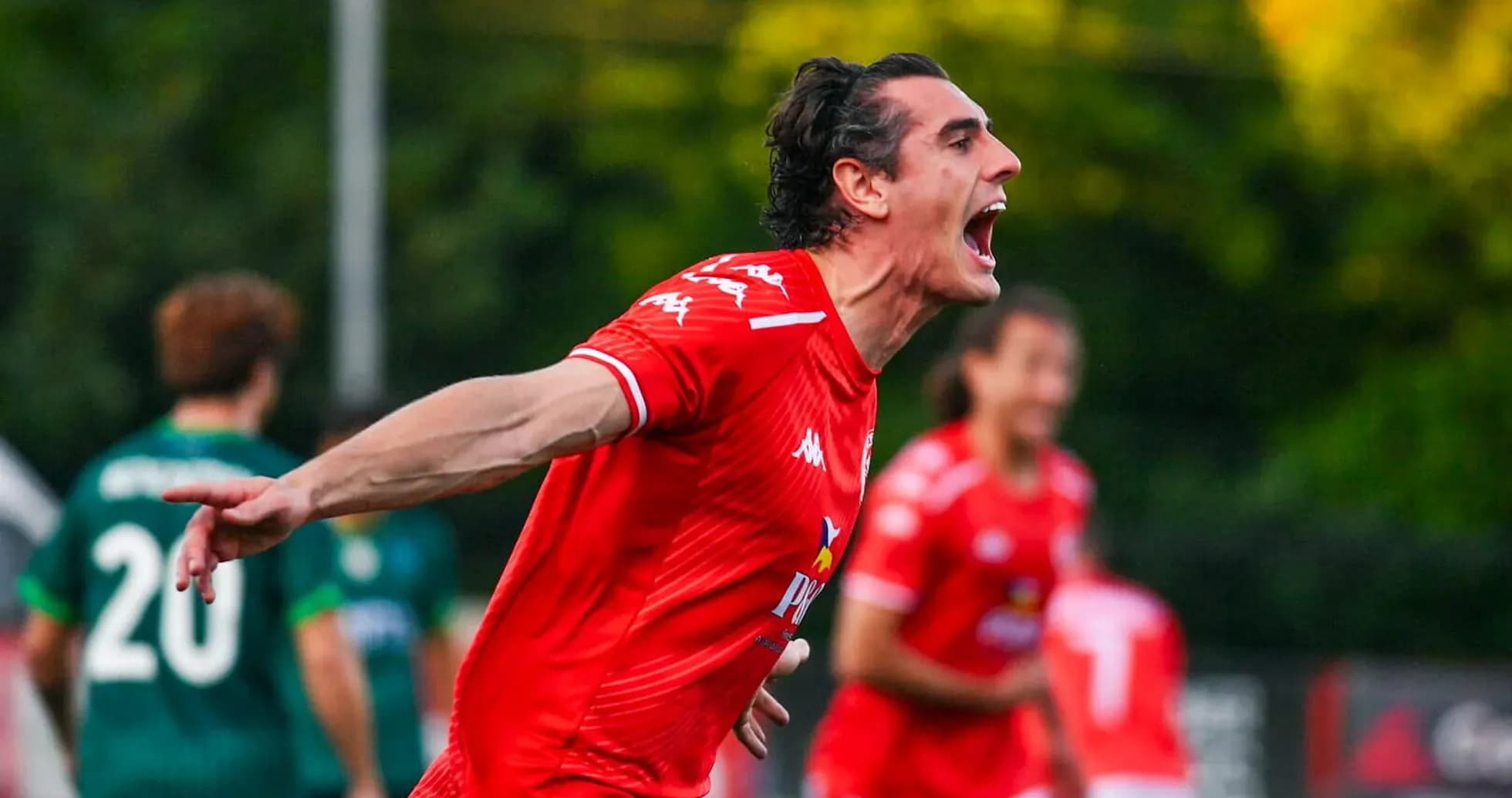
Larne vs Saburtalo: Tactically Tight UEFA Europa League Encounter
Larne and Saburtalo played out a goalless but tactically tight first leg at Inver Park in the UEFA Europa League 3rd Qualifying Round, a match defined more by structure and risk management than by attacking volume. With both sides lining up in a 4-3-3 and the score locked at 0-0 from start to finish, the evening evolved into a controlled territorial and dueling battle, with discipline, rest-defence and substitution patterns offering the clearest insight into each coach’s intentions.
Gary Haveron’s Larne used their 4-3-3 in a relatively orthodox way, with R. Ferguson in goal behind a back four of T. Cosgrove, D. Bent, M. Ridley and A. Donnelly. In possession, the full-backs had license to step into higher lanes, but the selection of S. Graham as a nominal defender on the left side of the second line hinted at a conservative tilt: Graham often tucked in to form a back three in build-up, allowing Cosgrove to be the more aggressive outlet on the right. The midfield trio of R. Doherty, C. Gallagher and D. Sloan provided a blend of work rate and ball circulation, with Sloan given the highest starting line to connect with forwards M. Gibson and M. Lusty.
Early on, Larne’s defensive posture was clear. The two early yellow cards — Tomas Cosgrove at 11' and Chris Gallagher at 45', both for “Foul” — underline a game plan that accepted contact and tactical infringements to break Saburtalo’s rhythm. Cosgrove’s caution came from a wide defensive duel, illustrating Larne’s willingness to step high with the full-backs to prevent Saburtalo’s wingers and advanced midfielders from turning. Gallagher’s card, arriving right on 45', reflected central pressure on Saburtalo’s build-up lanes as the half closed, a sign that Larne were prepared to compress space aggressively just before half-time to avoid conceding transitional chances.
Without shot, possession or passing data, the structural cues matter more. Larne’s front three, with Lusty and Gibson starting, were supported by Sloan from the right half-space. The double substitution on 65' — P. O’Neill (IN) came on for M. Gibson (OUT) and J. McEneff (IN) came on for D. Sloan (OUT) — subtly rebalanced the attack. O’Neill’s introduction for Gibson suggested a search for a more direct penalty-box presence or fresh pressing energy, while McEneff for Sloan pointed to a desire for more control and perhaps better ball progression between the lines rather than pure vertical running.
The later changes at 75' — K. O’Hara (IN) came on for M. Lusty (OUT) and J. Simpson (IN) came on for R. Doherty (OUT) — effectively refreshed both the front line and one of the central midfield roles simultaneously. This four-man rotation across the front and midfield bands between 65' and 75' indicates that Haveron saw the final quarter of the match as a phase to increase tempo and pressing intensity, while still maintaining the original 4-3-3 structure. The fact that Larne did not receive any further cards after 45' suggests that, despite the injection of energy, they managed their defensive aggression more cleanly in the second half.
On the Saburtalo side, Andriy Demchenko also set up in a 4-3-3 with G. Makaridze in goal and a back four of G. Kobuladze, V. Selimovic, A. Amisulashvili and Jemali Giorgi Jinjolava. In midfield, B. Kardava, N. Dadiani and G. Kutsia formed the central triangle, with Z. Natchkebia, N. Sikharulashvili and A. Bartishvili providing the attacking width and central occupation. The front three, however, had a more hybrid feel: both Sikharulashvili and Bartishvili are listed as midfielders, hinting at a slightly deeper, more possession-oriented wide presence rather than pure wingers constantly attacking the last line.
Demchenko’s first substitution at 59' — A. Dzagania (IN) came on for A. Bartishvili (OUT) — was a clear attacking adjustment. Replacing a midfielder-typed wide player with a forward suggested an attempt to stretch Larne’s back line more aggressively and to threaten in behind, perhaps reacting to Larne’s full-backs stepping forward or to a perceived lack of penetration. The second change at 78' — I. Alhassan (IN) came on for G. Kutsia (OUT) — refreshed the midfield, potentially adding more ball-carrying or defensive legs in the central zone as the game entered its closing stages.
Saburtalo’s only booking came at 66', when Jemali Giorgi Jinjolava received a yellow card for “Foul”. Coming just after Larne’s double substitution, this moment is tactically significant: Larne were attempting to raise their attacking tempo, and Jinjolava’s foul-based intervention on the left side of the back four shows Saburtalo’s willingness to commit a tactical infringement to halt that momentum. It also underlines how much of the contest was fought in the wide defensive channels, where full-backs on both sides had to manage 1v1 situations and overlapping runs.
With no recorded values for shots, possession, passes, saves, xG or goals prevented, the statistical verdict is necessarily framed around what we do know: the disciplinary balance and the goalless scoreline. Larne finished with 2 yellow cards, Saburtalo with 1, all three explicitly for “Foul”. That distribution aligns with the visual tactical picture: Larne’s slightly more proactive defensive approach, particularly in the first half, produced two cautions, while Saburtalo’s more measured, line-protecting style resulted in a single booking, timed at a key juncture when they needed to break Larne’s second-half surge.
The 0-0 full-time score, with half-time also at 0-0, confirms that both defensive structures held up under the limited offensive pressure each side could generate. Both 4-3-3s functioned primarily as platforms for stability rather than high-risk attacking gambits. Larne’s heavy rotation in advanced and midfield roles in the second half shows they were the side more actively searching for a late breakthrough, while Saburtalo’s adjustments were more about maintaining balance and introducing a different profile up front without losing their compactness. In the context of a two-legged European qualifier, this first leg at Inver Park felt like a carefully played opening move, with neither team willing to compromise their defensive integrity for the sake of short-term attacking gains.