Levski Sofia and AEK Athens FC: Tactically Rich Champions League Play-off
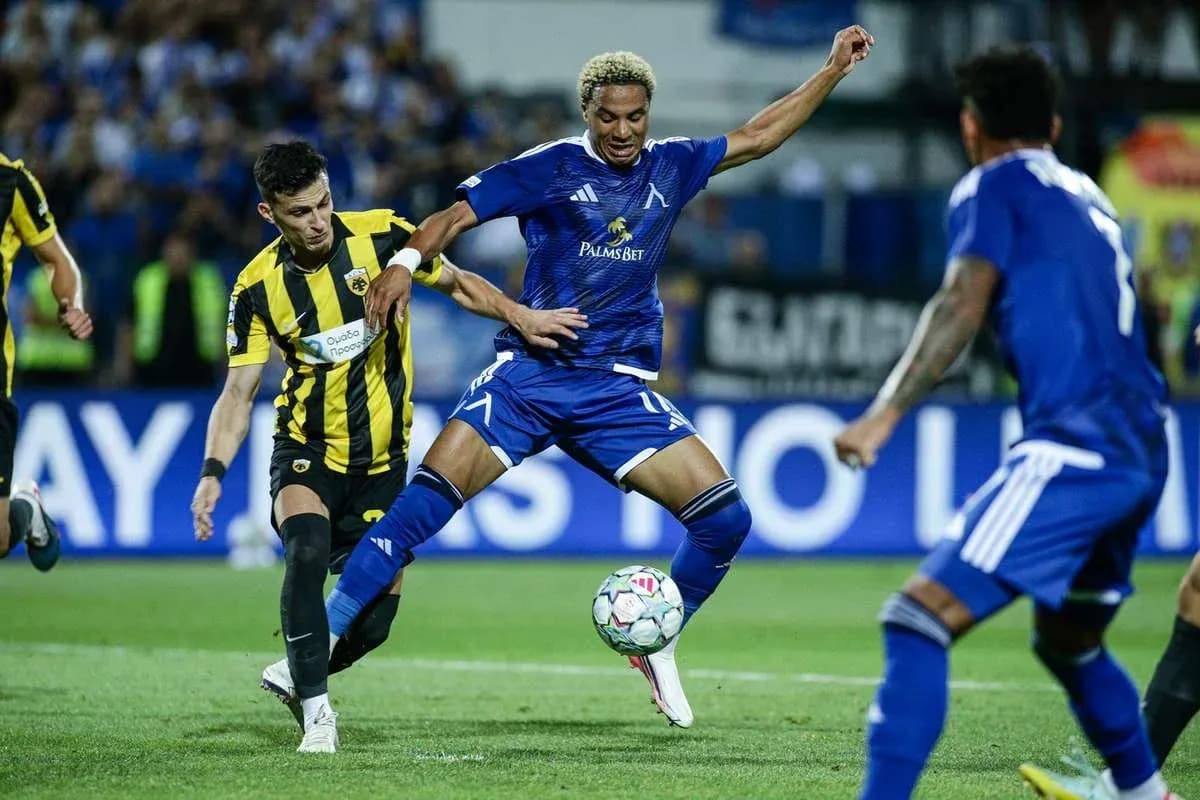
Levski Sofia and AEK Athens FC produced a goalless but tactically rich Champions League Play-offs first leg at Georgi Asparuhov Stadium, a match defined more by structure and risk management than by penalty-box chaos. The 0-0 scoreline reflects two well-organised units who largely neutralised each other, with Levski’s 4-2-3-1 offering marginal territorial and shot volume superiority, and AEK’s 4-4-2 responding with compactness and physical edge. Both sides finished with identical clean sheets but very different routes to them: Levski via controlled possession and build-up, AEK via a higher foul count and a more reactive, counter-attacking posture.
From the outset, Julio Velazquez’s 4-2-3-1 for Levski Sofia was built around structured progression. The double pivot of M. Moubarik and Maicon sat ahead of a back four that tried to circulate the ball patiently, reflected in Levski’s 52% possession and 485 total passes with an 88% completion rate (428 accurate). The full-backs A. Neves and A. Centelles provided width, allowing the three attacking midfielders — A. Oko-Flex, Serginho, and Everton Bala — to occupy interior half-spaces and between-the-lines pockets behind Reinaldo.
This shape translated into territorial pressure and shot volume: 15 total shots for Levski, with 3 on goal and 4 blocked, and a clear intent to test AEK from range as well as from structured entries (9 shots from outside the box versus 6 inside). The double pivot was key: Maicon in particular acted as the metronome, recycling possession and allowing the full-backs to push while keeping rest defence intact against AEK’s two forwards.
Marko Nikolic’s AEK Athens FC set up in a 4-4-2 that was more conservative without the ball but direct in transition. The front pair of Zini and L. Jovic started, supported by a midfield line of L. Majer, R. Marin, K. Kairinen and A. Koita. Out of possession, AEK’s wide midfielders dropped deep to form almost a 4-4-1-1 block, with one striker screening passes into Levski’s pivots. The compactness forced Levski to circulate side-to-side and contributed to AEK conceding only 6 shots inside the box.
AEK’s approach is also visible in the discipline and physical data: they committed 17 fouls to Levski’s 8, accepting stoppages and duels as a way to break Levski’s rhythm. Despite this, they maintained technical quality in circulation when they did have the ball: 453 total passes at 87% accuracy (394 accurate) shows that once they settled, they could construct attacks rather than purely clear their lines.
In goal, S. Vutsov (Levski Sofia) had a relatively quiet but concentrated evening, officially required to make 1 save. That low number underlines how effectively Levski’s back four and double pivot protected the central corridor, limiting AEK to 12 total shots and just 1 on target. H. Moukoudi and F. Relvas for AEK, by contrast, had to manage more penalty-area activity, with Levski generating 6 shots inside the box and 4 blocked attempts, suggesting aggressive defending and last-ditch interventions.
At the other end, T. Strakosha (AEK Athens FC) was more active, registering 3 saves. His involvement reflects Levski’s territorial edge and their willingness to shoot from distance (9 attempts from outside the box). AEK’s defensive block allowed shots but often from less dangerous zones, trusting Strakosha’s positioning and handling to deal with those that did find the target.
The substitution patterns reveal both coaches’ reading of the contest and their risk appetite. At 57', Nikolic moved first: L. Majer (OUT) with P. Mantalos (IN), and L. Jovic (OUT) with B. Varga (IN). The first change injected more craft and set-piece quality into midfield; the second freshened the front line with a more mobile runner in behind. These moves hinted at a desire to transition from pure containment to selective pressing and more vertical threat, especially as Levski’s back line had been relatively untroubled to that point.
Velazquez responded on 67', with J. Perea (IN) for A. Oko-Flex (OUT), a like-for-like change in the attacking midfield band that added fresh legs and slightly more direct running between the lines. The double change at 79' — M. Soula (IN) for Everton Bala (OUT) and A. Mitkov (IN) for Reinaldo (OUT) — subtly reshaped the attacking structure. With the original centre-forward off, Levski leaned more on fluid rotations and runners from deeper zones rather than a fixed reference point, a common late-game adjustment when chasing marginal gains in a tight first leg.
Nikolic’s 81' double substitution — M. Gacinovic (IN) for A. Koita (OUT) and O. Zubkov (IN) for Zini (OUT) — reinforced AEK’s wide and forward options with players capable of carrying the ball and attacking space in transition. It signalled a late push to exploit any over-commitment from Levski, but the overall shot profile (12 total, 1 on goal) suggests these changes improved field position and counters more than they did final-third incision.
The final Levski changes — S. Hevertton (IN) for A. Neves (OUT) at 88' and S. Stoyanchov (IN) for Maicon (OUT) at 89' — were about balancing freshness and security. Replacing a starting full-back late can be a response to fatigue against newly introduced wingers, while withdrawing Maicon removed a key passer but added energy for the closing phase, ensuring the team could still contest second balls and prevent late counters.
Statistically, the match tilts slightly towards Levski Sofia as the proactive side: more possession (52%), more total shots (15 vs 12), more shots on goal (3 vs 1), and more blocked attempts (4 vs 2), indicating sustained pressure against a deep, committed AEK block. Their passing volume and accuracy underline a clear plan to build from the back and probe patiently.
AEK Athens FC, meanwhile, framed the tie in two legs. Their 48% possession with 12 shots and a high foul count points to a strategy of controlled aggression: disrupt Levski’s rhythm, limit clear chances (only 3 shots on target conceded), and trust their structure plus T. Strakosha’s 3 saves to preserve the clean sheet. With no cards recorded and no goals, discipline was expressed more in tactical fouling than in reckless challenges.
In the context of a Champions League Play-offs tie, this 0-0 feels like a first chapter shaped by caution and defensive organisation. Levski showed they can control phases and generate volume; AEK showed they can absorb, foul smartly, and still carry enough threat to keep the tie finely balanced heading into the return leg.