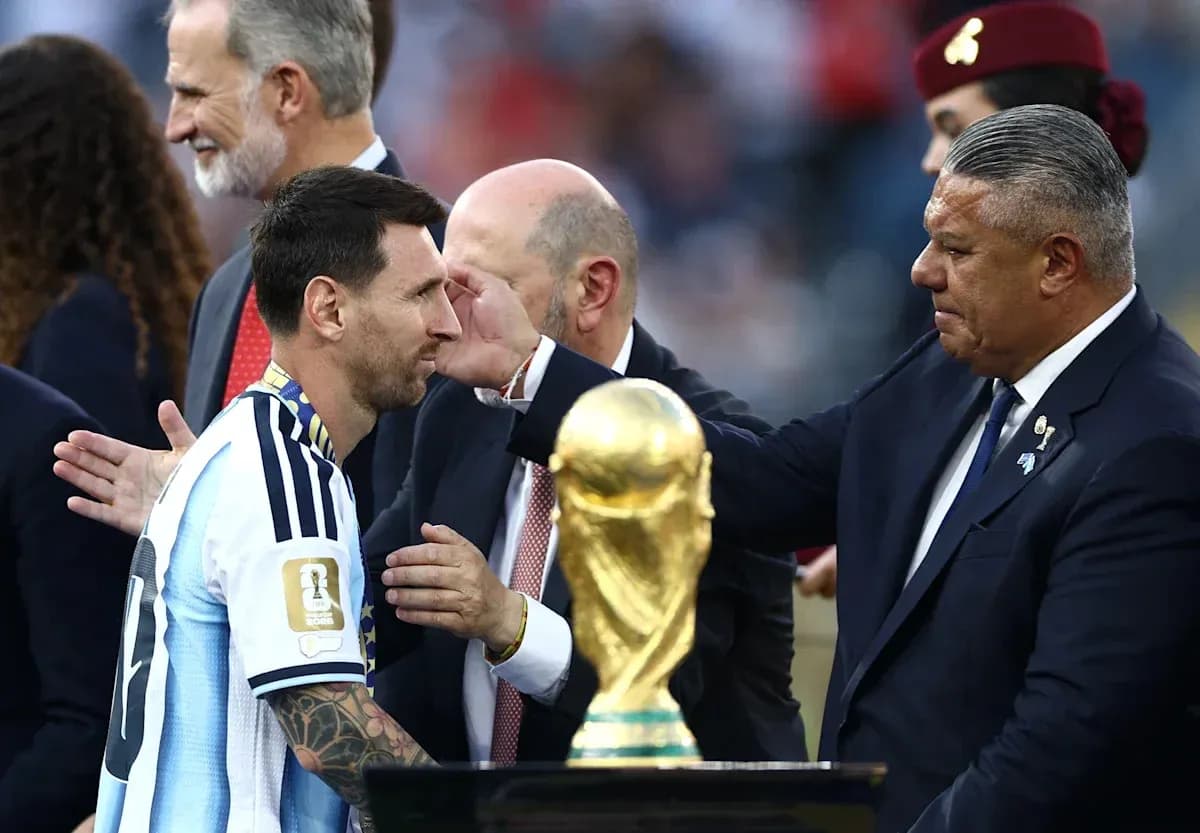
Lionel Messi's Future with Argentina: A Personal Decision
Lionel Messi’s future with Argentina will be decided by one man only: Lionel Messi.
That was the clear, almost protective message from Claudio “Chiqui” Tapia, president of the Argentine Football Association, who made it plain he has no intention of nudging the national icon toward the exit after another stunning World Cup campaign this summer.
“It’s a decision that is purely and personally his,” Tapia said in an interview on Argentine television. “You have to let him relax.”
He meant it. In 2022, as Messi dragged Argentina to the title in Qatar, no one inside the camp knew whether he would even consider pushing on to 2026. Messi himself framed it as a “game by game” journey. Two World Cups later, at 39 years old, he has just delivered one of the most productive tournaments of his international career.
Eight goals. Four assists. A World Cup final reached again, this time in the United States, where Argentina fell 1-0 to Spain in extra time. For most players, that would be a glorious last stand. For Messi, it felt like another chapter.
Tapia is in no rush to close the book.
“You have to let him keep enjoying playing football and after that he’ll make the decision he feels is the right one,” he said.
Messi turned 39 on June 24, two days after scoring twice against Austria in the group stage, and he has given no hint of when he will walk away from the national team or from Inter Miami in MLS. Retirement talk keeps circling around him; he keeps answering on the pitch.
On the biggest stage, the records fell around him. Messi became the first man to break Miroslav Klose’s career World Cup scoring mark of 16 goals. For a brief moment, he stood alone at the summit. Then Kylian Mbappé, France’s own phenomenon, stormed past both with a haul that took him to 22 career World Cup goals by the end of the tournament.
Still, Tapia’s verdict on Argentina’s captain was unwavering.
“It was a great World Cup from Leo,” he said. “We enjoyed it a lot, and we’ve got to feel proud. I enjoyed every moment. Without a doubt, he was the standard-bearer of this group in the World Cup. If you analyse the World Cup he had, for me he was the best player. He was break records match after match.”
The numbers back up the feeling. At an age when most forwards have either retired or retreated from the international scene, Messi continues to dictate games at the highest level, carrying La Albiceleste back to another final and maintaining a standard that defies the calendar.
Naturally, attention turns to how far this can go.
The 2030 World Cup, to be staged in Spain, Portugal and Morocco, with Argentina, Uruguay and Paraguay each hosting a match as part of the centenary celebrations, would arrive with Messi at 43. The benchmark for outfield longevity on that stage remains Roger Milla, who played for Cameroon at USA 1994 aged 42 years and 39 days.
Cristiano Ronaldo, another titan of the era, pulled on a Portugal shirt again this summer at 41. The boundaries of age are being pushed, but World Cups are unforgiving. Could Messi possibly join that list? Or is that stretch one too far, even for him?
For now, Argentina are dealing with something more immediate: the next international window, between September 21 and 29. Two friendlies are expected, opponents still to be confirmed. The dates are in the diary, the speculation already swirling.
There are whispers that the next home match could be Messi’s last in front of his own people in the Albiceleste shirt. No one inside the federation has confirmed it, and Messi has certainly not framed it that way. Yet every time he steps onto the pitch in light blue and white, the sense of occasion grows heavier. Each anthem, each touch, feels like it could be part of a farewell tour that has not yet been officially announced.
Argentina, reigning Copa America champions, also have a continental title to defend. They lifted the trophy in 2024 and will defend it again in 2028, with the host nation still to be named. Another major tournament, another possible stage for Messi to lead, to inspire, to stretch out this extraordinary second act of his international career.
Tapia’s stance is clear: there will be no pressure from above, no forced goodbye, no artificial curtain call. The greatest player in the country’s history will choose his own exit.
The question now is not whether Argentina are ready to move on from Messi.
It is whether Messi is ready to move on from Argentina.