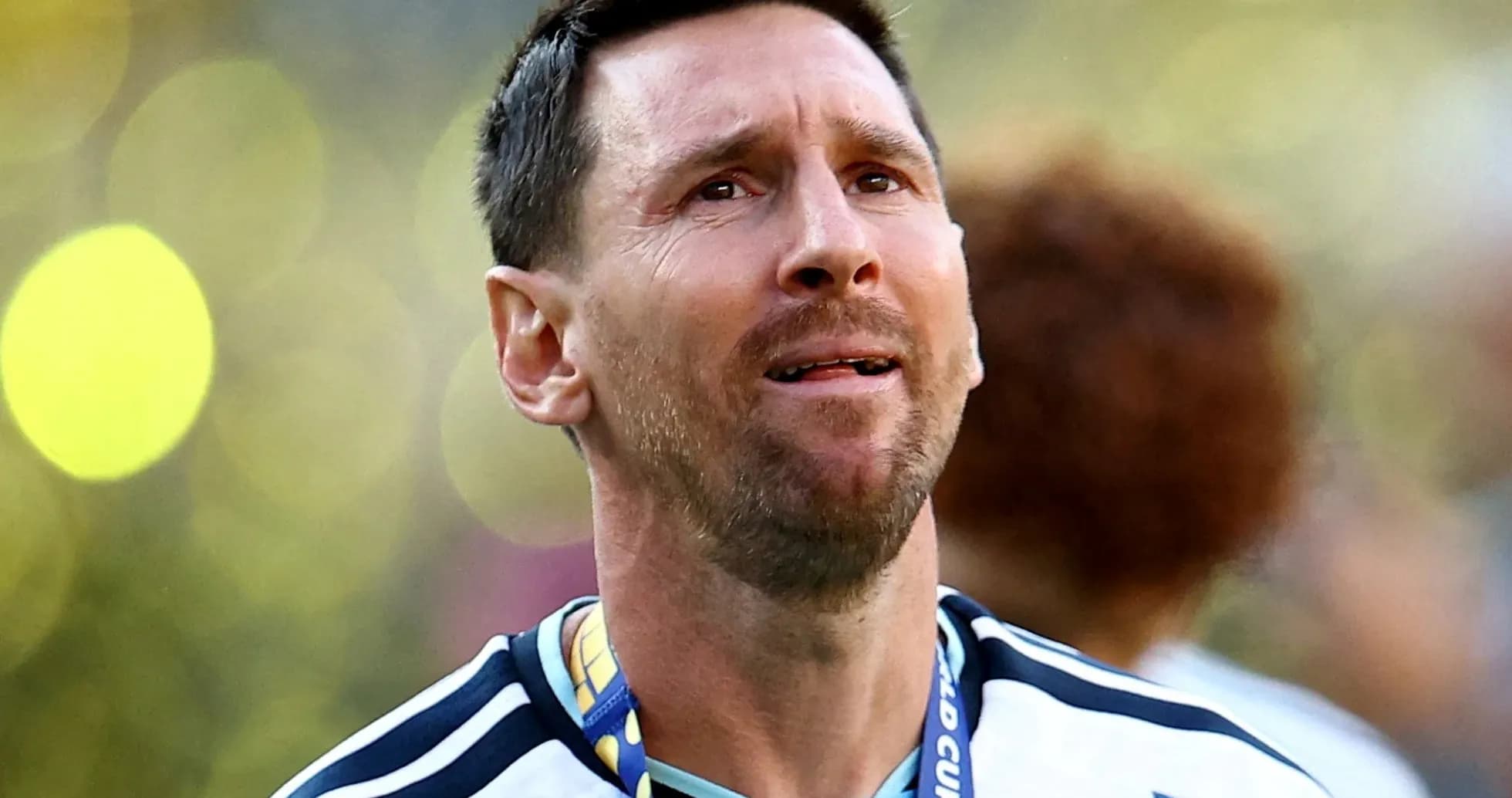
Lionel Messi's Heartbreaking Silver Medal at the 2026 World Cup
Lionel Messi stood alone on the MetLife Stadium turf, silver medal around his neck, eyes wet and distant. No trophy this time. No lap of honor. Just the weight of what might have been, and what very likely will never be again.
Spain had just beaten Argentina 1-0 in East Rutherford to claim the 2026 World Cup, denying Messi a second straight title and what would have been a final, crowning act on the biggest stage. At 39, he walked slowly, almost reluctantly, through the post-match formalities, applauding the Argentina fans who had followed him across continents for nearly two decades.
He did not say the word “retirement.” He didn’t need to.
Tears, a silver medal, and a message to a nation
By Monday evening, Messi had swapped the chaos of the mixed zone for the quiet of his phone screen. On Instagram, alongside a photo of him holding that silver medal, he poured out what the cameras had only hinted at.
“The pain is immense, and this wound will take time to heal,” he wrote in Spanish, admitting the hurt that cut through the celebrations of four years ago.
He refused, though, to let the story end on heartbreak alone. He clung to the journey.
“But I also hold onto all the good things… The matches we turned around by giving it our all – moments that will remain in our memories forever – and the support of an entire country which, combined with this group’s hard work and effort, brought us back among the world’s elite once again.”
It was a reminder of how far Argentina had come in this era. For all the agony of Sunday, this team had reached back‑to‑back World Cup finals. That was not lost on Messi.
“It is hard to fully appreciate our achievement right now,” he admitted, “but this group reached two consecutive World Cup finals.”
From Qatar glory to North American heartbreak
The contrast with 2022 could not have been sharper. In Qatar, Argentina survived a wild, pulsating 3-3 draw with France and held their nerve in a penalty shootout, finally delivering the one major trophy that had eluded Messi.
That night in Lusail felt like the perfect ending. A script completed. A career sealed with the greatest prize.
Yet Messi came back for more. One last World Cup, this time across North America, with Argentina again playing like champions. They were ruthless in the group stage, resilient in the knockouts, and relentless in the semifinal, where they rallied past England to book another shot at history.
Then came Spain.
On Sunday, the Spanish back line smothered Argentina’s attack, closing spaces, cutting passing lanes, and turning what was supposed to be a duel of stars into a tactical stranglehold. Argentina, so often free-flowing and inventive, did not register a single shot on goal in the final. Not one.
The pressure, the effort, the emotional toll of another deep run – it all seemed to converge in those 90 minutes. Spain found the one goal they needed. Argentina never found a way through.
A legend’s numbers, and the shadow of Mbappé
Even in defeat, Messi kept rewriting the record books.
Early in the tournament, he broke Miroslav Klose’s mark of 16 World Cup goals, moving clear as the all-time leading scorer on this stage. He finished the 2026 campaign with 21 World Cup goals to his name.
Then Kylian Mbappé arrived in the rear-view mirror – and went straight past him.
The French forward, who had already haunted Argentina in 2018 and 2022, ended this World Cup with 22 goals overall, overtaking Messi’s new record before the tournament was even over. He also snatched the Golden Boot, finishing with 10 goals to Messi’s eight.
Messi leaves with a historic tally. Mbappé leaves with one more. The rivalry, at least in numbers, tilts toward the Frenchman now.
Time, and the ticking clock
Messi turned 39 during this World Cup. If he were to appear at another, in 2030, he would do so at 43, in a tournament staged across Spain, Portugal, and Morocco.
He gave no indication on Sunday or Monday that such a return is in his plans. He did not close the door publicly, but his words carried the tone of a man looking back, not forward.
“Thank you from the bottom of my heart for every greeting and message,” he wrote to the fans. “Once again, we managed to unite as a country and stand together, sharing the immense pride of being Argentine.
“I also want to congratulate Spain on winning the championship.”
There was grace in defeat. There usually is with him. But there was finality, too.
Rest, recovery, and the next chapter
Even as the World Cup dust settles, the demands of club football loom. Not for Messi, not right away.
According to ESPN, Messi and his Argentina and Inter Miami teammate Rodrigo De Paul will sit out Inter Miami’s next two regular-season matches, and they will not take part in the MLS All-Star Game. Both will rest and recover after the grind of another World Cup run.
For now, the boots are not hung up. The club season will call, and Messi will answer again in pink in Miami.
The World Cup, though, feels different. He has climbed that mountain twice in succession, only to be knocked back one step from the summit this time.
If this was the last time Lionel Messi walked off a World Cup pitch, it ended not with a trophy in his hands, but with tears in his eyes and a silver medal pressed against his chest. The question now is not what more he can win, but how Argentina will ever begin to imagine a tournament without him.