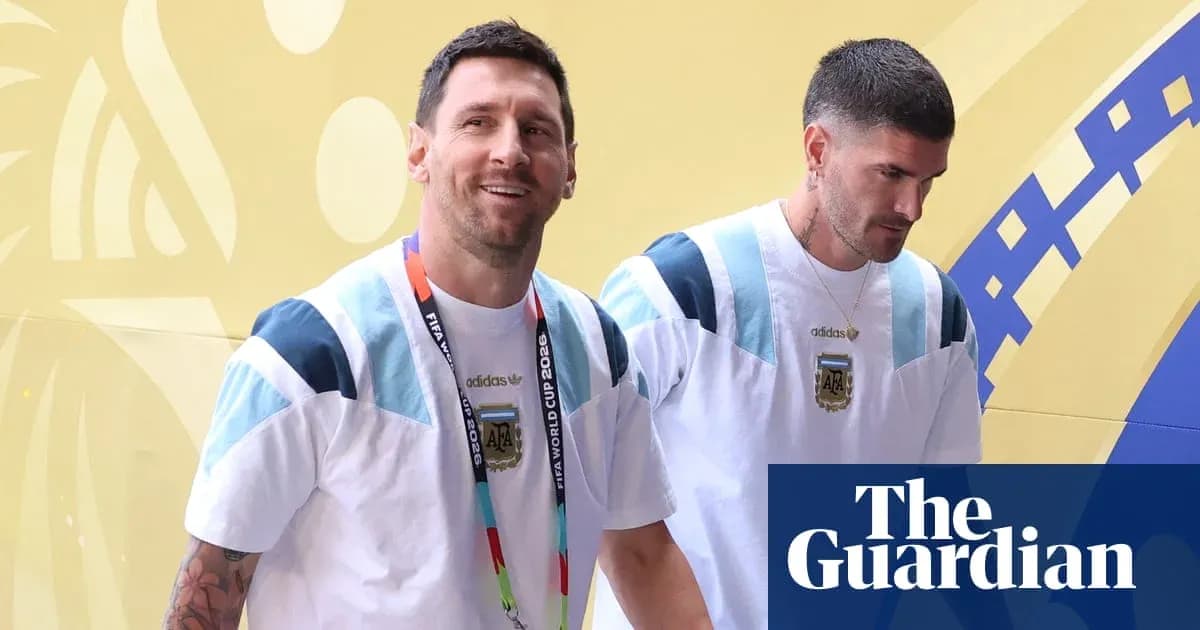
Lionel Messi's World Cup Legacy: A Month of Mastery
Lionel Messi’s last World Cup? It felt like it. It just didn’t look like it until the very end.
For a month, the 39-year-old treated the tournament as his own private canvas. Eight goals. Four assists. More progressive passes than anyone else, per Futi. No defensive shackles, no pretence. Just Messi, roaming where he pleased, bending matches back toward Argentina almost by force of habit.
He dragged them past Cape Verde with a 3-2 win. He assisted and then equalised against Egypt when the game threatened to slip away. Against England, he created both of Argentina’s late goals, turning a tight contest into another chapter of his enduring World Cup saga. This was the version of Messi that has lived in football’s imagination for nearly two decades: head up, shoulders loose, dictating everything.
Then came the final. And the curtain fell with a thud, not a flourish. Across 139 minutes, including stoppage time, Messi completed just 28 of 39 passes, had only one shot and left barely a fingerprint on the game. No Golden Ball, no trophy, no neatly packaged farewell. Just the strange sight of the greatest World Cup performer of his generation fading from view on the biggest stage. Even so, the legacy he carried out of this tournament is one almost no one else in history can touch.
Argentina’s supporting cast and the ones who rose
Around him, others quietly built their own stories. Rodrigo De Paul, so often the tireless engine, started all but two of Argentina’s games and gave 70 hard minutes in the final against Spain. He was never going to headline the tournament, but his aggression and security in possession helped push his country into a second straight World Cup final.
Elsewhere, new heroes emerged from less heralded nations.
Stephen Eustáquio became Canada’s metronome and main creative outlet. Cross after cross, he kept their attack alive, averaging 2.76 chances created and 0.36 expected assists per 90 minutes. His 46 progressive passes were the sixth most in the entire competition. Then came his moment: last-32, South Africa, dying minutes. He intercepted a clearance, cushioned it on his chest and lashed a half-volley into the bottom corner. Canada’s first-ever World Cup knockout victory, sealed by their 29-year-old midfielder who had just come off a loan spell at Los Angeles FC and returned to Porto.
South Africa found their own revelation in Mbekezeli Mbokazi. Just 20 and already the youngest player ever called up for Bafana Bafana at a World Cup, the Chicago Fire defender played as if he had been there for years. Calm, assured, authoritative. His displays were so strong that his Transfermarkt valuation more than doubled, jumping from $4m before the tournament to over $9m after it. One month on the world stage, and the market responded.
Paraguay, who spent most of the tournament without the ball, still unearthed two midfield pillars. Matías Galarza started every game after the opener, scored the only goal against Turkey and set up Julio Enciso’s strike against Germany in the knockouts. With Paraguay averaging just 29% possession – the lowest of any side – his attacking influence was inevitably limited, but he proved he could still function in a system that asked him mostly to suffer.
Alongside him, Andrés Cubas did the dirty work. The Vancouver Whitecaps midfielder played every minute of Paraguay’s five matches, anchoring a defence that dragged Germany to penalties and held France to a single goal. In that quarter-final against France, Cubas won seven of 12 duels, made seven tackles and three interceptions, and still found time to tangle with Kylian Mbappé. Paraguay left early. Cubas did not leave quietly.
Breakouts, bruises and quiet tournaments
New Zealand’s Finn Surman used the group stage to announce himself. The 22-year-old Portland Timbers centre-back threw himself into last-ditch tackles, blocked shots, cleared danger and, unexpectedly, scored New Zealand’s only goal in a 3-1 defeat to Egypt. For two games he looked like one of the All Whites’ best players, a defender playing on the edge but rarely over it.
The United States, by contrast, got a mixed bag from their MLS contingent. Sebastian Berhalter became one of Mauricio Pochettino’s trusted substitutes, appearing in every match. When he finally started, as a No 6, the US midfield sagged defensively – more a reflection of the squad’s lack of specialist holding players than of Berhalter himself. Even so, the Vancouver Whitecaps man, reportedly heading for Middlesbrough, managed a goal and an assist.
Matt Freese, at 27, put together a largely solid tournament in goal for NYC FC, with accurate passing and nine saves across four games. Yet like Tim Ream, his World Cup will be remembered for one bad day rather than the steady ones. Ream, the capital-V Veteran at 38 with Charlotte, saw his campaign unravel in a 4-1 hammering by Belgium. On the opener, he lost track of an in-form Charles De Ketelaere, who pounced with Ream nowhere in sight. Minutes after the US equalised, De Ketelaere climbed above him at the back post and buried another. A career built on reliability, undone in 90 brutal minutes.
Matt Turner, once the US No 1 and now backstopping New England Revolution, had his own nightmare: a start against Turkey that ended with three goals conceded and not a single save to his name. Miles Robinson, of FC Cincinnati, barely featured at all, used only in a meaningless final group game as Pochettino’s distrust of his defensive depth became impossible to ignore. Columbus winger Max Arfsten was thrown on in the 90th minute of the 4-1 loss to Belgium and never touched the ball.
Cape Verde’s run owed plenty to their full-backs. While Sidny Lopes Cabral drew more attention, Steven Moreira quietly held the back line together. The Columbus defender anchored a unit that took Spain, Uruguay and Argentina to the brink and left the impression of a team that belonged on this stage.
Australia found reliability rather than fireworks. Aiden O’Neill, playing the same understated role he fills at New York City FC, knitted play together as a possession-focused central midfielder. He won the Superior Player of the Match award against Paraguay and backed it up with another strong showing against Egypt. At the other end of the age spectrum, 18-year-old Lucas Herrington, a Colorado Rapids centre-back, forced his way into the XI and started Australia’s final two matches, a significant statement for a teenager on this stage. Kai Trewin, from NYC FC, came on for the injured Jordan Bos at half-time of the knockout tie with Egypt and helped drag the game to penalties.
Stars fading, careers turning
Some of the tournament’s most poignant images came from players whose peaks already lay behind them. James Rodríguez, 12 years on from his explosive breakout in Brazil and just two years removed from a magical Copa América run with one goal and six assists, arrived in the United States on loan at Minnesota United. The craft was still there, the left foot still elegant, but the end product vanished. Colombia’s last-16 exit to Switzerland felt like the closing of a long, slow chapter. No goal, no assist, no late flourish. Just a drawn-out goodbye to the World Cup and, in many ways, to the player he once was.
Son Heung-min’s tournament with South Korea carried a similar air of frustration. At 34 and playing for LAFC, he started twice, failed to score in either game and then watched from the bench as his country faced a must-win final group match. For a player so often the heartbeat of his national team, the silence was jarring.
Croatia’s Petar Musa and Marco Pasalic had less time but no less scrutiny. Musa, the FC Dallas striker, managed just one shot across two starts and 110 minutes – he scored it, but never looked fully integrated. Pasalic, the Orlando City winger, impressed in his lone start in Croatia’s third group game but squandered his one clear chance to score, a miss that hung over his performance.
Miguel Almirón’s World Cup will be remembered for the wrong reason. On the pitch, the Atlanta attacker mustered only four shots and 0.11 expected goals in four starts. His defining moment came in the group match against Turkey, when he was sent off for covering his mouth during an “altercation” between the sides – the first time the International Football Association Board’s new mouth-covering ban was enforced. A footnote in a rulebook, but a headline for Paraguay.
The grinders, the nearly-men and the footnotes
Not everyone can own the stage. Many simply held their ground, or tried to.
Juan Manuel Sanabria, of Real Salt Lake, started two of Uruguay’s three group games and drew one of the toughest assignments of the tournament: contain Lamine Yamal against Spain. He largely did. Yamal finished with just 0.03 xG, 0.10 xA and five successful dribbles from 12 attempts – low numbers for a player of his talent and freedom.
Canada leaned heavily on Richie Laryea to drive the ball up the left. He delivered 0.26 expected assists per 90 minutes and often progressed play, but his defensive lapses hurt. Against Bosnia and Herzegovina, his mark scored from an in-swinging corner. Against Switzerland, he was frequently out of position or slow to track back. For a long-time Toronto FC stalwart and national-team regular, this World Cup never quite caught fire.
Maxime Crépeau, now at Orlando City, left with six goals conceded and six saves in five games – a flat return for a goalkeeper hoping to make a statement. Jacob Shaffelburg, on loan at LAFC, came off the bench in all five of Canada’s matches but couldn’t bend any of them to his will. Jayden Nelson, with Austin FC, entered in the 87th minute of the knockout defeat to Morocco and watched a 3-0 loss unfold around him. Mathieu Choinière, another LAFC midfielder, started once, in a 2-1 defeat to Switzerland, and that was that. Toronto captain Jonathan Osorio saw only two cameos from the 87th minute onward, neither long enough to leave a mark.
New Zealand’s Michael Boxall, one of the oldest players at the tournament, looked it. The Minnesota defender seemed a half-step behind on almost every goal the All Whites conceded, a harsh reality check on the unforgiving pace of this level.
Haiti, the tournament’s lowest-ranked side, spent three games under siege. Danley Jean Jacques, from Philadelphia, shared a double pivot with Jean-Ricner Bellegarde, fighting losing battles in every match. Louicius Deedson, the FC Dallas winger, played in all three group defeats, totalling 112 minutes and just 13 completed passes. Derrick Etienne Jr, of Toronto, had nine minutes against Brazil, enough time to complete four passes and little else.
Panama’s Carlos Harvey started all three group games and offered flickers of threat from set pieces – a couple of dangerous headers from corners and long throws – but otherwise drifted through a quiet tournament. Aníbal Godoy, with San Diego, had the briefest of cameos: one minute plus stoppage time against Ghana, eight passes completed out of eight, and a last-minute winner conceded at the other end.
Iraq’s Ahmed Qasem featured in every match and went the full 90 against France, a rare constant in a side scrambling to adapt. He started again in the final group game, only to be sacrificed early after Rebin Sulaka’s 13th-minute red card forced a tactical reshuffle.
Orlando City midfielder Braian Ojeda saw only 21 minutes for Paraguay, against Germany in the last 32, and touched the ball just nine times. Some World Cups are like that: months of preparation, a handful of involvements, then the long flight home.
What lingers after the lights go out
When the tournament emptied out and the cameras moved on, the stories remained scattered across continents.
Messi, scoreless and subdued in the final, still walked away having extended a World Cup legacy that stretches beyond medals and man-of-the-match awards. Eustáquio returned to Porto as the man who delivered Canada’s first knockout win. Mbokazi went back to Chicago with his valuation doubled and Europe watching. Cubas, Surman, Sanabria and others carried new reputations as players who belong in the hardest games.
For some, this World Cup was a farewell. For others, it was a beginning. For many, it was just a line on a CV, a handful of minutes, a single mistake.
The next cycle will decide which of those stories were merely cameos – and which were the first act of something bigger.