Maccabi Tel Aviv's Tactical Win Over Sheriff Tiraspol
Maccabi Tel Aviv’s 1–0 win over Sheriff Tiraspol at Batumi Arena in the UEFA Europa League 2nd Qualifying Round was a controlled, system-driven performance rather than a chaotic cup tie. Both sides lined up in 4-3-3 structures, but Maccabi’s version was far more coherent, turning territorial balance and set-piece pressure into a narrow yet deserved advantage, while Sheriff struggled to convert structural changes into genuine threat.
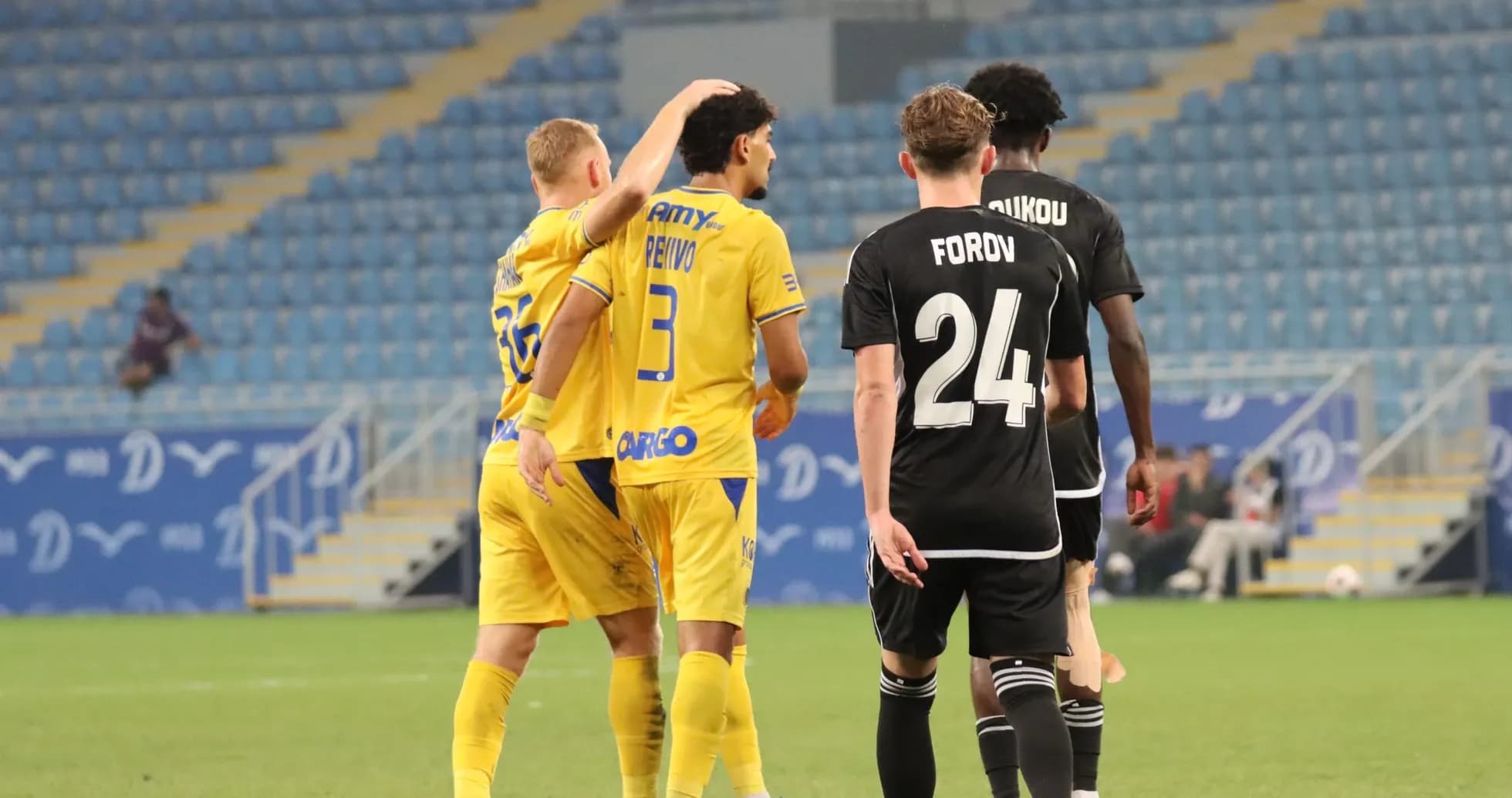
The decisive moment came on 29 minutes, when S. Kone diverted the ball into his own net, handing Maccabi Tel Aviv a 1–0 lead they would protect to full time. From that point, Kenny Miller’s team played the game largely on their own terms: 12 corner kicks to Sheriff’s 7, more blocked shots (3 to 2), and, crucially, the only shots on goal in the match (3–0). With ball possession officially split at 50–50, the difference lay in how each team used their share of the ball.
Maccabi’s Strategy
Maccabi’s 4-3-3 was clearly built around vertical occupation of the width and a compact three-man midfield. The back four of N. Ben Harush, M. Camara, R. Shlomo and R. Revivo gave a stable base, rarely needing to overcommit because the midfield line of D. Peretz, I. Sissokho and I. Shahar protected central spaces effectively. Peretz and Sissokho acted as the primary screen, allowing the full-backs to step up in wide zones and pin Sheriff’s wingers, which helped generate those 12 corners and repeated crossing situations.
Higher up, the nominal front line of S. Jehezkel, S. Abu Farkhi and H. Varela (listed as a midfielder but positioned in the advanced line) focused on stretching Sheriff’s back four horizontally. The lack of recorded “Shots inside box” and “Shots outside box” numbers does not allow a granular shot map, but the 3 shots on goal, combined with 3 blocked efforts, point to Maccabi repeatedly working the ball into shooting lanes around the edge of the box and half-spaces, forcing Sheriff to defend facing their own goal. That dynamic is exactly what produced the 29th-minute own goal: sustained pressure, bodies in the box, and a defender forced into a decisive, mistimed intervention.
Sheriff’s Approach
Sheriff Tiraspol also deployed a 4-3-3 on paper, but with a more hybrid, midfield-heavy interpretation. The starting XI featured E. Timbur in goal behind a back line of M. Ouedraogo, B. Ciss, B. Fomba and Rai. In front of them, Mota, D. Klas and A. Pergjoni formed a midfield three, with L. Jaures-Ulrich, S. Kone and D. Forov listed in advanced positions but functionally more like a fluid line of midfielders. The result was a side that could match Maccabi’s numbers in central areas and share possession, yet lacked clear reference points in the final third. Sheriff ended the match with 0 shots on goal despite 4 shots off target and 2 blocked, underlining how rarely they managed to access true finishing zones.
Victor Mihailov’s in-game adjustments underline this struggle. At 57 minutes, Mota (a defender) went off for Sapata (IN) in midfield, indicating a push for more ball progression and attacking impetus from deeper zones. Two minutes later, at 59', S. Kone was replaced by V. Nihaev (IN), a like-for-like change in terms of nominal position but aimed at refreshing the forward line. The triple substitution on 77 minutes — A. Pergjoni off for N. Swen (IN), L. Jaures-Ulrich off for V. Cozma (IN), and D. Forov off for J. Modelo (IN) — effectively reshaped the entire right side and parts of midfield, seeking more dynamism and perhaps more direct wing play. Yet the attacking metrics did not shift meaningfully: Sheriff still finished without a single shot on target, suggesting that structural tweaks could not overcome Maccabi’s compact block and control of central lanes.
Substitutions and Discipline
Maccabi’s substitutions were more about energy management and maintaining the structure than chasing a second goal. At 63', I. Ben Simon (IN) came on for I. Shahar, and O. Davida (IN) replaced S. Jehezkel, refreshing the midfield and wide roles while preserving the 4-3-3 shape. Later, at 79', I. Noy (IN) replaced H. Varela and I. Ben Hamo (IN) came on for N. Ben Harush, again like-for-like in terms of line occupation. These changes helped Maccabi maintain intensity in pressing triggers and defensive transitions, which is reflected in Sheriff’s inability to generate high-quality chances despite chasing the game.
Discipline also tells a tactical story. Sheriff committed 11 fouls to Maccabi’s 9 and collected both yellow cards in the match. At 71', V. Nihaev (Sheriff Tiraspol) was booked — “Tripping” — a sign of a team increasingly forced into reactive defending against Maccabi’s counters and ball protection. Deep into added time at 90+3', B. Ciss (Sheriff Tiraspol) also saw yellow for “Tripping”, underlining late, desperate attempts to break up play as Maccabi managed the lead. Maccabi’s clean disciplinary record (0 yellow cards, 0 red cards) aligns with their controlled, structurally sound approach and limited exposure in defensive transition.
Statistical Overview
The statistical profile reinforces the tactical reading. Possession was officially even at 50–50, but the quality of that possession diverged: Maccabi produced all 3 shots on goal and more blocked shots (3) from their share, while Sheriff’s 4 shots off target and 2 blocked efforts never troubled the goalkeeper. Corner kicks (12–7 to Maccabi) show a clear territorial edge and sustained pressure in the attacking third. Offside counts (4 for Maccabi, 2 for Sheriff) indicate that Maccabi were more aggressive in running beyond the last line, an expected by-product of their front three’s verticality.
With no recorded data for goalkeeper saves, passing volume, pass accuracy, xG or goals prevented, the evaluation must rest on available metrics and match events. Within that frame, Maccabi Tel Aviv’s 1–0 victory appears tactically robust: a well-drilled 4-3-3 that turned pressure and field position into a decisive own goal, then managed the game with structural discipline and intelligent substitutions. Sheriff Tiraspol’s mirrored 4-3-3 never solved the problem of chance creation, and despite multiple second-half changes, they left Batumi Arena without a single shot on target and with a deficit to overturn in the tie.