Mahmoud Bentaieb: Exploring International Allegiance Switch to Egypt
Mahmoud Bentaieb, the Zamalek defender capped by Morocco, is actively exploring a switch of international allegiance to Egypt – but the law may prove a far tougher opponent than any centre-forward.
The 26-year-old’s name has dominated headlines in Cairo and Casablanca in recent days after Egyptian outlets reported that he wants to play for the Pharaohs instead of the Atlas Lions. Moroccan reports quickly pushed back, insisting there was no such intention.
Then his agent spoke.
Agent confirms Egypt option on the table
Youssef Massaad, Bentaieb’s representative, told Moroccan newspaper “Al-Omk” that the player is indeed weighing up a change of sporting nationality after being overlooked by Morocco coach Mohamed Ouahbi in the latest squad.
Massaad said Ouahbi’s decision to leave out the Zamalek defender came as a surprise, especially given Bentaieb’s form in Egypt. That omission opened the door to a new scenario: officials in Egypt sounding out the possibility of him representing their national team.
According to Massaad, Bentaieb’s priority had always been to play for his home country, Morocco. Now, with that path blocked for the moment, the defender is seriously studying the Egyptian option.
He has already taken a concrete step. Press reports indicate that Bentaieb has contacted FIFA to ask about the legal feasibility of changing his sporting nationality and is waiting for an official answer.
The legal maze behind a flag switch
Lebanese legal expert Ralph Charbel laid out the framework in comments to Kooora, breaking down the conditions FIFA imposes on any player seeking to switch international allegiance.
For a player who has never represented the new country at any age level, the starting point is clear: he must first obtain that country’s nationality. On top of that, at least one of the following must apply:
- He was born in the country.
- His father or mother was born there.
- His grandfather or grandmother was born there.
- He has lived continuously in the country for a minimum of three years if he moved there before turning ten, or at least five years if he arrived after the age of ten.
That framework immediately complicates Bentaieb’s case. He was born in Casablanca to Moroccan parents. His roots are entirely Moroccan. His connection to Egypt is more recent and more personal than ancestral: he is married to an Egyptian woman, the daughter of Zamalek board member Ahmed Suleiman.
On the residency front, the numbers are not yet on his side either. Bentaieb joined Zamalek from French club Saint-Étienne in the summer of 2024 and has been living in Egypt for around two years. Under the standard five-year requirement for players who moved after age ten, he still has some way to go.
Arab Cup caps tighten the noose
Even if Bentaieb eventually meets the nationality and residency criteria, another hurdle stands in his way: his existing caps for Morocco.
Charbel explained that, under FIFA rules, a player cannot switch to another national team if he has played more than three matches for his current senior national team and three years have not yet passed since his last appearance.
On paper, Bentaieb’s youth record offers some hope. He never represented Morocco at youth or junior level. His story with the national team starts and ends, so far, with the senior side.
But that senior chapter is precisely where the problem lies.
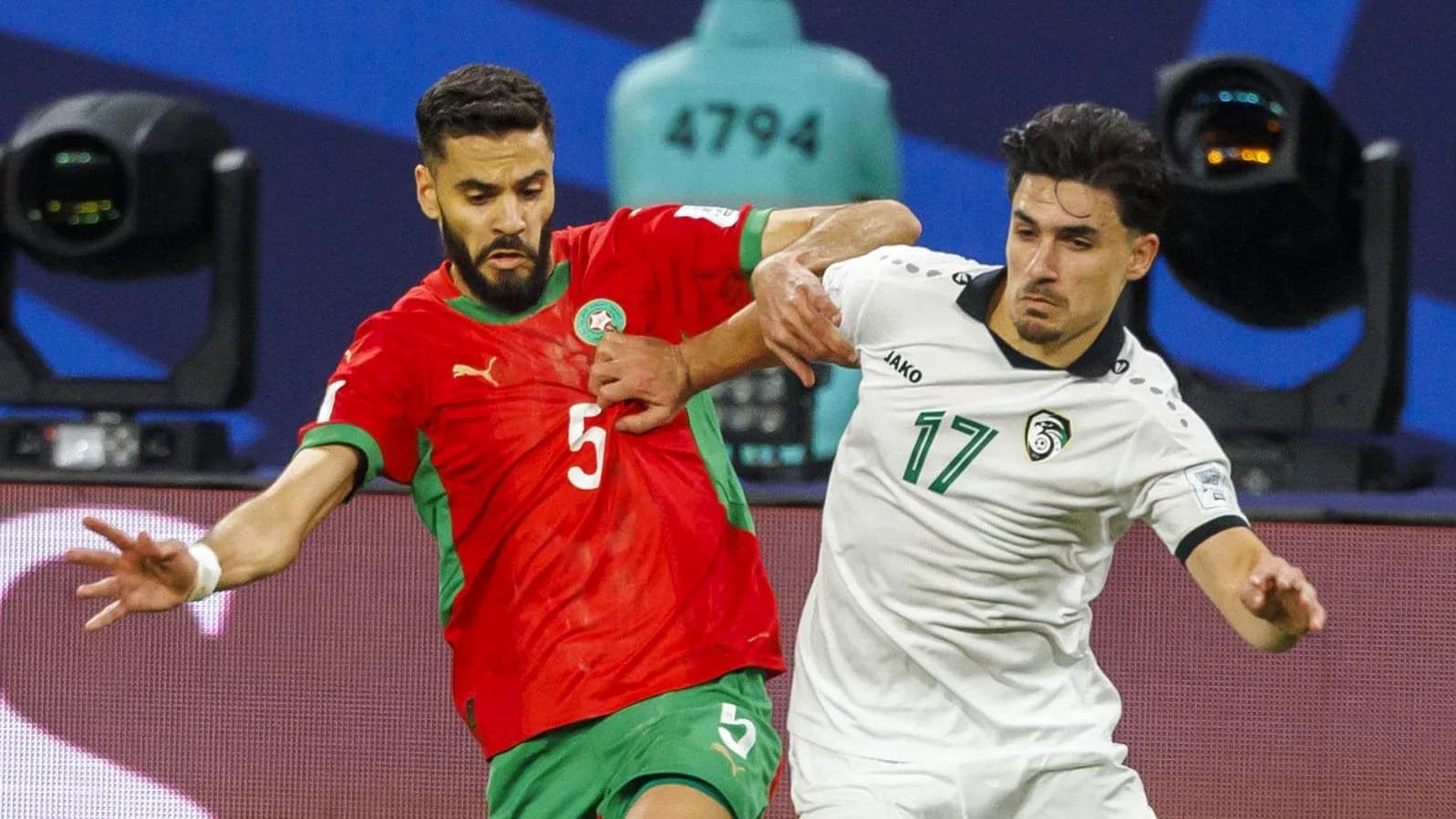
Bentaieb played four international matches for Morocco at the 2025 Arab Cup in Qatar, all as a substitute, against Saudi Arabia, Syria, the UAE and Jordan. Morocco won every one of those games. He also sat on the bench in the opening two group matches against Comoros and Oman, both of which ended in draws, as coach Tarik Sektioui rotated his squad.
Those appearances helped Morocco lift the Arab Cup title under Sektioui, who now coaches the Oman national team. They also left a legal footprint that is hard to erase.
Charbel underlined that FIFA has recognised the Arab Cup as an official competition under its umbrella since 2021. That recognition gives full international status to Bentaieb’s matches, even though Morocco fielded a second-string side without its Europe-based stars.
Four caps. One over the threshold. Each one now counts against his bid to pull on an Egypt shirt.
Waiting on FIFA – with slim margins
Given the facts, Charbel believes Bentaieb’s chances of changing his sporting nationality “at the present time” are slim. The combination of limited residency in Egypt, a lack of Egyptian lineage and four official senior caps for Morocco creates a formidable legal wall.
Yet the door is not completely locked.
Charbel stressed he cannot categorically predict FIFA’s response, because he does not know the exact legal arguments Bentaieb and his representatives will submit. The defender’s camp may look for nuances or exceptions within FIFA’s regulations, or rely on specific interpretations tied to the Arab Cup and its competitive context.
For now, Bentaieb waits. Between Casablanca roots and Cairo life, between the green of Morocco and the red of Egypt, his international future rests not on a coach’s squad list, but on a ruling from Zurich.