Manchester City Held to 2-2 Draw by Nottingham Forest
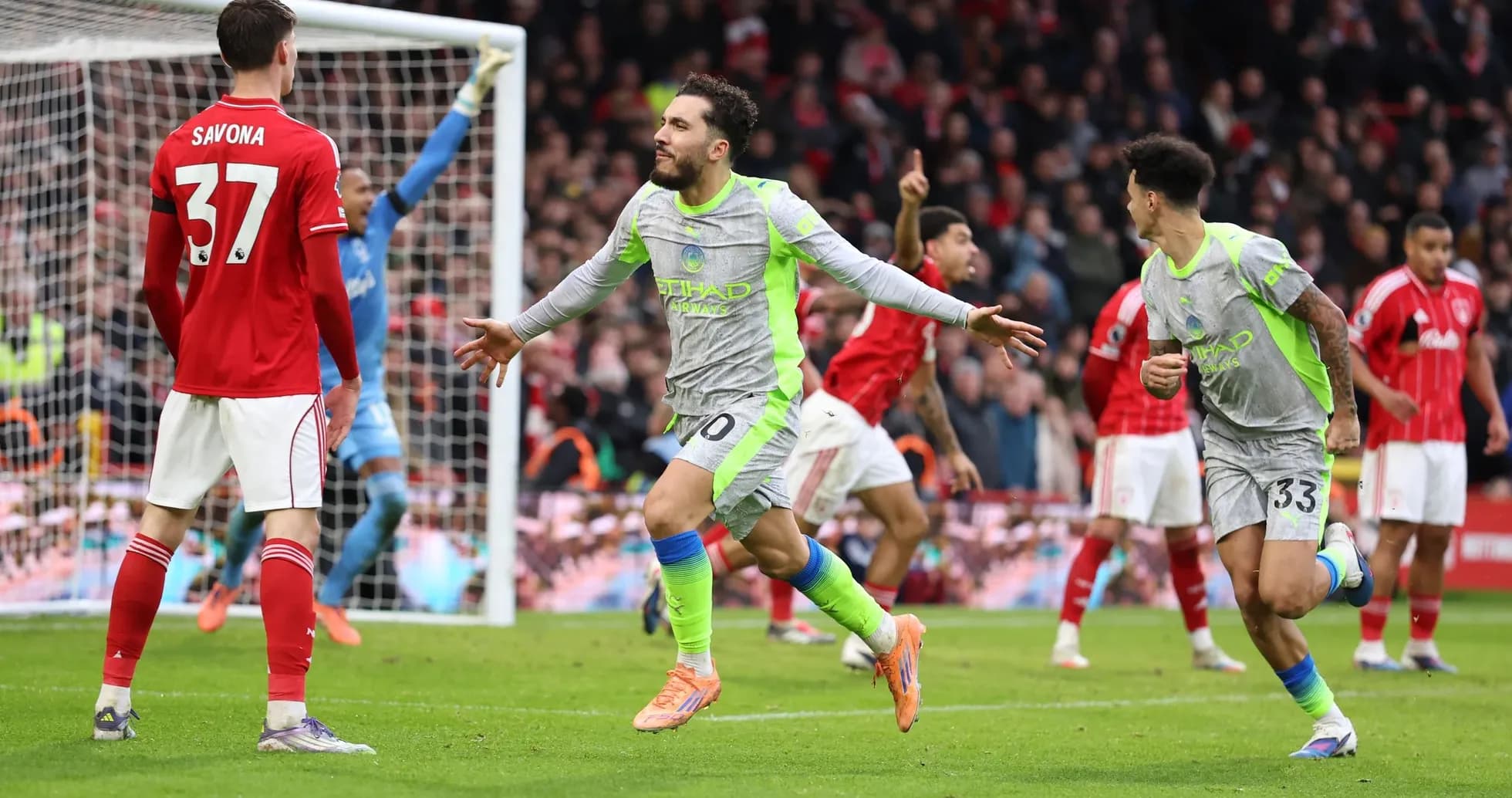
Manchester City were held to a 2-2 draw by relegation-threatened Nottingham Forest at the Etihad Stadium on Wednesday night, a result that stalls their title charge in the Premier League’s Regular Season - 29 round. City, second in the table on 60 points, twice led but failed to close the game out against a Forest side that began the evening 17th with 28 points and fighting to keep daylight between themselves and the bottom three. Despite long spells of domination, City’s control never translated into a decisive cushion, and Forest punished them with ruthless efficiency.
First Half Analysis
Manchester City started in a 4-1-3-2, immediately pinning Forest’s 5-3-2 deep. With 70% possession overall and a similar pattern evident early, City circulated the ball through Rodri, looking to free Phil Foden and Rayan Cherki between the lines.
The breakthrough came on 31'. A goal from open play reflected City’s patient probing: Antoine Semenyo finished after being supplied by Cherki, the forward timing his movement well to exploit a rare gap in Forest’s back five. It was a move that underlined City’s ability to manipulate tight defensive blocks rather than simply overwhelm them.
Forest offered little attacking threat before the interval but clung on through compact defending and last-ditch interventions, as shown by City’s six blocked shots across the match. Their only notable first-half incident was disciplinary: in 45+1', Ibrahim Sangaré was booked for a foul, a yellow card that encapsulated Forest’s reactive, survival-mode approach before the break. City went in 1-0 up, apparently in control but not out of sight.
Second Half & Tactical Shifts
Forest emerged after half-time with more intent, and the match flipped into a far more chaotic contest. On 56', they levelled with a well-worked goal from open play: Morgan Gibbs-White struck after being set up by Igor Jesus, punishing City’s first real lapse in defensive structure. The equaliser emboldened Forest, who began to transition with greater ambition.
Four minutes later, Murillo went into the book on 60' for a foul, a sign of Forest straining to contain City’s response. That response arrived swiftly. On 62', Rodri restored City’s lead, finishing from open play after Rayan Aït-Nouri provided the assist from the left. It was classic City: full-back underlapping into space, cut-back, and a composed finish from the edge of the area.
The temperature rose again on 63' when Nikola Milenković was booked for dissent, protesting a decision as Forest tried to disrupt City’s rhythm. Seconds later, N. Domínguez was withdrawn and Callum Hudson-Odoi came on for Forest at 63', a proactive attacking change that would prove decisive.
On 76', Forest equalised again. Elliot Anderson, one of the more industrious Forest midfielders, arrived to score a goal from open play, assisted by Hudson-Odoi. The substitute’s impact was immediate, justifying the shift from a more conservative midfield profile to a direct wide threat.
Pep Guardiola (though not listed, City’s structure bore his hallmarks) turned to his bench late. On 77', Jérémy Doku replaced Foden, and Abdukodir Khusanov came on for Aït-Nouri, a like-for-like defensive change that kept the back line stable. Forest answered with an attacking gamble of their own on 79', as Taiwo Awoniyi replaced Igor Jesus, adding a more physical focal point up front.
City’s final attacking tweak came on 82', when Savinho replaced Cherki to add fresh legs and one-v-one threat on the flank. Forest, meanwhile, focused on game management. Matz Sels was booked for time wasting on 90+4', underlining Forest’s satisfaction with the point. Before that, they had shored up the back line and midfield: Neco Williams made way for Morato on 90', and Gibbs-White was replaced by Ryan Yates on 90', both substitutions reinforcing their defensive structure for the closing moments.
Statistical Deep Dive
The numbers underline City’s territorial dominance but also their wastefulness. They attempted 774 passes to Forest’s 329, completing 714 to 269. That translates to a 92% pass accuracy for City against Forest’s 82%, a reflection of City’s structural control and Forest’s more direct, riskier transitions.
In terms of chance creation, City’s 21 total shots to Forest’s 9, with 7 versus 4 on target, reads like a siege. City’s xG of 2.12 matches their two goals from open play, suggesting they more or less took what the quality of their chances offered but failed to generate the volume of clear-cut opportunities that their possession might imply. Forest, with just 0.97 xG and two goals, were significantly more clinical, scoring twice from relatively limited opportunities.
Defensively, Forest’s three blocks and City’s six blocks highlight how both sides were forced into emergency defending at times, but the pattern of the match was City probing and Forest repelling. Discipline also tilted Forest’s way in terms of risk: they committed only six fouls to City’s ten but collected four yellow cards, all for fouls, dissent, or time wasting, reflecting the edge they operated on to disrupt City’s tempo.
Standings & Implications
For Manchester City, remaining on 60 points in second place feels like a missed opportunity in the title race, especially given their strong home record and recent form of DWWWW coming into this fixture. Failing to turn dominance into victory at the Etihad undermines their push to strengthen their position in the Champions League places.
For Nottingham Forest, a point away at City, keeping them on 28 points in 17th, is invaluable in the context of survival. Against a side with City’s firepower and structural control, this resilient, opportunistic draw supports their fight to stay above the relegation zone and offers a psychological boost heading into the run-in.