Manchester City Faces a Pivotal Summer: The Rodri Dilemma
Manchester City stand at a crossroads, and for once it has nothing to do with a title race or a Champions League semi-final. This is deeper. Structural. The kind of summer that can redefine a decade.
A new era, and a ripped-up core
Changing a manager after 10 years is seismic enough. Doing it while tearing out the spine of a Treble-winning side is something else entirely.
Four starters from that 2022-23 machine have gone: Manuel Akanji, Nathan Ake, Bernardo Silva and John Stones. These weren’t squad players. They were pillars, each one central to the control and flexibility that turned City into Europe’s benchmark.
Into that vacuum step £116m signing Elliot Anderson and 17-year-old Jeremy Monga, a teenager City believe can grow into the level this club now demands. It is bold business. It is also a gamble. You don’t replace that much experience and chemistry without feeling some tremors.
And the biggest question of all hasn’t even been resolved yet.
The Rodri dilemma
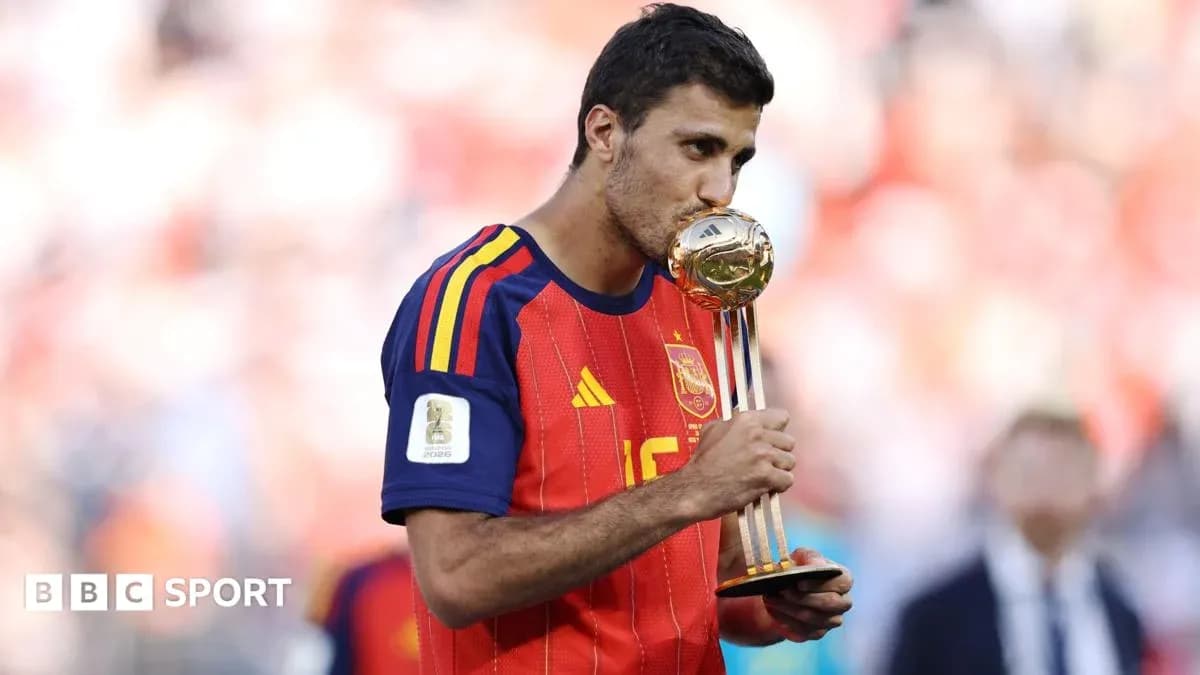
Fresh from lifting the World Cup as Spain’s captain and walking away with the Golden Ball, Rodri is heading for back surgery on Monday. He has one year left on his contract. Speculation over his future is no longer background noise; it’s the soundtrack to City’s summer.
Reports in Spain suggest Real Madrid are “operating on the basis” that Rodri will join them. City, publicly at least, are not playing along.
New manager Enzo Maresca was crystal clear in his first news conference.
“I think every manager wants to have Rodri because he is a top player,” he said. “But now, surgery on Monday... he needs a holiday... he needs to rest and recover and then he will be back with us.”
That last phrase matters. “Back with us.” Maresca is planning with Rodri, not without him.
But planning and reality are rarely perfect team-mates in modern football. At some point, City will have to decide: cash in when he returns to fitness, or dig in and build the new era around him?
Guardiola’s prophecy, Maresca’s problem
When Rodri tore his anterior cruciate ligament last year, doubts were inevitable. Could he return to the level that once made him a Ballon d’Or winner? Would the old rhythm still be there?
Pep Guardiola, the man Maresca now follows, never flinched. “In the World Cup, he will be the best Rodri, and next season he will be the best Rodri,” he said last October.
He nailed the first part. Rodri didn’t just play at the World Cup; he dominated it. He captained Spain to the trophy, dictated games from the back and was named the tournament’s best player.
Now the second part of that prediction falls into Maresca’s in-tray. The Italian inherits a midfielder at the peak of his powers, but also a contract situation and a surgery timeline that could reshape City’s season.
The plan from the dugout is simple: keep him. The reality on the boardroom side might prove more complicated.
Maresca’s chessboard
To understand why Rodri matters so much to this new City, you have to understand Maresca.
He is a disciple of positional play, a coach who talks about football in the language of chess.
“There are a lot of similarities,” Maresca has said. “The most important is positional play and strategy. For a coach, it’s important to have the mentality of a chess player: develop a plan, study counter-moves, choose the arrangement of the pieces.”
His teams attack in an on-the-ball structure that often resembles a 3-2-2-3. It’s not just a formation; it’s a framework. Within it, players rotate, trade zones, step in and step out, all while maintaining balance.
This is where Rodri becomes priceless.
Throughout the World Cup, he showed exactly the kind of fluidity Maresca craves. When Aymeric Laporte carried the ball out, Rodri dropped into the back line. When space opened in midfield, he stepped up, took control and advanced play. He read pressure. He judged risk. He moved between predefined positions without ever breaking the team’s shape.
That ability to glide between roles is what turns Maresca’s system from theory into something devastating.
Life with – and without – Rodri
City will look better with Rodri. That much is obvious. He understands tempo, spacing and danger in a way that cannot be taught in a single pre-season. It took him years to fully master those demands himself, learning under Fernandinho and then becoming the reference point for everyone else.
But City cannot afford to be naïve. Contingencies are already in motion.
Anderson is one of them. Signed for £116m, he is expected to become a central figure in Maresca’s evolving midfield. City are also tracking 18-year-old Lille midfielder Ayyoub Bouaddi, who caught the eye for Morocco at the World Cup. Young, versatile, technically sharp – exactly the type of piece Maresca likes to move around his board.
The question is how quickly those pieces can learn the game.
A coach who moves players, not just magnets
If Rodri does leave, Maresca’s track record offers at least one source of comfort for City.
He has shown a sharp eye for repositioning players into roles they hadn’t fully explored. During City’s Treble-winning season, when Maresca worked as Guardiola’s assistant, John Stones stepped from centre-back into midfield, forming a double pivot with Rodri in that now-famous 3-2-2-3 shape.
At Chelsea, Maresca’s more daring tweak involved Moises Caicedo. On paper, he was a right-back. On the pitch, he defended in a back four and then slid into a holding midfield role when Chelsea attacked, again creating that 3-2-2-3 structure.
He has used Marc Cucurella higher up the pitch, nudging him into attacking midfield zones. He has repeatedly shown he can see a different version of a player before the rest of us do.
That imagination might become essential if City are forced to construct a midfield without their metronome.
A bigger squad, a different City
One clear shift under Maresca is likely to be numbers. Where Guardiola preferred a smaller, tightly knit squad, the Italian appears more open to a deeper pool of options. More pieces, more combinations, more ways to hit that 3-2-2-3 he trusts.
Whether Rodri stays or goes, that change alone could alter the feel of City’s season. It gives Maresca more room to experiment, more chances to land on a formula that works, more protection if injuries and exits bite at the wrong time.
Right now, though, everything circles back to one man.
City have lost Stones, Ake, Akanji and Bernardo from the starting XI that conquered Europe. They have a new manager, a new structure, and new faces trying to grow into old responsibilities.
The next move on this chessboard belongs to Rodri – and to the club that must decide whether to build the future around him, or learn to live without the player who has quietly become their most irreplaceable piece.