Manchester City's Transition: Rodri's Future and Maresca's Vision
Manchester City stand at a crossroads, and this time it is not just about a new face in the dugout.
For the first time in a decade, the club is trying to redraw its identity without Pep Guardiola. That alone would be seismic. Layer on a Treble-winning core being dismantled and the uncertainty around the man who has come to define their control of games, and you start to understand the scale of the rebuild facing Enzo Maresca.
A Treble spine ripped out
Four starters from the 2022-23 Treble side have gone in one summer. Manuel Akanji, Nathan Ake, Bernardo Silva and John Stones were not just names on a teamsheet; they were pillars of Guardiola’s most complete City. Between them, they offered versatility, control, and a deep understanding of the positional play that turned City into a machine.
They are now memories.
In their place, City have moved aggressively but selectively. Elliot Anderson has arrived for £116m, a bold fee that underlines how highly the club rate him as a long-term midfield solution. Alongside him, 17-year-old Jeremy Monga represents the other side of the project: raw promise, a bet on tomorrow.
And this might only be the start.
Rodri: the piece everything revolves around
The biggest question mark hovers over the player City can least afford to lose.
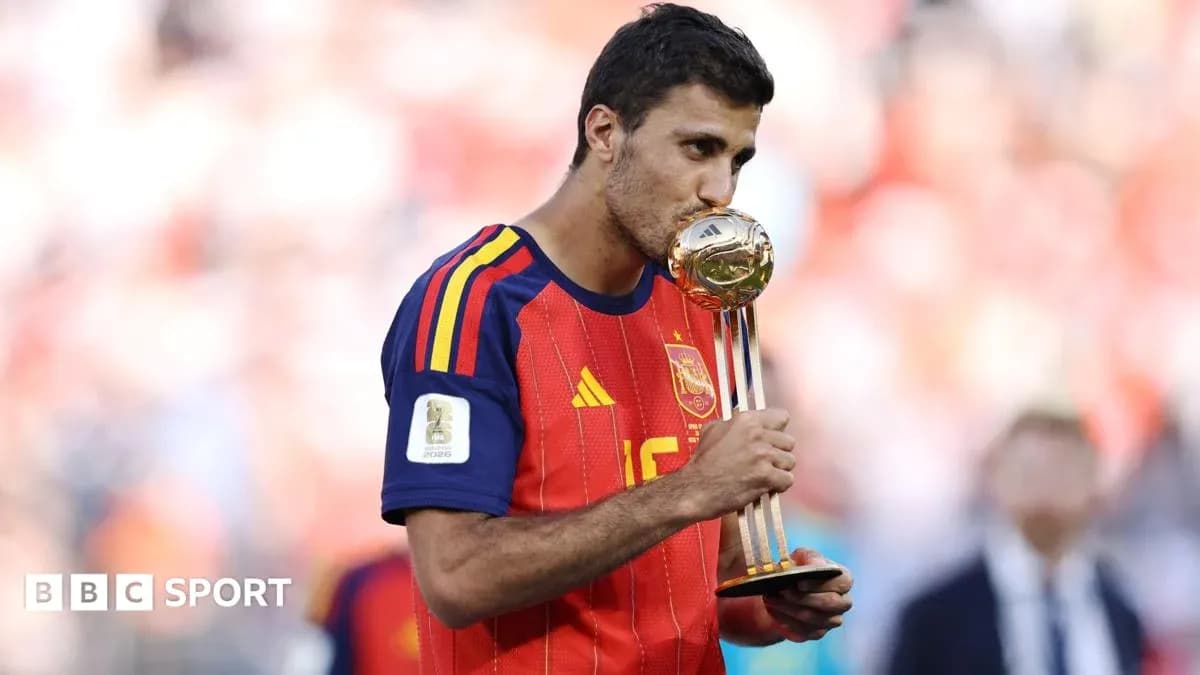
Rodri, fresh from captaining Spain to World Cup glory and winning the Golden Ball as the tournament’s best player, will undergo back surgery on Monday. He has a year left on his contract. His future is being pulled into the spotlight, with reports in Spain suggesting Real Madrid are working on the assumption he will eventually land at the Bernabeu.
City do not yet know how long their 30-year-old anchor will be out. They do know what Maresca thinks of him.
“I think every manager wants to have Rodri because he is a top player,” the new manager said in his first news conference. The message was firm: surgery, rest, recovery – and then “he will be back with us.”
The intention is obvious. City want to keep one of the best players in world football, not cash in on him.
But intention does not guarantee outcome. Not when Madrid are circling. Not when a contract is running down. And not when a squad is already being reshaped around a new coach and a new idea of what City should look like.
So the club must plan for both futures: with Rodri, and without him.
Maresca’s board, Maresca’s pieces
To understand why Rodri is so central to this conversation, you have to understand Maresca.
He is a disciple of positional play, a coach who talks about football in the language of chess. He speaks about “positional play and strategy,” about developing a plan, studying counter-moves, and arranging his pieces so that the structure, not just the individual, wins the game.
His teams usually build in a 3-2-2-3 when they have the ball. It is a shape, but more importantly it is a framework of roles and zones. Players rotate within it. The innovation lies in how he creates that structure from different starting points.
We have seen it before at City. In the Treble season, when Maresca worked as Guardiola’s assistant, John Stones stepped out of centre-back and into midfield alongside Rodri. City defended as a 4-4-2, then morphed into that 3-2-2-3 in possession. Stones was the surprise pivot. Rodri was the constant.
At Chelsea, Maresca pushed the concept further. Moises Caicedo started at right-back, defended in a traditional back four, then drifted inside to become one of the two holding midfielders when they attacked. Again, same structure, different route. He even used Marc Cucurella in attacking midfield zones. It is a pattern: Maresca sees roles for players that others have not quite unlocked.
This is where Rodri becomes priceless. Few midfielders in the world understand space, risk and tempo as he does. He can drop into the back line to build play, as he did so often for Spain when Aymeric Laporte drove forward. He can sit in front of the defence and screen. He can step into advanced pockets when the game opens up.
He is not just a holding midfielder in this model. He is the hinge.
Life with Rodri… and life without him
City with Rodri under Maresca is easy to picture. The Spaniard would slide between those predefined positions, allowing others to rotate around him. His reading of when to step up, when to drop, when to slow the game or inject tempo would give Maresca a reliable axis as he experiments with the rest of the structure.
Anderson, for all his talent, will need time to reach that level of understanding. So will any teenager stepping into this environment. City are tracking 18-year-old Lille midfielder Ayyoub Bouaddi, who impressed for Morocco at the World Cup. He fits the profile: technically gifted, tactically flexible, comfortable in tight spaces.
But Rodri did not become Rodri overnight. He grew into the role under Fernandinho’s guidance, adjusting to the demands of a team that asks its holding midfielder to be both metronome and safety net. Anderson and Bouaddi, or anyone else who comes in, will face the same steep learning curve.
If Rodri stays, Maresca can build his City around a ready-made reference point. If he goes, the project becomes more experimental, more volatile – and perhaps more revealing of Maresca’s ingenuity.
Because this is where the Italian has already shown he can be ruthless and imaginative. Stones into midfield. Caicedo into full-back. Cucurella into attacking midfield lanes. He does not wait for players to define themselves. He defines them.
A different kind of City
One thing is already clear: Maresca’s City will not be a carbon copy of Guardiola’s, no matter how closely their footballing principles are aligned.
Guardiola preferred a tight, elite core. A small squad, heavily trusted, relentlessly drilled. Maresca, by contrast, is open to having more pieces on his board, more options to shuffle into his 3-2-2-3 framework. That depth could prove crucial in a season of transition.
The club are already edging towards that bigger, more flexible group. Anderson, Monga, potential moves for someone like Bouaddi – these are not just signings, they are extra lines on Maresca’s tactical notebook.
The question now is whether the most important piece stays in place.
If Rodri remains, City’s new manager starts his tenure with a world-class fulcrum and the luxury of evolution rather than revolution. If he leaves, Maresca’s chessboard will still be set up, the structure still there, but the game will feel very different.
Either way, next season will not be about preserving what City were under Guardiola. It will be about discovering what they can become under Maresca – and whether they can do it without the man who has been their calm in the chaos.