Marc Cucurella’s Impact at Real Madrid
Real Madrid made plenty of noise with their summer business, but one of their smartest moves slipped in almost under the radar. Marc Cucurella arrived as a solid, sensible reinforcement for the left flank. Within weeks, the transfer has started to look like a masterstroke.
Not because of a spectacular debut at the Bernabéu. Because of what happened thousands of miles away.
From Chelsea signing to World Cup champion
When Luis de la Fuente named his Spain squad for the 2026 World Cup, there was a striking detail: not a single Real Madrid player made the list. For a club that has long fed La Roja with stars, it was a jarring snapshot of the current moment.
Then came Cucurella.
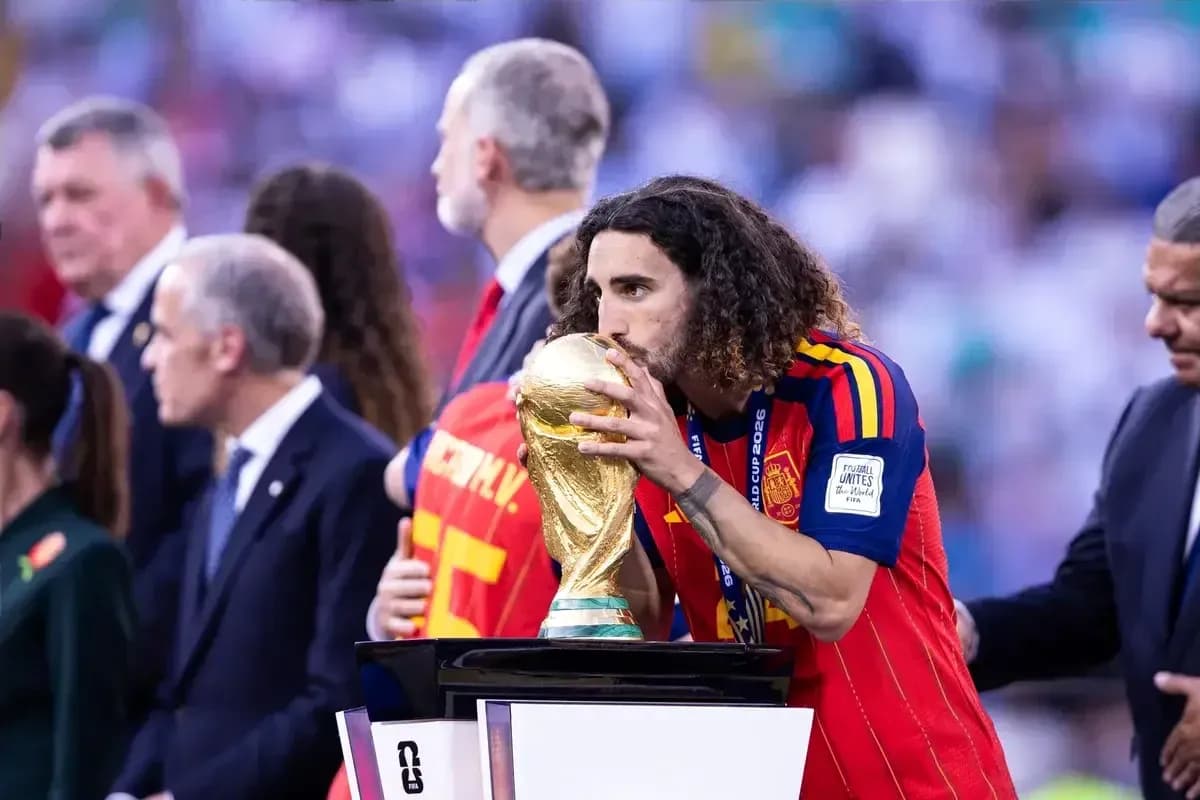
Signed by Madrid in the summer, the fullback walked into the World Cup as a Chelsea player and walked out of it as a world champion with a new badge on his chest. Spain lifted the trophy, and suddenly Madrid could once again claim a piece of that glory. Through Cucurella, the club had its fingerprints back on the biggest prize in international football.
The impact did not stop with the trophy. Fans voted him into the FIFA World Cup Best XI, one of three Real Madrid players to make the cut. His performances on the world stage pushed his valuation on Transfermarkt up to €60 million, a sharp rise in the price tag of a player Madrid had only just brought in.
In pure business terms, the club’s asset appreciated almost overnight.
More than just a left-back
On the pitch, Cucurella offers exactly what Madrid needed: energy, aggression, and quality down the left. But his signing also solves a quieter, more bureaucratic problem that can shape a season just as much as any tactical tweak.
UEFA rules are clear. From a 25-man squad, at least eight players must be locally trained to be registered for the Champions League and other European competitions. For Real Madrid, that means players who spent key development years, between 15 and 21, at a Spanish academy – either their own or another club’s.
Cucurella ticks that box with room to spare.
He came through La Masia at Barcelona, continued his development at Eibar and Getafe, and only then crossed to England with Chelsea. Those years in Spain ensure he counts as locally trained, and with his arrival, Madrid hit the required quota of eight such players in their European squad.
It is the kind of detail that rarely makes headlines but can cause chaos if overlooked. Fail to comply, and a club is forced to shrink its list or leave important players out of continental competition. Madrid have been around long enough to know that these margins matter.
A signing that works on every level
Strip the deal down and the logic is ruthless.
- Sporting value: a proven, high-intensity fullback entering his prime, fresh from winning the World Cup and recognised by fans worldwide in the tournament’s Best XI.
- Economic value: an immediate jump in his market valuation to €60 million, strengthening Madrid’s balance sheet and giving them leverage for the future.
- Regulatory value: a locally trained player who helps meet UEFA’s homegrown criteria and protects the club’s flexibility in squad building.
Cucurella may not be the loudest name in a galáctico era, but his arrival carries the kind of layered significance sporting directors dream about. One transfer, three problems solved.
For Real Madrid, the question now is simple: how far can a “smart” signing like this push them when the Champions League nights return and every detail, from the left-back’s positioning to the fine print of UEFA regulations, comes under the spotlight?