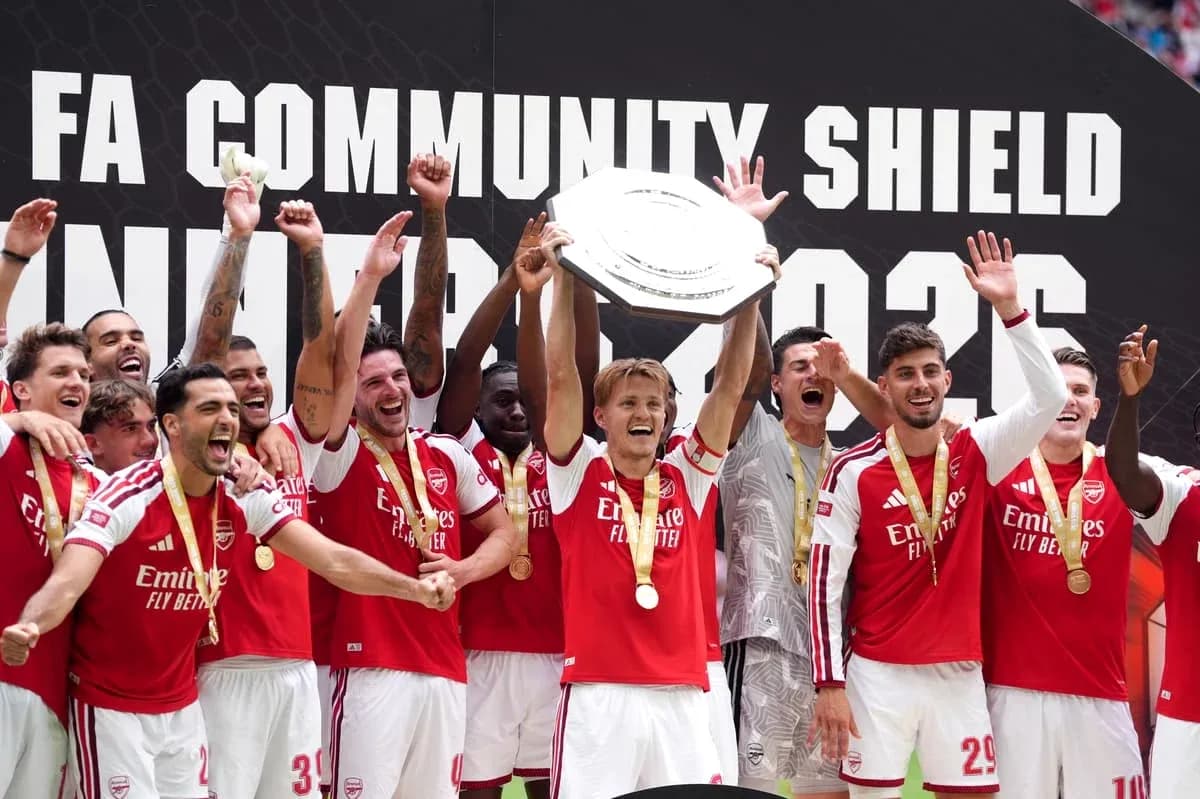
Martin Odegaard: Arsenal's Driving Force After Community Shield Victory
Martin Odegaard did not just score. He took control of Arsenal’s summer.
Ghosting into space early in the second half of the Community Shield, the captain froze Gianluigi Donnarumma with a feint, rolled the goalkeeper to the turf and clipped in the finish of a player who knows exactly what he’s doing again. Two minutes after the restart, the ball hit the net. The contest was already over.
Arsenal 3, Manchester City 0 in Cardiff. No marquee forward, no new superstar winger. Just the same captain who lifted the Premier League trophy in May, back dictating everything.
A modest trophy, a major signal
Yes, it is only the Community Shield. The warning comes every year. Since 2018/19, nobody has paraded this curtain-raiser and then gone on to win the title.
Yet this felt bigger than a pre-season bauble. It felt like the night Odegaard’s season truly restarted.
He has already written his name into club folklore as the captain who ended a 22-year wait for the League title. Last season, though, belonged more to the collective than to him individually. Knee and shoulder problems chopped his campaign into frustrating fragments. He started only 16 League games. Across 36 appearances in all competitions, he scored once.
For a player of his talent, that return bit hard.
There were murmurs. Eberechi Eze’s name floated around as a possible upgrade in the XI. Some wondered whether Declan Rice should take the armband. Odegaard’s authority, for the first time, was questioned.
Mikel Arteta never flinched.
“He missed five or six months for different things and it was extremely difficult for him to get any momentum,” the manager said after the win. “I’m sure this year if we can maintain him fit, available with the players around him, we’re going to see a very different Martin.”
On Sunday, that “different Martin” walked out in red and white.
From stop-start to relentless
The numbers behind the performance against City told the same story as the eye test. Odegaard did not just decorate the game with one outrageous finish and a deft clipped cross for Arsenal’s second goal; he drove the entire tempo.
Last season he often looked a yard off it, slightly hesitant in 50-50s, a player still wary of what his body might do to him next. That caution has gone. Against City, he won five of his seven duels. Nobody on the pitch made more recoveries. He hunted, pressed, snapped into tackles — and then, when the ball arrived at his feet, everything slowed to his rhythm.
The Norwegian has carried this form over from the World Cup, where only Michael Olise produced more assists. That tournament seemed to restore his swagger. Then came three precious weeks off with his wife and young son, time that he describes as “massive” after what he calls “a big struggle with a lot of difficult moments.”
“Last year was really a big struggle with a lot of difficult moments. That’s the worst thing for a footballer, to not be on the pitch,” Odegaard said. “I had quite a lot of weird injuries and bad luck… After last season, to miss so many games is really frustrating. What I’ve done is use that as motivation for this year and come back stronger.”
Arteta felt the change as soon as his captain walked back into the building.
“I sense from the first day that he joined that he has something else in the belly that he wants to prove and show because the team needs it as well,” the Spaniard said.
Transfer wait, internal solution
All of this lands at a pivotal moment in Arsenal’s summer.
The club still want another attacker. They have chased the market for an elite left winger, missed out on Morgan Rogers and Vinicius Jr, and watched the pool of realistic options shrink week by week. That long-talked-about “statement signing” in the final third remains elusive, and with the window ticking down, it is not obvious who that player even is.
So the most transformative attacking upgrade available to Arteta right now might already be in the dressing room.
Odegaard has entered the final two years of his contract. This is the stretch that will likely define his last major long-term deal. The team need a fully firing captain. He needs a fully firing season.
The early signs say both parties are on the same page.
He only made his first pre-season appearance just over a week ago, playing 30 minutes against Borussia Dortmund. That was enough time to slice them open twice with through balls. Now, with Bruno Guimaraes added to the midfield, Arsenal’s technical level between the lines should rise again. Give Odegaard more clean ball through the thirds and he will find the gaps.
Remembering the numbers of a fit Odegaard
Arsenal’s title triumph was built from the back. They did not have an Erling Haaland up front. Their wingers, for all their talent, never quite found unbroken, ruthless form across the season.
It still did not matter.
Imagine that same defensive base, but with the 2022/23 version of Odegaard restored. That year, he scored 15 League goals and supplied seven assists. The following campaign he dropped to eight goals and 11 assists, still strong figures but the start of the injury-interrupted pattern that has stalked him since.
An ankle problem, then the knee, then the shoulder. Rhythm vanished. Confidence flickered.
The Community Shield suggested that chapter is closing. Physically he looks lighter, sharper, more robust in duels. In the final third he looks decisive again, not searching for his game but imposing it.
And if Arsenal cannot land that superstar forward before Deadline Day? There is still room for internal growth. Bukayo Saka, now over his Achilles issue according to Arteta, can go again. Christos Tzolis already looks like an upgrade on the left. Guimaraes will find angles others simply do not see.
But none of them change the face of this attack quite like a peak Odegaard.
He has already lifted the Premier League trophy as Arsenal captain. The question now is simple: with his body finally in sync with his talent again, how far can he drag this team a second time?